

Per capita foreign debt tops $646

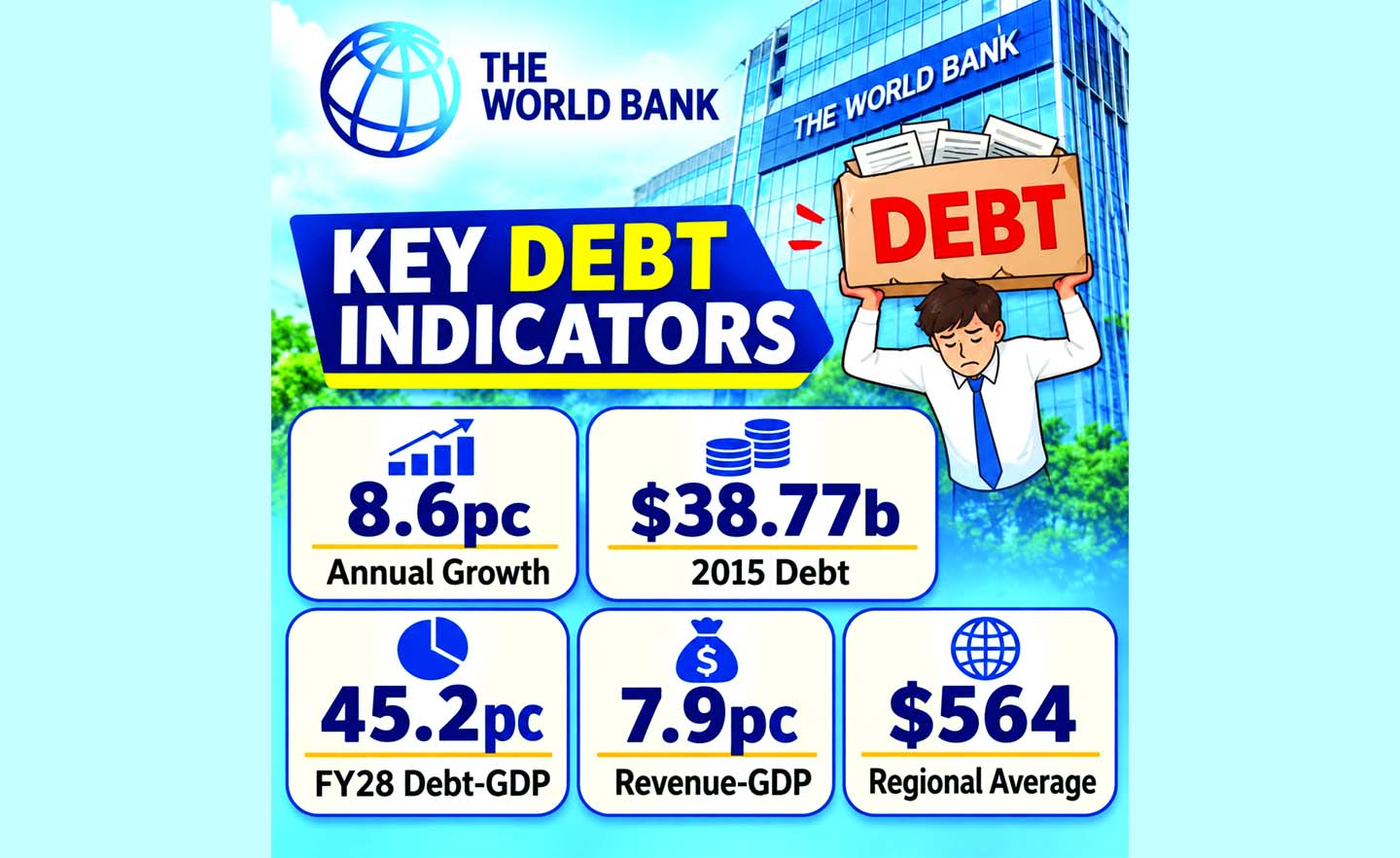
Bangladesh’s growing dependence on foreign borrowing is adding to the country’s economic burden, with external debt reaching approximately $646 per person in 2025, exceeding the South Asian average of $564.
Although this does not represent an individual citizen’s personal liability, the mounting debt is putting increasing pressure on public finances, as the government struggles with rising expenditure on salaries, pensions, subsidies and interest payments amid weak revenue collection.
 According to the World Bank’s International Debt Report 2026, released on November 5, Bangladesh’s external debt stock reached $113.44 billion at the end of 2025, marking an 8.6 per cent increase from a year earlier.
The amount has nearly tripled from $38.77 billion in 2015.
The per capita figure is calculated against the country’s reported population of 175.7 million.
Bangladesh Bank data show that gross external debt had climbed to nearly $115 billion by June 2026.
The country’s external liabilities comprise $89.51 billion in public and publicly guaranteed debt, $9.87 billion in private nonguaranteed debt and $14.06 billion in short-term debt.
Multilateral creditors hold $51.14 billion of public and publicly guaranteed debt, while bilateral lenders account for $32.65 billion and private creditors $5.72 billion.
Among multilateral lenders, the World Bank’s International Development Association (IDA) is the largest creditor at $22.64 billion, followed by the Asian Development Bank (ADB) at $17.52 billion.
Japan is Bangladesh’s largest bilateral creditor, with $12.72 billion, followed by Russia at $9.02 billion.
External debt stood at 210 per cent of exports in 2025, up 6.7 per cent from 2015, while the debt-to-gross national income (GNI) ratio increased 5.9 per cent to 24 per cent.
Debt service as a share of exports, however, declined to 16 per cent, while its share of GNI fell to 2 per cent.
PUBLIC DEBT NEARS SUSTAINABILITY THRESHOLD
The growing external liabilities are accompanied by rising domestic public debt. The World Bank has warned that Bangladesh’s public debt-to-GDP ratio could reach 45.2 per cent by FY28, approaching the 55 per cent threshold the International Monetary Fund (IMF) considers sustainable.
The ratio rose from 38.9 per cent in FY25 to an estimated 40.5 per cent in FY26. It is projected to reach 43 per cent in FY27 before crossing 45 per cent in FY28.
“Public debt continued to rise, posing risks to debt sustainability,” the World Bank said in its latest development update.
The increase reflects growing expenditure on public sector salaries, pensions, subsidies, capital support for troubled banks and debt servicing, against sluggish revenue growth.
Government spending on salaries, allowances and pensions, currently Tk 1.31 lakh crore, could rise to Tk 2.37 lakh crore following full implementation of the new pay scale.
The World Bank estimates that the additional wage bill will amount to around 0.6 per cent of GDP in FY27.
Subsidy and incentive allocations have increased from around Tk 24,000 crore in FY21 to Tk 1.16 lakh crore in the current fiscal year. Meanwhile, interest payments could exceed Tk 1.5 lakh crore next fiscal year, compared with Tk 1.31 lakh crore in FY25.
The government has also provided Tk 20,000 crore in capital support to Shamilita Islamic Bank, formed through the merger of five troubled Islamic banks. Further assistance may be required as banking-sector reforms continue.
The fiscal deficit is consequently projected to widen to 4.8 per cent of GDP in FY27 and 4.9 per cent in FY28.
REVENUE SHORTFALL DEEPENS RISKS
The World Bank has cautioned that continued government borrowing from banks to finance the fiscal deficit could deepen macro-financial vulnerabilities by crowding out private-sector credit, keeping lending rates high and discouraging investment.
Weak revenue mobilisation remains a major concern. Bangladesh’s revenue-to-GDP ratio stood at just 7.9 per cent in 2025, among the lowest globally. A narrow tax base, weak compliance and fragmented tax administration continue to constrain collection.
The World Bank has called for digitalising tax administration and phasing out poorly targeted tax exemptions to strengthen domestic revenue mobilisation.
Bangladesh’s per-capita external debt is higher than India’s approximately $522 and Nepal’s $401, but considerably lower than Sri Lanka’s $2,645, Bhutan’s $4,218 and the Maldives’ nearly $8,957.
South Asia’s combined external debt reached $955 billion in 2025, up 6.4 per cent from 2024. India accounted for $763.52 billion, followed by Bangladesh at $113.44 billion and Sri Lanka at $57.66 billion.
Globally, external debt in low- and middle-income countries rose 5.5 per cent to a record $9.4 trillion in 2025. These countries paid $1.4 trillion in principal and interest, marking a fifth consecutive annual increase.
“The return of private lending to low- and middle-income countries is welcome, but these countries are borrowing more, paying more, and in many cases leaving less for long-term development,” said Haishan Fu, World Bank Group Chief Statistician and Director of Development Data.
Against this backdrop, the government and the ADB will jointly organise a two-day international debt conference in Cox’s Bazar on November 15-16, with delegates from 30 countries.
Discussions will focus on sustainable borrowing, debt management reforms and mobilising private capital for public investment, including the possible establishment of a dedicated Debt Management Office, as Bangladesh considers raising funds through a sovereign bond.