

AI promises $12.3b windfall, but BD not ready

Bangladesh could gain an additional $12.3 billion in GDP over the next 10 years through artificial intelligence (AI), but only 12% of young people surveyed currently use the technology for work, exposing a major skills gap that could hold back the economic opportunity, a new Commonwealth report has found.
The country ranks 21st among 56 Commonwealth nations in the 2026 Commonwealth Youth AI Readiness Index, scoring 48.7 out of 100, below the readiness benchmark of 53.
Published by the Ayre Think Tank, the index identifies Bangladesh as having the largest estimated AI-related economic opportunity among 41 Commonwealth countries that fall short of the benchmark.
The report estimates that AI could contribute an additional $4.1 billion to Bangladesh’s GDP under a conservative scenario, $8.2 billion under a moderate scenario and $12.3 billion under an optimistic scenario over the next 10 years.
Despite strong interest in the technology, the country faces a significant gap between young people’s confidence in AI and their ability to use it in practice.
Around 76.3% of young Bangladeshis surveyed expected to use AI for education or work within the following year. The country scored 8.7 out of 10 in motivation and confidence.
However, only 28% of respondents said they used AI for studying, while just 12% reported using it for work.
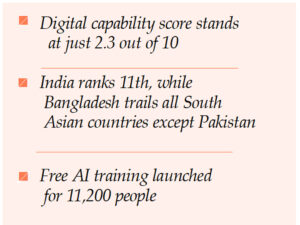
The gap is even more pronounced in practical digital capabilities, where Bangladesh scored only 2.3 out of 10.
Citing a 2023 survey, the report said only 39.6% of young people had installed software, while just 0.8% had written a computer programme.
Bangladesh has around 48.3 million people aged between 15 and 29, offering a substantial potential workforce for an AI-driven economy. But turning this demographic advantage into higher productivity and employment will require stronger technical education and hands-on digital skills.
Bangladesh trails regional peers
Bangladesh ranked ahead of only Pakistan among South Asian countries in the index, highlighting its relatively weak position in preparing young people for an AI-driven economy.
India ranked 11th with a score of 60.6, while Pakistan stood 24th with 46.4. Ghana ranked 17th with 51.2, and Kenya scored 48.7, matching Bangladesh’s score but placing 22nd.
Singapore topped the index with 77.6, followed by Malta at 75, Australia at 71, the United Kingdom at 70.8 and Canada at 70.2.
Only 15 of the 56 Commonwealth countries met the readiness benchmark, leaving 41 below the required threshold.
The findings suggest that although interest in AI is growing in Bangladesh, practical skills and the capacity to apply the technology remain major challenges.
Training efforts and economic prospects
The government has taken steps to address the skills gap, launching a new round of free AI training across all 64 districts in October 2026.
The programme aims to provide basic AI training to 9,600 people and advanced training to another 1,600, preparing participants for technology-related employment and self-employment.
The report outlines five priorities for improving youth AI readiness: ensuring affordable and reliable access to technology, introducing practical skills-based education, strengthening pathways from training to jobs and entrepreneurship, developing AI tools suited to local languages and needs, and establishing safeguards that allow people to challenge automated decisions.
Calvin Ayre, founder of the Ayre Think Tank, said AI would transform how people work, conduct business and create wealth, but young people needed the necessary skills and opportunities to benefit.
He said the AI transition was not a race that only the biggest or wealthiest countries could win, stressing the need for governments to help young people start businesses, secure jobs and build their own ventures.
Professor C. Justin Robinson, pro vice-chancellor and campus principal of the University of the West Indies, Five Islands Campus, said young people should be equipped not just to use AI tools developed elsewhere but also to question, improve and govern the technology.
He called for greater support to develop AI solutions tailored to local needs, warning against leaving young people as mere consumers of technologies created abroad.
Editorial note: I have retained the figures, rankings and claims from your supplied copy while restructuring the intro, tightening transitions and reducing repetition. Verify the 76.3% survey figure and its exact wording against the original report before publication.