

How drugs, arms threaten a generation


In Cox’s Bazar, a 10-year-old Rohingya boy’s involvement in transporting yaba, a methamphetamine, illustrates how criminal networks can exploit vulnerable children.
Human Rights Watch has documented cases of Rohingya children being drawn into drug trafficking, highlighting how poverty, disrupted education and economic pressure can expose young people to exploitation.
The boy’s story is not simply about crime; it reflects the consequences of growing up without adequate protection and opportunities.
As the Rohingya crisis enters its ninth year since the mass exodus from Myanmar in 2017, Bangladesh faces a challenge beyond sustaining a displaced population: preventing an entire generation from becoming increasingly vulnerable to drug trafficking, armed groups and organised crime.
The scale of the challenge is considerable. UNICEF reported in 2026 that Bangladesh hosted nearly 1.2 million Rohingya refugees, more than half of them children.
More than 235,000 refugee children aged five to 17 were estimated to be out of school. Limited access to education and skills development leaves many adolescents vulnerable to trafficking and exploitation.
Displacement means more than losing a home. For many Rohingya adolescents, it means growing up in overcrowded camps with restricted educational opportunities, limited prospects for employment and little certainty about their future.
These conditions do not inevitably lead to crime. Most young refugees are not criminals; many are themselves victims of intimidation, violence and exploitation. However, when education, meaningful activities and opportunities remain scarce, criminal networks can more easily manipulate vulnerable individuals.
When vulnerability becomes a security concern
Research highlights the connection between these vulnerabilities and criminal exploitation. A peer-reviewed study published in 2024, based on fieldwork in Cox’s Bazar in 2018 and 2019, identified child labour, substance abuse, drug trafficking, family violence and neglect among the risks facing adolescent Rohingya boys. Financial pressure and a lack of age-appropriate activities were among the factors contributing to their vulnerability.
The risks extend beyond drugs. Human Rights Watch reported in June 2025 that children in the camps faced abduction, trafficking and recruitment by armed groups. Protection monitors recorded 51 child abductions in the first quarter of that year.
These findings highlight an important distinction: young people may become involved in criminal activities through coercion, manipulation, economic pressure or a search for protection and belonging. Treating every suspected young participant as an independent offender risks overlooking those exploited by more powerful networks.
Drug trafficking, illegal arms circulation and armed-group recruitment also create wider security concerns. Their consequences extend beyond the camps to Bangladeshi host communities.
However, these problems must not be used to portray the Rohingya population collectively as a security threat. Such generalisations risk deepening mistrust and undermining cooperation between refugees, host communities and law enforcement agencies.
Education is a line of defence
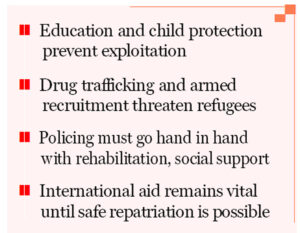
Education remains one of the strongest safeguards against exploitation. It provides structure, builds confidence and gives young people a sense of purpose.
Yet funding shortages threaten these opportunities. In May 2025, UNICEF warned that education for around 230,000 Rohingya refugee children was at risk. It reported that 83% of school-age children in the camps were enrolled in UNICEF-supported learning centres, leaving their education vulnerable to disruptions in humanitarian funding.
When learning centres close, children lose more than classroom access. They also lose safe spaces, peer networks and contact with trusted adults who could identify signs of coercion or abuse.
Education alone, however, cannot address the crisis. Young people also need psychosocial support, recreational facilities, family assistance, protection from recruitment and opportunities to develop practical skills. Programmes must recognise the different vulnerabilities of boys, girls, children with disabilities and adolescents who have dropped out of education.
Security and protection must go together
Bangladesh has every reason to combat drug trafficking, illegal arms circulation and violence. Law enforcement agencies must investigate crimes, dismantle criminal networks and protect residents. But enforcement should be evidence-based, proportionate and consistent with due process, particularly when children may have been coerced or trafficked.
Humanitarian agencies and international donors must also recognise youth protection as an essential part of the security response. Sustained investment in education, child protection and psychosocial services can reduce opportunities for criminal networks to exploit vulnerable young people.
Closer coordination among law enforcement agencies, humanitarian organisations, camp-based community groups and host-community representatives is equally important. Safe reporting mechanisms, witness protection and rehabilitation programmes can help distinguish between perpetrators, coerced participants and victims requiring protection.
The international community also has a responsibility. Safe, voluntary and dignified repatriation to Myanmar remains essential, but it cannot happen without conditions that guarantee the Rohingya’s security and rights. Until then, sustained international assistance is indispensable.
Protecting a generation is protecting Bangladesh
The vulnerability of Rohingya youth to drug and arms-related crime is not simply a question of individual morality. It reflects prolonged displacement, insecurity, restricted opportunities and the exploitation of these conditions by criminal networks.
Bangladesh needs effective policing, but policing alone cannot secure a generation’s future.
The choice is not between protecting refugees and protecting Bangladeshis. Both objectives are closely connected.
Every child who remains in education, every adolescent protected from forced recruitment and every young person offered an alternative to exploitation represents a gain for public safety.
The cost of neglect will not fall on Rohingya youth alone. It will also be borne by the communities living alongside them and by Bangladesh as a whole.
Protecting this generation is therefore not merely a humanitarian obligation; it is a long-term investment in national security, social cohesion and the country’s future.