


Unsold potatoes pile up in cold storages amid price fall

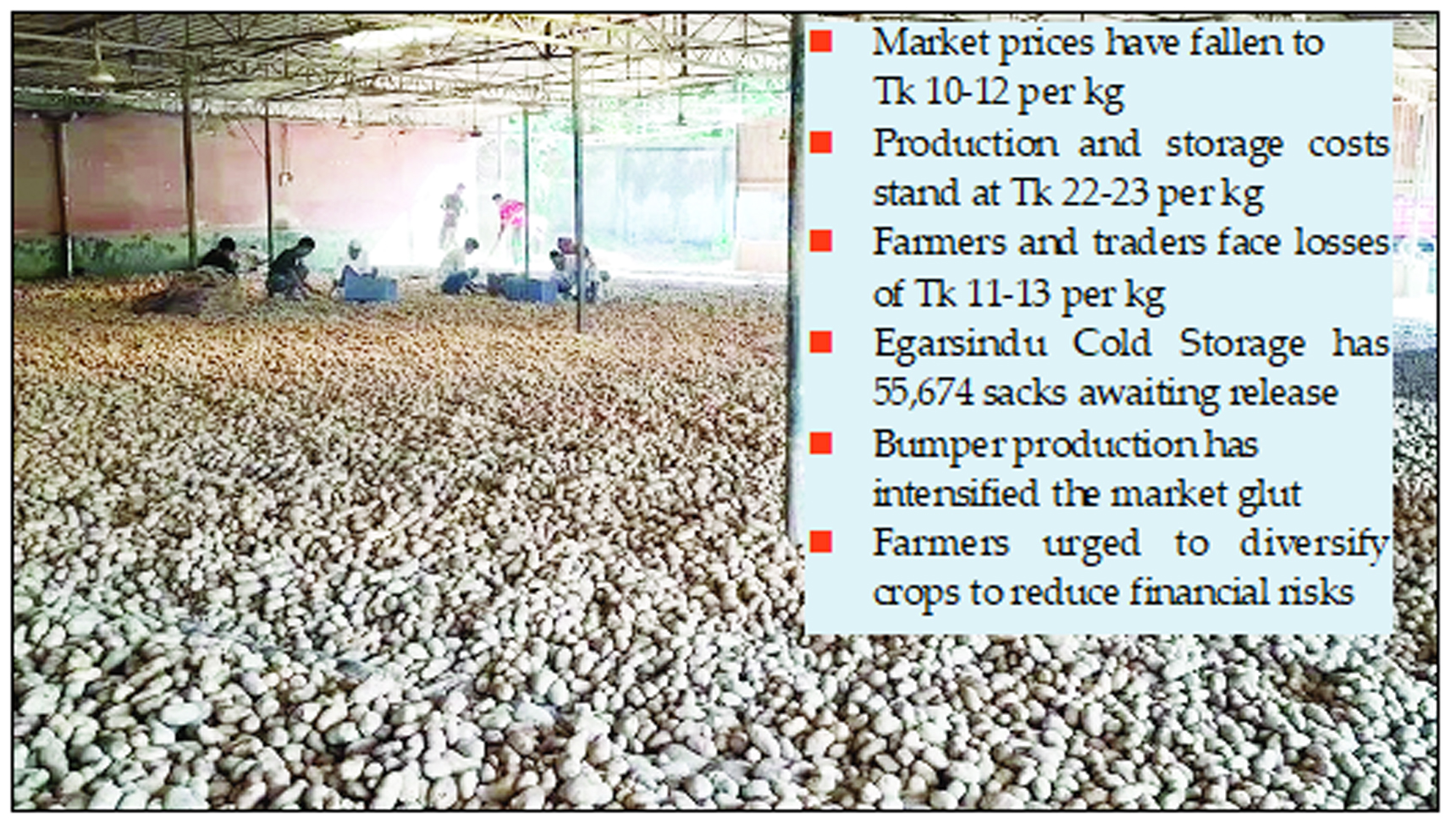
Thousands of sacks of potatoes remain unsold in cold storages across the country, including those in Kishoreganj, as a bumper harvest has led to oversupply and a sharp fall in market prices, leaving farmers and traders facing heavy losses.
Despite the end of the storage season approaching, growers and traders are struggling to secure their expected prices. With few buyers and prices continuing to decline, many are reluctant to take their stocks out of cold storage.
The combined cost of production, transportation and storage has reached Tk 22-23 per kg. However, potatoes are now selling for only Tk 10-12 per kg in the market, resulting in losses of Tk 11-13 per kg for farmers and traders.
Cold storage operators said growers were reluctant to release their stocks as market prices remained far below their expectations.
A large quantity of potatoes remains unsold in cold storages in Pakundia upazila of Kishoreganj. There is growing uncertainty over whether all the stored potatoes can be released within the scheduled period.
Many farmers and traders had stored their produce this year hoping to recover losses from the previous season, but are now facing another round of financial setbacks.
Traders said a typical sack contains 65 kg of potatoes, of which around 60 kg remain saleable after sorting. Including production, transportation and cold storage charges, and the cost comes to Tk 22-23 per kg. However, the prevailing market price has dropped to Tk 10-12.
There are six cold storages at the district and upazila levels, including two government-run and four privately operated facilities. Pakundia has one government and two private cold storages, while the district headquarters has one government facility and Bhairab has two private ones.
Thousands of sacks are still lying in storage.
A recent visit to Purbachal Cold Storage and Egarsindu Cold Storage in Pakundia found little activity in potato unloading despite the approaching end of the season. Rows of sacks filled the storage facilities. While some workers were opening sacks and removing potatoes, others were looking after the stored produce.
However, the shortage of buyers and falling prices have discouraged many farmers and traders from releasing their stocks.
Cold storage officials said the potatoes had been stored in March and April this year and were scheduled to be released by November 15. However, the large market supply and falling prices have left a substantial quantity in storage, making it unlikely that all the stocks will be released within the deadline.
Rafiqul Islam, a potato trader from Hossainpur, said he had stored 2,200 sacks at Egarsindu Cold Storage. His total cost, including purchase, transportation and storage charges, stood at Tk 23-24 per kg.
“Initially, the market price was Tk 16-17 per kg. Now it has dropped to Tk 10-11. This is causing a loss of Tk 11-12 per kg,” he said.
Ripon Mia, a potato farmer from Sukhia village in Pakundia, said rising agricultural production costs had added to his difficulties.
“I worked hard to produce potatoes and kept them in cold storage hoping to get a good price. Now, even in the peak season, there are no buyers, and the price has also dropped. This has put us in a dilemma,” he said.
Abdul Qadir, a businessman from Sreepur in Gazipur, said he had purchased potatoes from Egarsindu Cold Storage at Tk 13 per kg two days earlier but had yet to take them out.
“Meanwhile, the price has fallen by Tk 2 per kg. After adding transportation and other expenses to take the potatoes to Gazipur, we will have to count further losses,” he said.
55,674 sacks awaiting unloading
Manager of Purbachal Cold Storage Limited Delwar Hossain said 5,500 metric tonnes of potatoes had been stored at the facility, of which 4,000 metric tonnes had already been released. Most of the remaining stocks were seed potatoes.
Egarsindu Cold Storage Manager Engineer Md Altaf Hossain said 139,174 sacks of potatoes had been stored at the facility this year. Of these, 83,500 sacks had been released by November 7, leaving another 55,674 sacks in storage.
He said farmers and traders had slowed down the release of potatoes because of the price slump, adding that it would not be possible to clear all the remaining stocks within the scheduled period.
Higher production, lower prices
According to the Pakundia Upazila Agriculture Office, potatoes are cultivated on an average of 1,300 hectares of land in the upazila every year. During the last fiscal year, farmers expanded cultivation to 1,450 hectares in the hope of securing better prices.
With favourable weather conditions, the average yield stands at around 30 tonnes per hectare. However, increased potato production across the country has pushed down market prices, leaving growers struggling with financial losses.
Pakundia Upazila Agriculture Officer Agriculturist Noor-e-Alam advised farmers to diversify their crops rather than depend on a single agricultural product.
He said farmers should give importance to mustard and wheat alongside potatoes during the Rabi season. Maize, onions and winter vegetables could also be cultivated on smaller plots of land.
Diversifying crops would allow farmers to offset losses from one crop with profits from another, reducing their overall financial risks, he added.
Meanwhile, concerns are growing that without arrangements to export surplus potatoes and improve the country’s marketing system, farmers may gradually lose interest in cultivating potentially profitable crops, including potatoes, jute and sugarcane.