


Law, order debate heats up in JS

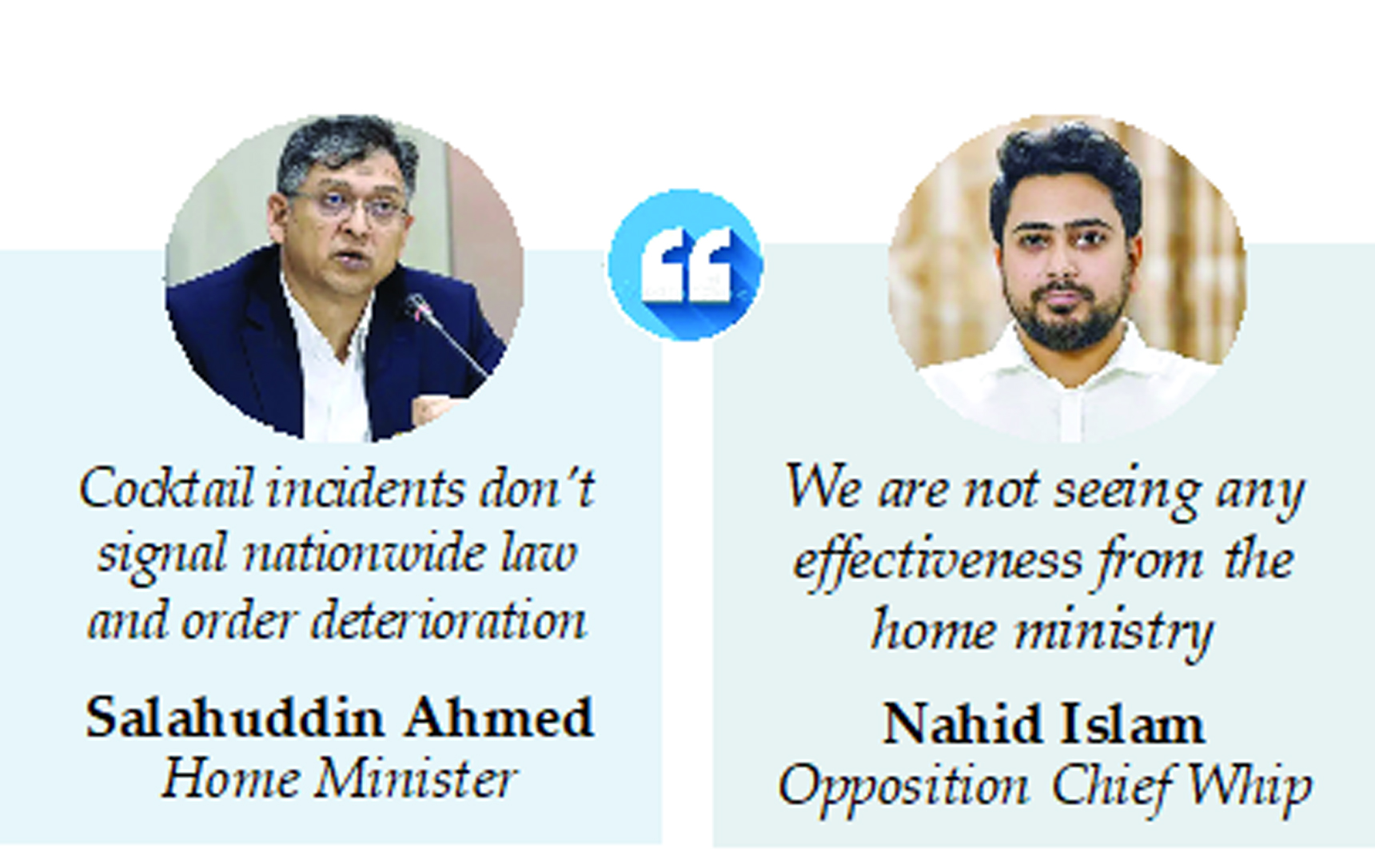
Home Minister Salahuddin Ahmed has dismissed allegations of a widespread deterioration in the country’s law and order situation, saying that a handful of isolated incidents, including cocktail-bomb explosions and bus arson, do not indicate a breakdown in overall security.
However, opposition Chief Whip and National Citizen Party (NCP) Convener Nahid Islam has strongly criticised the government’s handling of law and order, accusing the Home Ministry of failing to prevent sabotage, covert attacks and growing insecurity.
The two leaders exchanged sharply contrasting views in Parliament on Tuesday, with Nahid raising the issue through a point of order on a matter of urgent public importance.
Speaking in Parliament, Nahid alleged that the country had witnessed unprecedented acts of violence, sabotage and disorder over the past two days.
He said elements of the ousted Awami League were allegedly carrying out covert attacks in different parts of the country, setting buses on fire and creating instability. He expressed particular concern over an alleged attack in Moulvibazar on Hasib Al Islam, president of Jatiya Chhatra Shakti and a coordinator of the Students Against Discrimination movement, the cocktail-bomb explosion at Dhaka University and the vandalism of BNP offices.
Criticising the Home Ministry’s performance, Nahid said the government’s failure to maintain law and order had become increasingly evident over the past seven months.
He remarked that the Home Minister appeared more focused on constitutional amendments than on ensuring public safety and national security.
Nahid also alleged that former lawmakers of the Awami League, whose political activities have been banned, had been able to enter the country, organise programmes and subsequently leave without facing obstruction.
He further criticised the lack of a comprehensive government statement on the country’s security situation during Parliament’s question-and-answer session.
Demanding accountability, the opposition Chief Whip called on the Home Minister to make a formal statement in Parliament and explain the government’s response to security failures, intelligence shortcomings and diplomatic engagement with India.
Home Minister rejects allegations
Responding to the criticism, Salahuddin Ahmed said the opposition was entitled to express concern and that the government welcomed constructive cooperation.
However, he argued that it was unreasonable to describe the overall political and law and order situation as having deteriorated based on a few isolated or symbolic incidents, such as cocktail-bomb explosions and the burning of buses.
He said forces associated with the ousted regime were allegedly pursuing various conspiracies to destabilise the country, with encouragement from individuals who had fled abroad and taken refuge across the border.
Providing details of recent incidents, the Home Minister said seven cocktail-bomb explosions had occurred in different parts of the country. Those responsible had been apprehended, he claimed.
Regarding the incident near the Chief Metropolitan Magistrate (CMM) Court, he said two of the three people involved had been arrested and handed over to police.
He also referred to the cocktail-bomb explosion on the roof of a car parked near Dhaka University’s Business Faculty and the arson attack on an empty bus, saying such incidents did not justify claims of a nationwide breakdown in law and order.
“Some incidents do not mean a breakdown in law and order,” he maintained, describing the incidents as isolated rather than evidence of a widespread security crisis.
Government foiled plot to destabilise industrial sector
The Home Minister also claimed that the government had successfully thwarted a conspiracy aimed at disrupting the country’s ready-made garment (RMG) and export sectors.
He said a coordinated plan, allegedly backed by substantial financial resources from both domestic and foreign sources, had been devised to create unrest in the country’s largest foreign-exchange-earning industry.
According to him, law enforcement agencies demonstrated patience and professionalism, avoided provocation and prevented the situation from escalating.
Police, industrial police and Border Guard Bangladesh (BGB) personnel are working in coordination across major industrial areas, including Gazipur, Savar, Ashulia and Narayanganj, he said.
He added that regular discussions with factory owners’ and workers’ organisations were helping maintain a business-friendly environment.
Home Minister cites decline in homicides
Addressing crime statistics, Salahuddin Ahmed claimed that crime control had improved since he assumed office.
Citing police website figures and institutional data, he said the number of homicides had declined by approximately 300 compared with the corresponding period last year.
He accused certain quarters of creating public panic by presenting an incomplete picture of the country’s security situation.
Issuing a stern warning, the Home Minister said the forces responsible for the ousted regime would not be allowed to regain political ground following the mass uprising.
He warned that any attempt to destabilise the country, whether originating domestically or from abroad, would be exposed with evidence and resisted firmly.
Salahuddin Ahmed also announced that the government would place a detailed statement on the country’s law and order situation before Parliament under Rule 300 of the Rules of Procedure.