

Formal financial access reaches 64.5pc

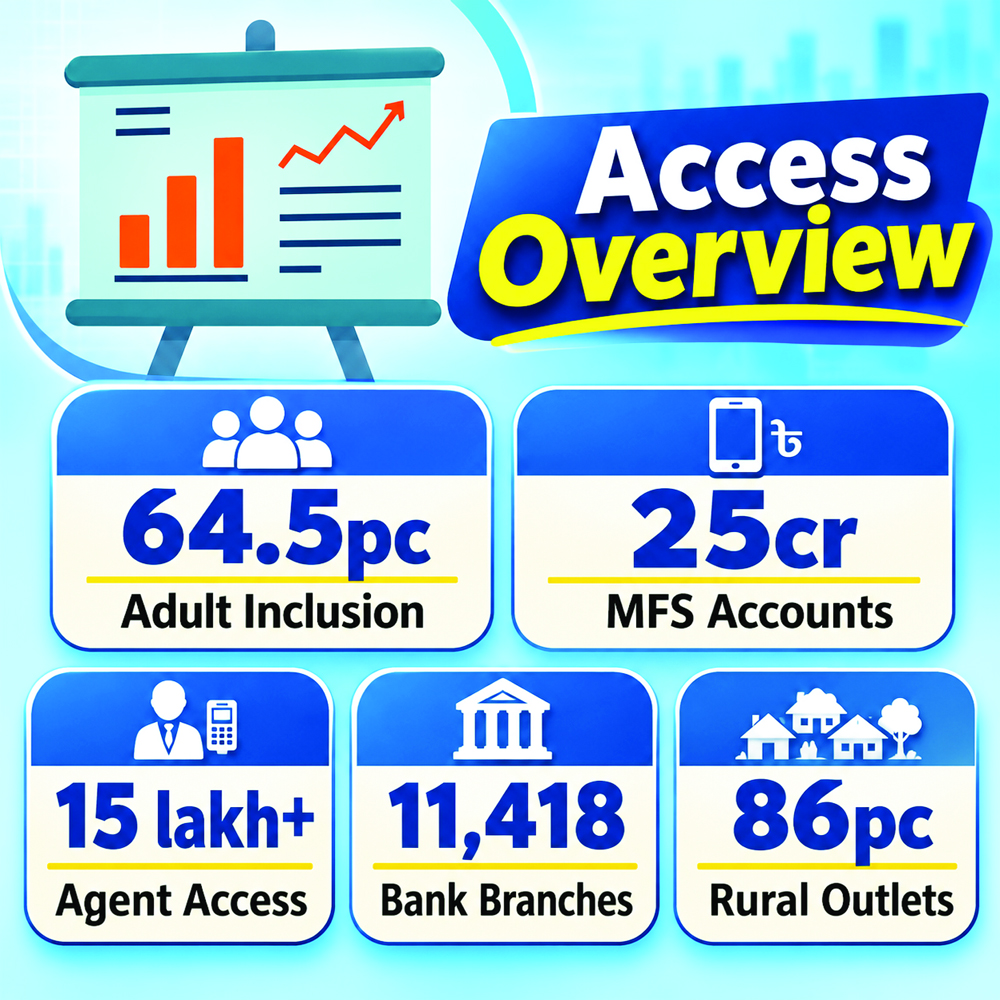
Bangladesh has brought nearly two-thirds of its adult population under the formal financial system, marking significant progress in widening access to banking and other financial services, although disparities persist across gender and education levels.
Around 64.5 per cent of adults now have an account with at least one formal financial institution, including banks, mobile financial service (MFS) providers, microfinance institutions, insurers, finance companies and capital market intermediaries, according to the National Financial Inclusion Survey 2025.
The findings were presented in the Financial Inclusion Report 2025, published by Bangladesh Bank, which takes stock of the country’s progress during the final phase of the National Financial Inclusion Strategy (NFIS) 2021-2026.
The report highlights the growing contribution of mobile financial services, agent banking and supportive policy frameworks to expanding access to formal financial services, particularly among previously underserved sections of the population.
MFS providers continued to command the largest customer base, reflecting their central role in extending digital financial services across the country.
The number of MFS accounts reached 25 crore, including 10 crore accounts held by women, supported by an extensive agent network. Annual transactions through the platforms exceeded Tk 2 lakh crore in 2025.
Although MFS providers operate without conventional branch networks, their services are delivered through a widespread agent-based distribution system, offering more than 15 lakh access points. This low-cost, agent-driven model has enabled providers to reach a broader population.
Banks, meanwhile, retained the country’s largest physical service network, with 11,418 branches, all connected through online banking facilities. This reinforces their position as the backbone of the formal financial system.
Agent banking also continued to expand its reach, with 20,501 outlets serving around 2.5 crore accounts. Rural communities accounted for 86 per cent of the outlets and 85 per cent of the accounts, with private commercial banks and Islamic banks playing the leading role in the segment.
The report also highlighted growing acceptance of digital merchant payments through Bangla QR, the national interoperable QR-code payment standard introduced by Bangladesh Bank to establish a unified, secure and cost-effective payment system for merchants.
By the end of 2025, approximately 9.63 lakh merchants had been registered under the system. During the year, Bangla QR facilitated around 64 lakh merchant payment transactions worth Tk 2,771 crore.
Despite the expansion of financial services, the survey identified persistent gaps in access between men and women, with the financial inclusion rate remaining higher among men across both rural and urban areas.
Educational attainment was also found to have a strong bearing on financial inclusion. Account ownership stood at 55.1 per cent among adults without formal education, compared with nearly 90 per cent among those with tertiary-level education.
The report further revealed uneven growth across different segments of the financial sector in 2025.
Finance companies recorded the highest expansion, with their account numbers increasing by 19 per cent year-on-year, followed by banks, which registered 10 per cent growth.
MFS providers and microfinance institutions posted more moderate increases of 8 per cent and 7 per cent, respectively.
In contrast, accounts held with capital market intermediaries remained largely unchanged, declining marginally by around 0.6 per cent during the year.