


Inherited liabilities, global turmoil mounting pressure on recovery attempts

After a decade and a half long economic plunder caused by an unprecedented corruption, misuse of discretionary power, mismanagement during the regime of ousted Prime Minister Sheikh Hasina, and global turmoil the economy of Bangladesh under the Bangladesh Nationalist Party (BNP) government led by Tarique Rahman host challenges to move towards equity-based Development.
The new government took office amid a difficult reality shaped by political instability, economic pressure, administrative weaknesses and a crisis of public confidence following the sixteen years of ousted Prime Minister’s rule.
Critically low revenue collection, huge debt burden, high inflation, banking sector weaknesses, stagnant private investment, an employment crisis, and a vulnerable energy sector drawing major huddles to pull the economy up from its lowest point in decades.
However, the bright spot in some indicators of country’s economy provided some reason for overall optimism.
Expatriate income is strong, inflation has fallen slightly from its previous peak, and the government has taken new programs in social security and agricultural support.
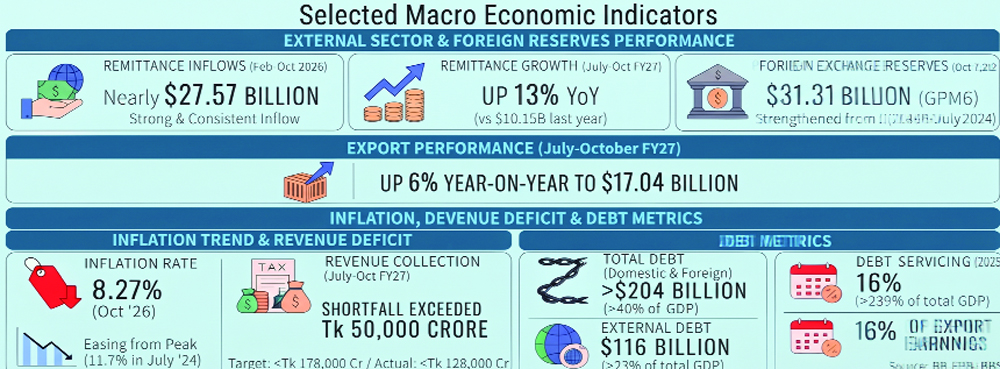
Bangladesh’s remittance inflows for the last nine months (February – October 2026) recorded nearly $ 27.57 billion, according to the data published by the central bank.
During the July-October period of FY27, the country received nearly $11.465 billion in remittances, up 13 percent from $10.15 billion in the same period last year.
Correspondingly, country’s total export earnings also maintain a considerable growth in last 9 months. From February -July in 2026 Bangladesh’s total export earnings surpassed $24.8 billion, concluding fiscal year 2025-26 at $48 billion, data from Export Promotion Bureau (EPB) showed.
Export earnings grew 6 percent year-on-year in the first four months of fiscal year 2026-27, which exporters described as encouraging.
Likewise, country’s foreign exchange reserves have strengthened further since February. As of October Seven, 2026, forex reserves stood at $31.31 billion (BPM6), up from $30.06 billion on February 19, 2026 and $20.49 billion on July 31, 2024.
As a result, the Bangladesh taka remained one of the most stable currencies in South Asia and neighboring economies over the past year, according to the latest quarterly report by Bangladesh Bank.
This follows Moody’s recent revision of Bangladesh’s sovereign outlook from negative to stable.
Earlier, Taka began weakening against the dollar in 2022 due to instability in the foreign exchange market, driven by turmoil in both global and local economies. Since July that year, the Bangladeshi currency has depreciated by about 30 percent at mid of 2024.
For this government, one of the most challenging tasks is reducing the inflation rate, which has remained stubbornly high over the past four years.
Prime Minister’s Adviser on Finance and Planning Dr Rashed Al Mahmud Titumir recently said the previous government had left the country’s economy in a critical condition before leaving office, describing it as an economy that had been left in the intensive care unit (ICU).He said the incumbent government had inherited a fragile economy, critically low revenue collection and a huge debt burden.
The government has undertaken coordinated initiatives to reform the revenue system, boost investment, create employment and restore economic momentum, he added.
In July 2024, inflation had shot to 11.7 percent; it came down to 9.13 percent in February 2026. In July 2026, inflation dropped to 8.32 percent from 9.16 percent the month before and Point-to-point inflation fell to 8.27 percent in October from 8.34 per cent in September – a positive sign.
The launch of Family Card, one of the election pledges made by the BNP, is another positive initiative. In fact, it’s among the fastest commitments met by the government following the election. Under the Family Card programme, poor families will receive Tk 2,500 per month.
However, the programme’s success depends on whether the support reaches the truly needy families, whether it’s adequate and regular, and whether the card distribution is done with full transparency and accountability.
In the banking sector, several key reforms have been made. Parliament passed the Bank Resolution Act, 2026, which grants the Bangladesh Bank an enhanced authority torestructure, recapitalise, merge or resolve troubled banks.
A dedicated Bank Resolution Department has been created. The Deposit Insurance Act, 2026 has improved safeguards for small depositors.
The Bangladesh Bank is working on an integrated digital payment ecosystem through the expansion of Bangla QR, development of a unified payment interface, promotion of cashless transactions, and introduction of an Instant Interoperable Payment System by June 2027.
In contrast, still the private investment is weak, there is a large deficit in revenue collection, energy supplies are uncertain, low industrial output and the government’s debt and interest payments are increasing.
According to preliminary figures from the National Board of Revenue (NBR), a massive deficit has emerged in meeting revenue targets during the first four months of the current fiscal year(July-October) of FY27.
During this period, the target for revenue collection was nearly Tk178,000 crore.but the actual collections amounted to less than Tk128,000 crore. Consequently, the revenue shortfall compared to the target has exceeded Tk50,000 crore.
Private sector credit growth has fallen to a historic low as businesses shelve investment plans and banks stay cautious about lending amid mounting economic pressures.
Credit to the private sector grew by just 4.17 percent in September, referring growth has remained below 5 percent for seven consecutive months, as demand for loans has weakened mainly due to inadequate energy supplies and geopolitical tensions.
More alarmingly, Bangladesh’s domestic and foreign debt has recently exceeded $204 billion, equivalent to more than 40 per cent of its GDP. As of November 2026, Bangladesh’s outstanding external debt stood at $116 billion, equivalent to more than 23 per cent of the country’s total GDP.
Bangladesh’s foreign debt has almost tripled in 10 years and debt servicing in 2025 took 16 percent of Bangladesh’s export earnings.
CPD at a study finds the government inherited weak banks, poor revenue mobilisation, fiscal constraints, subdued investment and an adverse global environment.
The US-Israel war on Iran and volatility around the Strait of Hormuz have also sent energy shock waves across the world and also observed negative trends outweighing positive ones in the country.
Many of those negative trends are entrenched and structural.
Debapriya Bhattacharya, distinguished fellow of the Centre for Policy Dialogue (CPD) said the country’s economic stabilisation remains fragile, and the recovery is likely to take longer than the government expects.