


No return, only extradition

Ousted prime minister Sheikh Hasina cannot legally return to Bangladesh through ordinary travel arrangements and must be brought back from India under the bilateral extradition treaty, according to political analysts, lawyers and political leaders.
They say her conviction by the International Crimes Tribunal (ICT), along with several pending cases, leaves no scope for a voluntary return using a passport or visa.
 Bangladesh has already sent a formal diplomatic note to India seeking her extradition under the 2013 treaty between the two countries.
The government has also dismissed a recent initiative by her lawyers to obtain a new passport and national identity card (NID), describing the move as legally irrelevant and without any scope.
Legal and political observers argue that the central issue is no longer whether Hasina can arrange travel documents to return home, but whether India will hand her over to Bangladesh to face pending trials and serve her sentence under the law.
They maintain that discussions surrounding passports, visas and immigration procedures cannot override the legal obligations arising from the extradition treaty. As a convicted person facing additional cases, Hasina’s return must be dealt with through the formal legal process between the two governments.
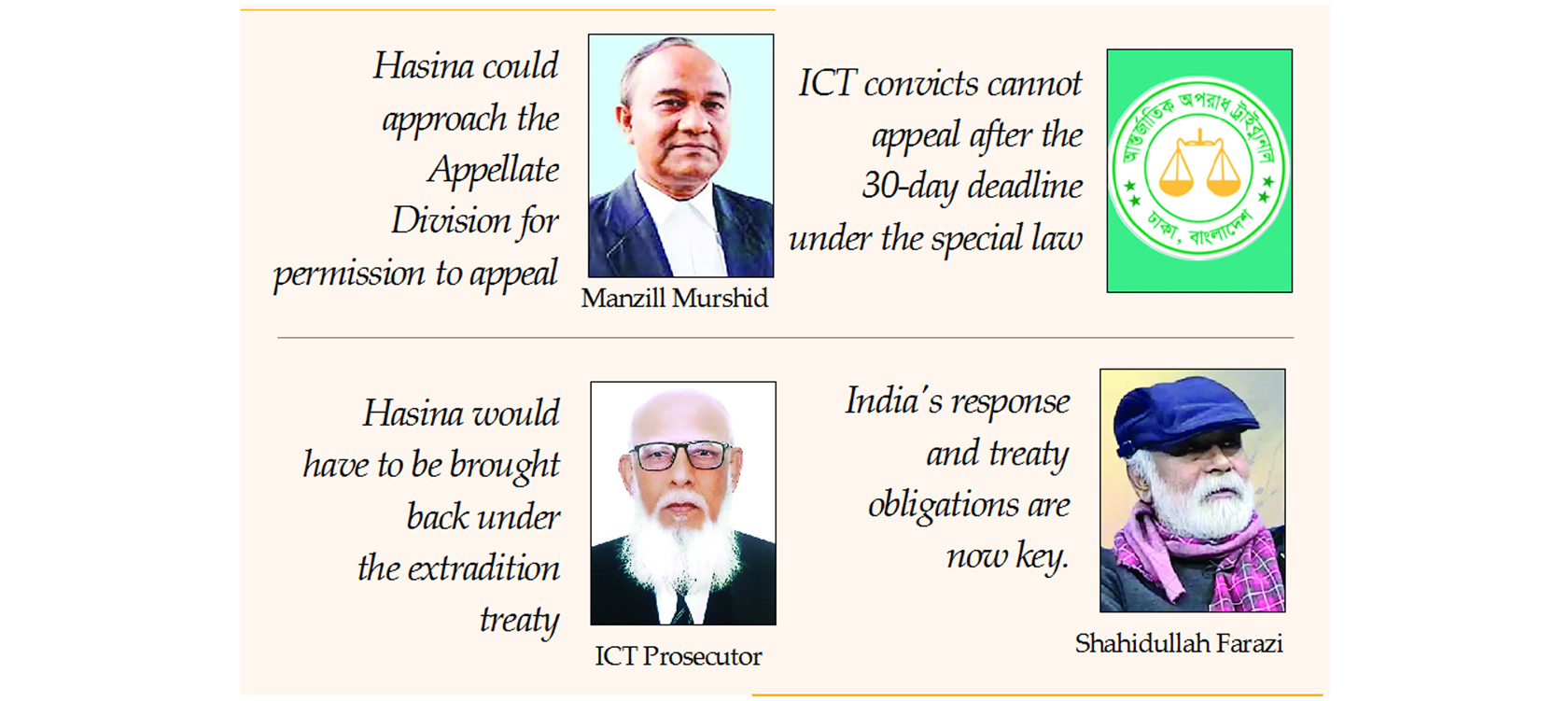
Political analyst Shahidullah Farazi said Bangladesh had already made an official extradition request to India, making the matter much broader than Hasina’s personal desire to return or her lawyers’ efforts to secure travel documents.
He said India’s response to the request and its obligations under the existing treaty were now the key considerations.
BNP Acting Secretary General Ruhul Kabir Rizvi said on Friday that Hasina would be brought back from India under the existing extradition treaty, ruling out any possibility of her returning independently while speaking at a discussion organised by Jatiyatabadi Mahila Dal at the National Press Club in Dhaka to mark National Revolution and Solidarity Day.
“Sheikh Hasina wants to come back to the country again,” he said.
“Her lawyers are seeking a passport, a visa, a national identity card. Why? There are two issues here: one is return, the other is extradition. Sheikh Hasina will be brought back under the extradition treaty.”
Earlier on Tuesday, Prime Minister’s Information and Broadcasting Adviser Dr Jahed Ur Rahman also said Hasina would have to return from India through the existing bilateral extradition treaty rather than through an application for a new passport.
Legal options for appeal
Supreme Court senior lawyer and Human Rights and Peace for Bangladesh (HRPB) President Manzill Murshid told The New Nation that a person wishing to return and face legal proceedings after the 30-day appeal period following a verdict could approach the Appellate Division for permission to appeal.
Such an application would have to explain the reasons for the delay and seek the court’s permission to proceed with the appeal, he said.
Murshid noted that there was no precedent in Bangladesh for carrying out a death sentence without the matter going before the Appellate Division.
Referring to Article 104 of the Constitution, he said the Appellate Division had the authority to issue any direction, order, decree or writ necessary to ensure complete justice in a matter before it. The power to condone delays in filing appeals also rested entirely with the court.
He argued that demands for the execution of a sentence without allowing the convicted person an opportunity to appeal would amount to circumventing the legal process.
However, legal experts said that as the International Crimes Tribunal (ICT) operates under a special law, a person convicted by it has no right to appeal after the 30-day deadline expires.
Citing the execution of Captain Abdul Majed in April 2020, who had remained a fugitive in India for nearly 22 years, they said he was not given any further opportunity to appeal. He was executed just four days after his plea for presidential clemency was rejected.
ICT Prosecutor Md Abdus Sobhan Tarafder told The New Nation that Hasina would have to be brought back under the extradition treaty if she were to return to Bangladesh.
Although she had 30 days from the publication of the verdict to file an appeal, she did not do so, he said. She must now face the legal process in accordance with the provisions of the treaty, he added.
Hasina has been living in India since the July 2024 mass uprising, more than two years ago. A Bangladeshi court has since sentenced her to death.
Several months ago, she told Reuters in an interview that she intended to return to Bangladesh in December. She has reportedly maintained that position, although she has yet to announce a specific date for her return.
India, where Hasina has been staying, has made no formal statement on her reported plan to return. It has also kept Bangladesh’s extradition request pending for nearly two years.
Responding to questions on the issue, India’s Ministry of External Affairs spokesperson has repeatedly said that it is a legal matter and will be addressed through legal means.