


Rethinking education in Bangladesh

Imagine a public university in Bangladesh where students attend classroom lectures twice a week but can revisit recorded lessons, access reading materials and participate in online discussions whenever they need.
In a law course, for instance, a teacher explains constitutional principles in class and then assigns an online case study for students to analyse before the next session. Students return to the classroom prepared to discuss their findings, exchange ideas and engage in group activities.
This is the potential of blended learning, an approach that combines traditional face-to-face instruction with digital learning opportunities. Rather than replacing classroom teaching, it extends learning beyond the physical classroom, giving students greater flexibility and more opportunities to understand complex subjects.
For Bangladesh, where students often face overcrowded classrooms, limited contact hours and unequal access to educational resources, this approach could offer a practical way to improve the quality of education.
The COVID-19 pandemic exposed significant weaknesses in the country’s traditional education system and demonstrated the importance of integrating technology into teaching and learning.
On March 17, 2020, the government closed educational institutions nationwide to contain the spread of the virus. During the prolonged closure, authorities introduced several remote learning initiatives, including televised lessons, online classes, digital learning materials and assignments to help students continue their education.
However, emergency remote education and blended learning are not the same. While the former was largely a response to an unprecedented crisis, the latter requires a carefully designed and sustained combination of classroom instruction and digital resources.
Bangladesh should therefore move beyond treating technology as an emergency substitute for conventional teaching and recognise it as an integral part of modern education.
Blended learning is also not a concept that originated during the pandemic. It has been developed and practised internationally for decades. According to the research article Over Two Decades of Blended and Online Physics Courses, Michigan State University in the United States introduced online homework in a physics course in 1992, demonstrating how digital resources could complement traditional instruction.
Bentley University began experimenting with hybrid learning in 1999, while the Rochester Institute of Technology conducted a blended learning pilot during the 2003-2004 academic year.
The initiative involved 25 faculty members, 26 courses and approximately 550 students, as discussed in the 2014 study Snapshot of a Hybrid Learning Environment.
Similarly, researchers at the New Jersey Institute of Technology examined the combination of classroom teaching and online instruction in the 2006 study A Guide to Establishing Hybrid Learning Courses.
These experiences demonstrate that blended learning is not simply about introducing technology into classrooms; it requires a planned approach to teaching, learning and student engagement.
Bangladesh has already taken steps towards this transition through the University Grants Commission’s blended learning policy. However, translating policy into effective practice requires stronger institutional coordination and long-term investment.
First, the Ministry of Education, the UGC and educational institutions should work together to establish clear implementation guidelines for schools, colleges and universities.
A uniform model would not be suitable for every institution. Public universities, private universities, colleges and schools have different technological facilities, financial capacities and student needs. Their blended learning models should reflect these differences.
Second, teacher training must become a continuous professional development priority. Simply providing teachers with access to digital platforms will not ensure effective blended learning.
They must also learn how to design interactive lessons, facilitate online discussions, prepare digital learning materials and assess students through both online and face-to-face activities.
Without these skills, technology risks becoming little more than a tool for uploading lecture notes and recorded classes.
Equally important is the digital divide. Many students, particularly those from rural and low-income households, do not have reliable internet connections, personal computers or affordable access to digital devices. A system that assumes every student has these resources could deepen existing educational inequalities rather than reduce them.
Educational institutions should therefore introduce low-bandwidth learning platforms, downloadable recorded lectures, offline learning materials and printed alternatives.
Universities and colleges could also establish digital learning facilities on campus to support students who lack adequate resources at home. Access to digital education must be treated as an essential component of educational equality.
Assessment methods also need to evolve. Instead of relying exclusively on traditional examinations and written assignments, teachers could combine classroom tests with online quizzes, case studies, presentations, collaborative projects and research-based tasks. Such methods can encourage independent thinking, practical application and active participation.
Ultimately, blended learning should not be viewed as a technological trend or a replacement for teachers. Its real value lies in combining the strengths of classroom interaction with the flexibility and accessibility of digital education.
Bangladesh has an opportunity to make its education system more responsive to the needs of a changing world.
But this transformation will require more than distributing devices or introducing online platforms. It demands thoughtful policies, trained educators, reliable infrastructure and a commitment to ensuring that no student is left behind.
The future of education in Bangladesh should not be a choice between the classroom and the screen. It should bring the two together to create a more flexible, inclusive and effective learning environment.
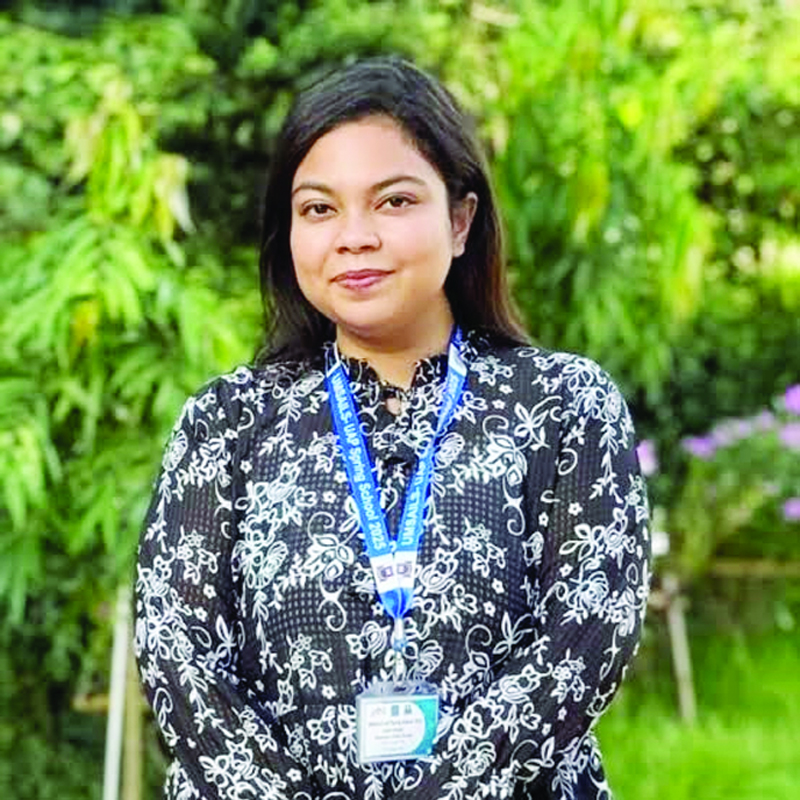
(The author is a law graduate)