


15 lakh university seats available for 6 lakh students

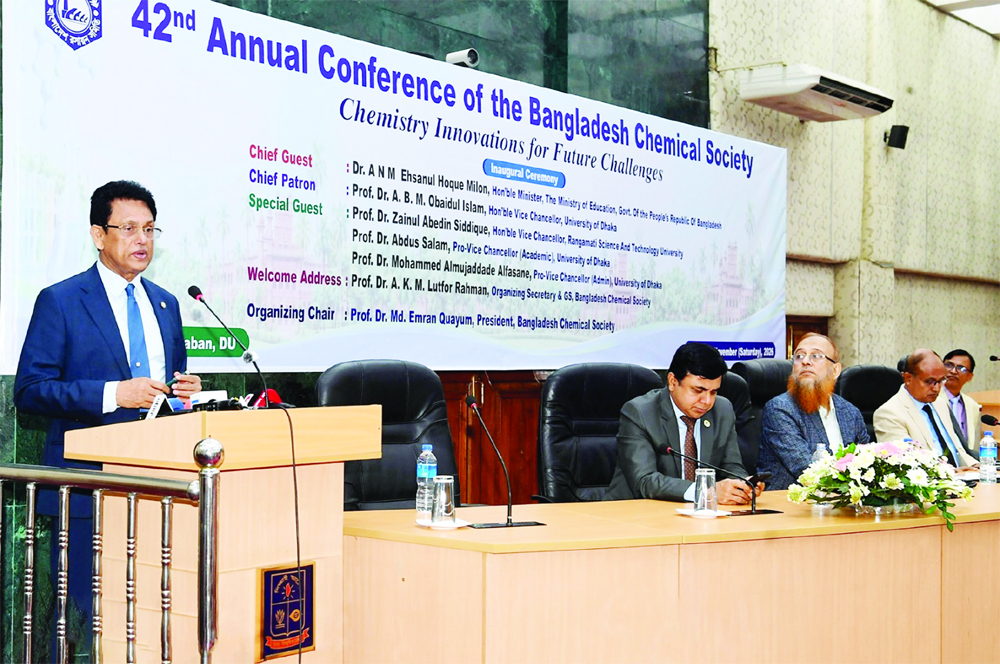
Around 15 lakh seats are vacant at public and private universities across the country, while the number of prospective university students this year is estimated at around six lakh, Education Minister ANM Ehsanul Hoque Milon said on Saturday.
He urged universities to hold their admission tests without delay, saying institutions such as Dhaka University (DU), Bangladesh University of Engineering and Technology (Buet) and medical colleges did not need to postpone their admission processes while waiting for students who might not secure places there.
Speaking at the 42nd annual conference of the Bangladesh Chemical Society at the Nabab Nawab Ali Chowdhury Senate Building of Dhaka University, the minister said students who failed to get into leading institutions would have plenty of opportunities at other universities.
“I am not asking you [Buet, DU and medical colleges] to wait for the referred students, as there are plenty of vacant seats in our universities where they can get admitted,” he said.
Milon said the government wanted to reduce session backlogs and universities should make admission opportunities available to students as soon as possible.
He acknowledged that this year’s Higher Secondary Certificate (HSC) and equivalent examination results were unsatisfactory, with only 52 per cent of candidates passing.
The minister said he had already held a meeting with vice-chancellors and decided to facilitate the re-evaluation of examination scripts.
The re-evaluation process began on November 7 and was scheduled to end on November 23, with the revised results expected to be published on the same day, he said.
He added that the Dhaka University vice-chancellor had decided to accept admission applications until November 25. Milon said he would request the vice-chancellor to extend the deadline by a few more days so that students whose results improved after re-evaluation could also apply.
Recalling his previous tenure as education minister from 2001 to 2006, Milon said he had found irregularities in the evaluation of examination scripts, including alleged script replacement and inconsistencies in marking.
However, the government at the time could not take action because the Examination Act of 1980 did not authorise the re-evaluation of scripts, he said.
“This year, we amended the 1980 law in parliament and passed a new law in 2026. Through this law, the authority to re-evaluate examination scripts has now been established,” he said.
Referring to this year’s Secondary School Certificate (SSC) examination results, the minister said re-evaluation had changed the grades of around 45,000 students.
Nearly 5,000 students who had initially failed subsequently passed, while the grade point averages of 3,079 students improved, he said.
Milon described the changes as significant and expressed hope that the ongoing HSC re-evaluation would also improve results, allowing more students to pursue higher education this year.
He also stressed the need to eliminate session backlogs in universities, recalling his own experience as a Dhaka University student.
“DU is my alma mater. I spent the longest period of my life here. It took me more than eight years to complete a four-year course,” he said.
A four-year degree programme should be completed within four years and a five-year programme within five years, he said, adding that any delay beyond the stipulated period should be treated as an administrative failure.