


Fury over soaring rents in Spain

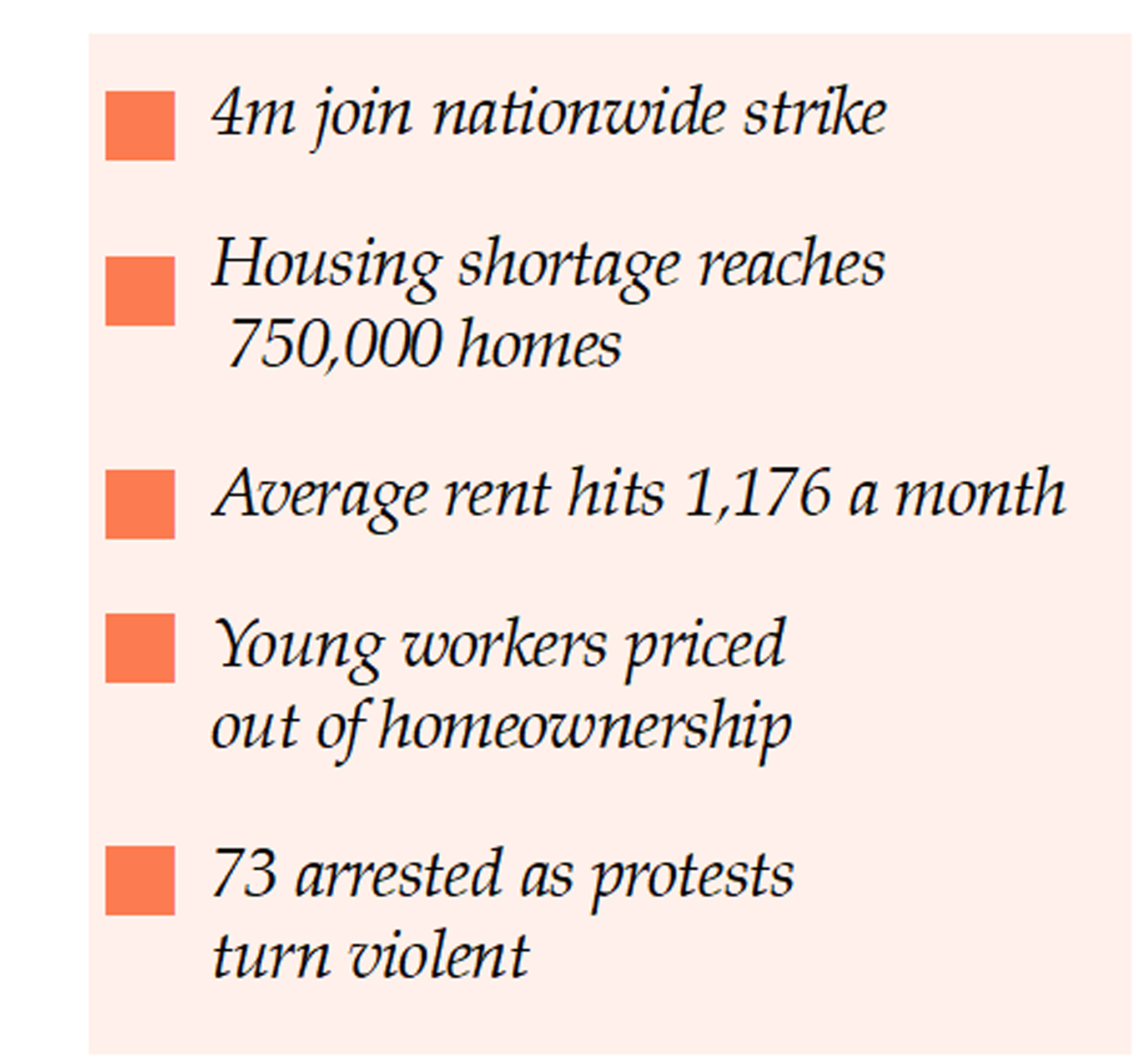
Around four million people took part in a general strike across Spain on Wednesday, protesting the worsening housing crisis, soaring rents and growing difficulties in affording homes.
The strike, the country’s first large-scale general walkout in 14 years, was called by Spain’s two largest trade unions, the General Union of Workers (UGT) and the Workers’ Commissions (CCOO), with support from tenants’ associations.
The unions estimated that around four million people, representing one-fifth of the country’s workforce, joined the protests despite severe weather caused by two powerful storms, Charles and Bruna.
The protests came less than three weeks before Spain’s snap general election, with housing affordability emerging as a major political and economic concern.
Although demonstrations remained largely peaceful during the day, clashes broke out between protesters and police in parts of Madrid and Barcelona in the evening, according to the unions.
In Barcelona, protesters set furniture on fire in the streets after the main march. In Madrid’s Plaza de España, riot police used foam bullets, tear gas and pepper spray to disperse demonstrators.
Police reported at least 1,044 incidents during the strike, including road blockades, disruptions in industrial areas and fires involving rubbish containers. At least 73 people were arrested.
The unions accused police of using disproportionate force, including tear gas and batons, and said at least 20 protesters were injured. They announced plans to file criminal complaints over the police response.
Several major retailers, including Primark, H&M and Pull&Bear, closed their outlets along Madrid’s main shopping street, Gran Vía, amid security concerns. Many shops in Barcelona were also boarded up as a precaution.
The unions described the strike as a success, with particularly strong participation in coastal areas, where housing shortages and rising rents have placed significant pressure on residents.
However, stormy weather forced organisers to cancel some afternoon marches in southern cities, including the port city of Cádiz.
According to the Bank of Spain, the country faces a housing shortage of around 750,000 homes, a figure that could exceed one million by 2028. As homeownership becomes increasingly unaffordable, demand for rental properties has further intensified competition in the market.
The Spanish Youth Council estimates that average monthly rent stands at 1,176 euros, consuming nearly 98.7% of the average monthly salary of a young working professional.
Jesús González, a 36-year-old IT worker at a Madrid hospital, said he still could not afford to buy a home despite his age.
Describing the situation as “unbearable”, he said rents and property prices continued to rise relentlessly.
However, Ángela de Miguel, vice-president of the Spanish Confederation of Business Organisations (CEOE), the country’s main business association, argued that the strike could prove counterproductive.
Speaking to state broadcaster TVE, she said the housing crisis was also making it difficult for small businesses to recruit workers. She argued that the solution lay in increasing housing construction and reducing taxes on building and purchasing homes.