


Info Commission begins 100-day plan, vows to remain impartial

The Information Commission has launched a 100-day work plan, pledging to maintain its independence and impartiality under the democratic government, Chief Information Commissioner Prof Dr Nahreen Islam Khan said on Thursday.
“We began our 100-day work plan with the belief that the Information Commission under a democratic government will remain impartial and independent,” she said at a press briefing at the commission’s building in the capital.
Responding to a question about whether the commission would side with the people or the government, Nahreen said it would remain neutral.
“My answer is unequivocal: the Information Commission will not stand with the people, nor will it stand with the government; it will remain impartial,” she said.
She expressed the belief that a strong Information Commission would help the government advance democracy.
The briefing outlined the newly formed commission’s priorities, including effective implementation of the Right to Information (RTI) Act, 2009, ensuring public access to information and making the exercise of this right more effective.
Explaining the significance of the law, Nahreen said most laws were enacted by governments to regulate citizens, while the RTI Act allowed ordinary people to seek information from the government and hold it accountable.
She said one of the initial challenges after joining the commission was that many people did not know about its existence or understand its functions.
The commission wants to make citizens aware that the country has an institution dedicated to protecting their right to information and that its services are open to everyone, she added.
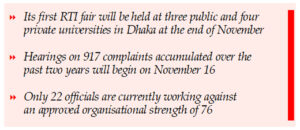
As part of the 100-day programme, the commission will organise the country’s first RTI fair at the end of November, initially at three public and four private universities in Dhaka.
The weeklong event will help students learn how to use the RTI Act to pursue their demands and raise grievances through lawful channels.
The commission will also start hearings on November 16 to address 917 complaints accumulated over the past two years, Nahreen said. It aims to make its work more effective by dealing with both pending and newly filed complaints.
She urged citizens to regard themselves as equal members of society and the state, expressing hope that the commission’s impartial role would help strengthen democratic practices.
Nahreen also acknowledged significant staffing constraints. Although the commission’s approved organisational structure provides for 76 officials, only 22 are currently working at its 15-storey building.
Despite the shortage of manpower and other challenges, she said the commission had begun its work rather than waiting for all necessary resources.
Information Commissioner S A M Mahfuzur Rahman said the commission could play an important role in improving access to information.
He said it expected to work with the media to promote transparency by ensuring ordinary citizens could obtain information.
Describing information as a major source of power in modern society, particularly as artificial intelligence continues to transform the world, Mahfuzur urged journalists to help combat disinformation. He called for a clear distinction between misinformation and disinformation and stressed the importance of ensuring the flow of objective, authentic and verified information.
Information Commissioner Khan Mohammad Abul Hossain said freedom of expression was essential for democracy and that the right to information was an inseparable part of that freedom.
“Freedom of expression can never flourish without the right to know,” he said.
He added that journalists and media organisations played a major role in helping people exercise their right to know, and stressed that the Information Commission needed media cooperation to function effectively.