

Hasina applies for passport

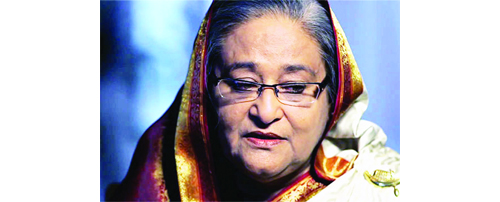
Bangladesh has ruled out issuing a fresh passport or National Identity Card (NID) to deposed former Prime Minister Sheikh Hasina, insisting that her return from India must take place through the bilateral extradition treaty and established judicial procedures.
The government maintains that legal accountability cannot be bypassed through ordinary administrative arrangements, as Hasina has already been sentenced to death for crimes against humanity and Bangladesh has formally sought her extradition from India.
The issue surfaced after the Bangladesh High Commission in New Delhi received an email from British legal chambers Matrix Chambers requesting a new passport and NID for Hasina, who has been living in India since fleeing Bangladesh in August 2024.
However, the mission questioned the authenticity of the request, saying it contained no evidence that Hasina had formally authorised the law firm to represent her.
Speaking to journalists at the Foreign Ministry on Monday, State Minister for Foreign Affairs Humaiun Kobir described the passport request as ‘extremely laughable’, saying Bangladesh would not issue travel documents to someone sentenced to death and living abroad as a fugitive.
“She has been sentenced to death. Bangladesh does not provide passports to a terrorist,” he said.
Referring to the extradition treaty between Bangladesh and India, Kobir said Dhaka wanted Hasina handed over through the existing legal mechanism.
“We want Hasina to be handed over. She will be handed over. She is a terrorist. She is a fugitive criminal. There is an active extradition treaty between Bangladesh and India,” he said.
Questioning the need for a passport, he added, “Is she coming to visit her in-laws’ residence in Rangpur, and do we need to give her a passport so she can make that visit? We have an active extradition treaty with India. You do not need a passport to arrest terrorists and criminals.
This is a matter of handover, and a judicial process is in place.”
Taking aim at the British legal chambers, Kobir said, “The law firm should know who their client is. Their client is a terrorist who has fled Bangladesh, killing thousands of people over the years. She was involved in abduction and extradition killings.”
He urged the lawyers not to pursue financial gains at the expense of professional ethics, saying, “Don’t run after her stinky money, looted money from the people of Bangladesh. Exercise some ethical and moral boundaries. If you don’t have those boundaries, you will be shamed in the world.”
He also questioned whether the legal team could publicly defend Hasina’s innocence and described her as a ‘rotten client’ for the firm.
The controversy followed a Reuters report that Hasina had sought fresh Bangladeshi travel and identity documents through her UK-based legal representatives.
In a letter to the Bangladesh High Commission, Steven Powles KC, a barrister at Matrix Chambers, requested new documents, citing Hasina’s Bangladeshi nationality and obligations under domestic laws and international human rights instruments. He also asked the mission to explain the formalities and documentation required to process the applications.
High Commission Press Minister Saidur Rahman told The New Nation that the mission had received the email but could not establish whether it genuinely represented Hasina’s wishes.
“We do not know whether the request is genuine. There is no way for us to establish that this is a request made on Sheikh Hasina’s behalf,” he said.
He explained that the correspondence contained no authorisation or supporting evidence showing that Hasina had formally appointed the legal chambers.
“When a law firm makes a request on behalf of an individual, there should be an authorisation from that person,” he said, adding that the email was not a formal application for a new passport or NID but had been forwarded to the Foreign Ministry.
Meanwhile, Home Minister Salahuddin Ahmed said the government was examining the authenticity and legal basis of the reported application.
“We have heard that fugitive and convicted accused Sheikh Hasina has applied for a passport. The authenticity of the application and its legal basis will be examined,” he told journalists at the Secretariat.
He said the government would continue pursuing her return under the extradition law through diplomatic initiatives.
Chief Prosecutor of the International Crimes Tribunal Md Aminul Islam dismissed Hasina’s reported passport initiative and statements about returning to Bangladesh as political manoeuvres.
“Sheikh Hasina’s current activities, which we are seeing through various channels, are political stunt,” he said, adding, “For now, my comment is that she will not return, and these are her political stunt.”
He said his office would provide a formal briefing on Tuesday explaining the legal position.
Former law adviser Dr Asif Nazrul, in a Facebook post, said the passport request could strengthen Bangladesh’s extradition case.
” The Bangladesh government has written to India seeking her extradition as a convicted criminal. A convicted person whose extradition has been sought cannot return to the country with a new passport.
She must be returned in her capacity as a convicted criminal. A passport is not required for this.
The Indian government can simply arrest her and hand her over to Bangladesh,” he wrote. “The Bangladesh government can now argue that she is confident enough to return because justice prevails in the country”, he added.
He argued that the request prove the claim that Hasina could receive a fair trial in Bangladesh, adding that Dhaka could now press India more forcefully for her extradition.
He also accused Hasina of putting ordinary Awami League leaders and activists in greater difficulty by raising expectations of her return.
The controversy comes amid Hasina’s renewed declaration that she intends to return to Bangladesh in December.
In an interview with the Associated Press, she said, “If death is my destiny, I would rather die on the soil of my own country, among my own people.”
“So, I will return to Bangladesh. That decision has not changed,” she added.
Hasina fled to India on 5 August 2024 after a student-led mass uprising ended her 15-year rule. In November 2025, the International Crimes Tribunal-1 sentenced her to death for crimes against humanity over her government’s deadly crackdown on protesters.
Bangladesh has repeatedly sought her extradition, while New Delhi has said the request is being examined through established legal procedures.
Indian High Commissioner to Bangladesh Dinesh Trivedi said on 3 October that the process was ongoing and involved the courts, making a timeline difficult to provide.
“The process is on,” he said, adding that “nobody can give you a timeframe”.