Middle-class dream of home ownership dims in downturn

Staff Reporter :
Bangladesh’s real estate sector, once a key pillar of urban development, is currently experiencing a severe downturn, attributed to political transition, rising construction costs, and policy uncertainty surrounding the Detailed Area Plan (DAP).
The slowdown has not only stifled industry growth but has also dampened the aspirations of the country’s middle class, many of whom now view home ownership as increasingly out of reach.
Shahjalal Khan, a retired school headmaster from the Mohammadpur area of Dhaka, had long hoped to purchase a modest flat as a peaceful retreat in retirement. His wife, Rayea Akter, who is nearing retirement herself, shares this long-standing dream. Despite having saved Tk 75 lakh over decades of service, the couple now finds their aspirations thwarted.
“Following the political change, we’re no longer confident in using our savings to invest in a flat,” Shahjalal told the media. “Our combined earnings and pension savings aren’t enough. The registration fees alone add 15 per cent to the cost. It’s simply unaffordable now.”
Like many middle-income households, the couple has been paralysed by uncertainty over economic stability and property market volatility.
Despite the subdued domestic sentiment, international forecasts remain optimistic.
According to Statista Market Insights, Bangladesh’s housing market is projected to reach US$2.75 trillion by the end of 2025, with a compound annual growth rate (CAGR) of 1.99 per cent. The market is expected to grow to US$3.07 trillion by 2029. The residential segment alone is forecast to reach US$2.07 trillion in 2025, rising to US$2.21 trillion by 2029 at a CAGR of 1.63 per cent.
However, market insiders present a grimmer view of present conditions. Md Rasel Mukul, Assistant General Manager (Sales & Marketing) at Basic Builders Ltd, reported that flat sales have fallen by 40 per cent among middle-income buyers and by up to 70 per cent among high-income clients. “Bookings have dropped significantly. Even plot sales have slowed,” he said, reflecting widespread distress among small and medium developers.
A sharp rise in construction input costs has compounded the crisis.
“There are around 280 materials required to construct a flat. Prices for key components, such as steel rods and cement, have increased by approximately 25 per cent due to inflation and higher land costs in DAP-affected zones,” said Dawn Shahenul Kabir, Director (Construction) at Eastern Housing.
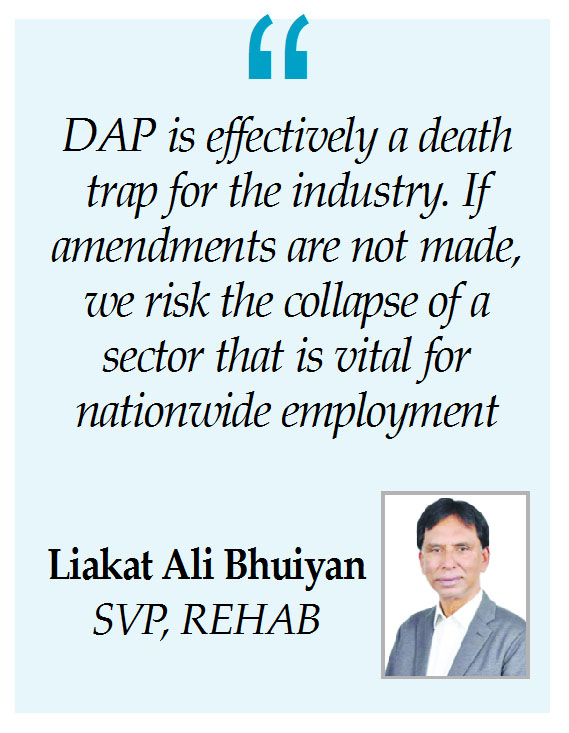
Adding to the sector’s woes is a significant capital shortfall. “Since the change in government, many key investors – including business leaders, bureaucrats and politicians – have remained inactive,” noted Liakat Ali Bhuiyan, Senior Vice President of the Real Estate & Housing Association of Bangladesh (REHAB). “The opportunity to invest undeclared income has ended, cutting off a major stream of liquidity.”
At the centre of the controversy is the Detailed Area Plan (DAP), implemented by RAJUK in August 2023, which seeks to restructure Dhaka into a more liveable city. However, developers argue the zoning regulations are overly restrictive and have had a paralysing effect on the sector. “This DAP is effectively a death trap for the industry,” warned Bhuiyan. “If amendments are not made, we risk the collapse of a sector that is vital for nationwide employment.”
A RAJUK official, speaking on condition of anonymity, confirmed that a revised version of the DAP is close to finalisation and is expected to be gazetted following ministerial approval. While REHAB has expressed cautious optimism, urban planners have voiced concern that revisions may prioritise private interests over public welfare.
As the industry awaits clarity on regulatory reform, developers and prospective buyers alike remain in limbo – caught between policy uncertainty, rising costs, and fading confidence in the market’s direction.