



Bracing for Trump’s trade gamble

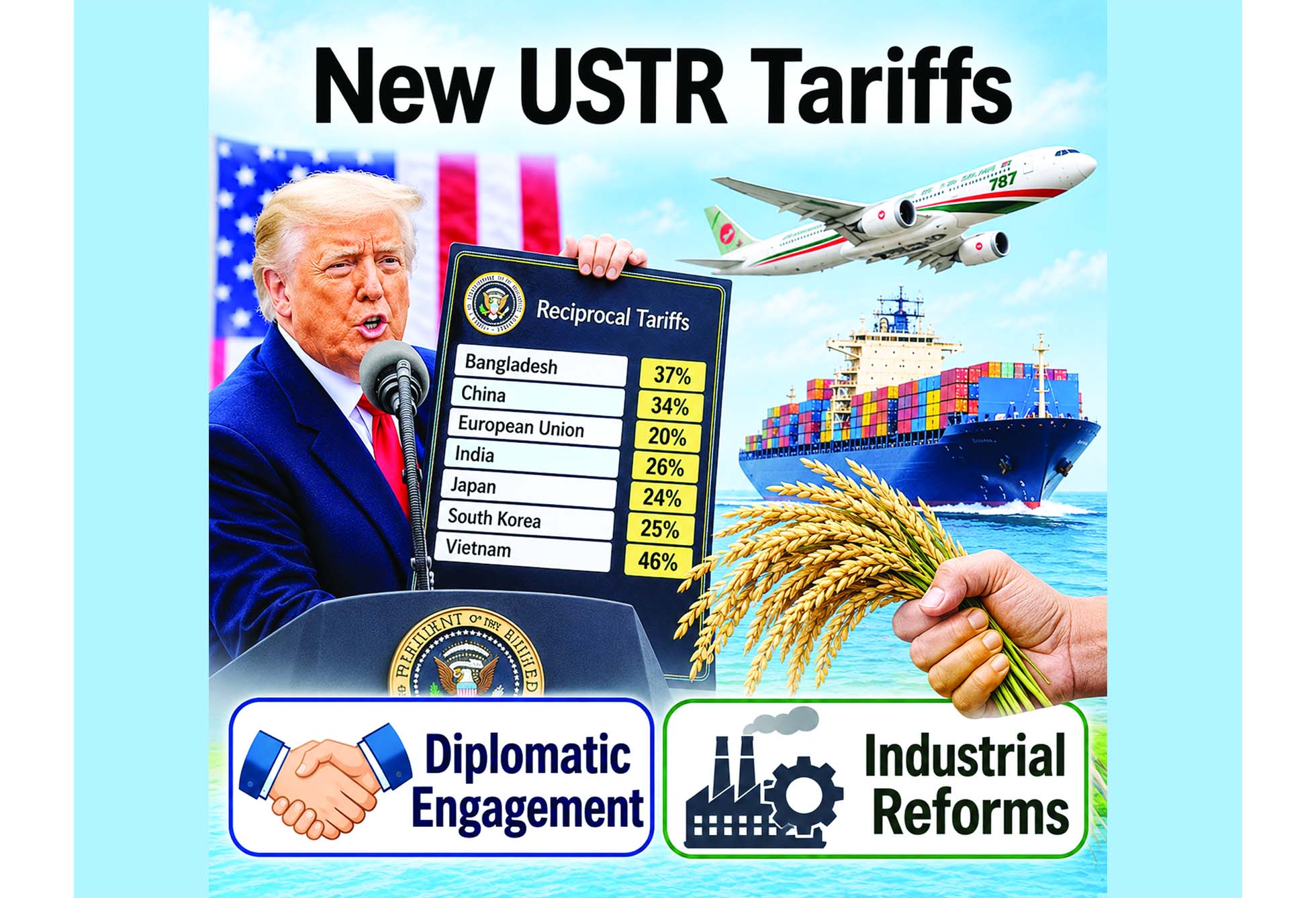
Bangladesh’s export-oriented economy faces another significant challenge as the Trump administration moves towards imposing additional tariffs on its imports.
The Office of the United States Trade Representative (USTR) has proposed tariffs of up to 18 per cent on Bangladeshi goods, citing excess manufacturing capacity, industrial subsidies and the country’s growing reliance on Chinese production inputs.
Coming when the readymade garment (RMG) industry is already grappling with labour unrest, rising production costs and intensifying international competition, the proposal could further undermine Bangladesh’s export prospects.

The USTR argues that Bangladesh’s industrial policies and export-oriented manufacturing practices restrict commercial opportunities for American producers.
It particularly questions government incentives and subsidies, which it believes distort competition.
The report also raises concerns over imports and foreign direct investment (FDI) from China, which Washington classifies as a non-market economy.
According to the USTR, inexpensive Chinese machinery, yarn, fabrics and synthetic fibres give Bangladeshi manufacturers a cost advantage, while Chinese investment could provide an alternative channel for exporting excess manufacturing capacity.
The trade figures illustrate the stakes involved.
In 2025, US imports of ready-made garments from Bangladesh amounted to approximately $8.6 billion, representing around 8 per cent of total American imports in this category.
Meanwhile, Bangladesh’s merchandise trade surplus with the United States increased from $5.9 billion in 2021 to approximately $7 billion in 2025.
Although this surplus reflects Bangladesh’s export competitiveness, it has also become a significant consideration in Washington’s trade policy.
Bangladesh’s agreement with Boeing to purchase 11 additional aircraft, taking Biman Bangladesh Airlines’ planned acquisitions to 25, demonstrates its willingness to expand commercial engagement with the United States.
Its emergence as the eighth-largest market for US wheat and cotton in 2025 further reflects efforts to increase American imports and narrow the bilateral trade imbalance.
Additional tariffs could undermine these efforts and jeopardise prospects for a more balanced trading relationship.
The proposed tariff requires careful interpretation. The USTR has proposed a rate of up to 18 per cent, net of existing Section 301 tariffs.
This would increase the existing 10 per cent tariff component imposed in July 2026 by eight percentage points, rather than simply being added to it.
Including the average most-favoured-nation (MFN) duty of approximately 15.62 per cent, Bangladesh’s overall average tariff exposure could rise from around 25.62 per cent to 33.62 per cent.
However, the proposal is not final. Written comments are due by 5 January 2027, followed by public hearings beginning on 25 January, giving Dhaka an important opportunity to present its case.
The potential consequences extend across the economy. As Bangladesh’s largest single-country export market, the United States accounts for a substantial share of its export earnings.
Higher duties could make Bangladeshi products less competitive against those from Vietnam, India and Cambodia, prompting American importers to demand lower prices or shift orders elsewhere.
Combined with rising production costs and already narrow profit margins, this could reduce export receipts, weaken foreign exchange inflows and threaten factory operations and employment across an industry supporting millions of workers.
Bangladesh must therefore prioritise diplomatic engagement before the proposal is finalised.
The government should initiate urgent negotiations with Washington, involving trade experts, economists, diplomats and industry representatives, and submit a comprehensive, evidence-based response within the consultation period.
It must explain the developmental rationale behind domestic industrial incentives while addressing legitimate American concerns over subsidies and investment practices.
Negotiators should also seek product-specific exemptions or preferential arrangements for the garment sector, highlighting its importance to both countries’ commercial interests.
Dhaka should demonstrate its commitment to balanced trade by exploring commercially viable purchases of American agricultural products, aircraft and industrial machinery.
Regular high-level trade dialogues could strengthen confidence and identify opportunities to expand bilateral commerce. However, imports must be guided by economic considerations rather than undertaken merely to secure tariff concessions.
Domestic reforms are equally important. Bangladesh must strengthen local textile and backward-linkage industries, diversify import sources and increase domestic value addition to reduce supply-chain vulnerabilities.
Manufacturers should invest in modern technology, energy efficiency, productivity and higher-value products instead of relying primarily on low labour costs.
The government must ensure reliable energy supplies, affordable industrial financing, streamlined customs procedures and a predictable business environment. Constructive dialogue between factory owners and workers is also essential to maintaining industrial stability.
Furthermore, Bangladesh must diversify its export destinations beyond the United States and traditional European markets.
Exploring opportunities in East Asia, the Middle East, Africa and Latin America, alongside developing non-RMG sectors such as pharmaceuticals, leather goods, light engineering and agro-processing, would reduce dependence on a limited number of markets.
The proposed US tariffs expose Bangladesh’s vulnerability to changing global trade policies and excessive dependence on a narrow range of export markets and production inputs.
The immediate priority must be to secure a favourable outcome through negotiations and credible evidence.
More fundamentally, protecting export competitiveness requires a stronger industrial base, diversified markets, higher productivity and sustainable labour relations.
Failure to act could turn an external trade measure into a wider economic setback, threatening export earnings, employment and macroeconomic stability.