



Dhaka to raise reservations over US tariffs

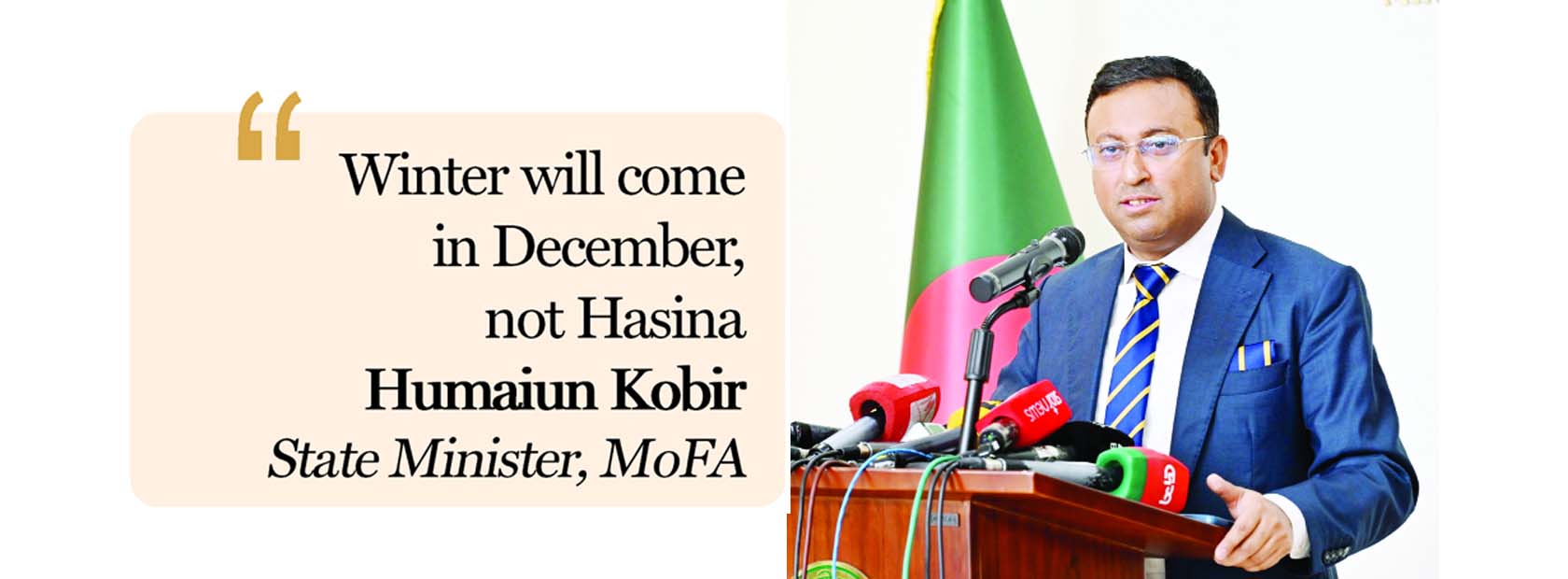
Bangladesh will engage with the United States over tariff measures it considers unjustified, while seeking to build its case for negotiations ahead of a January 26 public hearing, State Minister for Foreign Affairs Humaiun Kobir said on Thursday.
Kobir said Dhaka had reservations about some aspects of Washington’s tariff measures and would use the upcoming hearing to present its arguments, including on the benefits of importing US cotton for manufacturing export products.
“There is scope where we consider some things unjustified. There is also an opportunity to talk about this,” he said while speaking to journalists at the Ministry of Foreign Affairs.
Referring to the January 26 hearing, he said Bangladesh would prepare its case to negotiate with the US administration over the tariff issue.
“If we take their cotton, manufacture products here and export them to the United States, we can negotiate with them on the tax issue,” Kobir said.
“Of course, we have reservations and we will talk and negotiate with them,” he added, noting that the US tariff policy was not directed exclusively at Bangladesh, as several
other countries had also faced similar measures.
‘Sheikh Hasina will not come in December’
Kobir dismissed speculation about Hasina’s return next month, saying it should not be confused with the legal extradition process.
“Sheikh Hasina will not come in December. The only thing coming in December is winter,” he said, advising journalists to buy “jumpers or jackets” for the colder weather instead.
He said December would be an important month for Bangladesh’s diplomatic engagements, with possible visits by the prime ministers of Malaysia and the Maldives, alongside the country’s Victory Day celebrations.
Describing Hasina as politically irrelevant, he said, “This is the end of her. She is worthless, irrelevant. A terrorist’s place has been determined through extradition.”
“Through the extradition treaty, she will be brought on a plane in handcuffs or under strict surveillance. This is the only way she can come back,” he said.
Kobir accused Hasina of showing no remorse over the deaths of thousands of people and said her presence in India was creating diplomatic irritation.
“She is a terrorist, and they recognise the challenges of having a terrorist in their sovereign territory. It causes them unnecessary irritation,” he said.
Comparing the situation to a troublesome guest, Kobir said, “It is like inviting a guest into your house who enters, starts acting crazy and talking nonsense, and you can neither kick them out nor digest them.”
He said the situation had become an irritant for India and had implications for bilateral relations.
Ganges treaty renewal
On the long-pending Ganges Water Sharing Treaty, Kobir said Bangladesh had already written to India regarding the renewal or replacement of the agreement, which is due to expire on December 12.
“We have written to India regarding this. It is in progress now. It is for Bharat to respond. We are doing what needs to be done from our side, and we are very open about it,” he said.
Dhaka dismisses West Bengal minister’s remarks
Responding to remarks by West Bengal’s transport minister threatening that Bangladesh would be occupied by December 16, Kobir dismissed the statement as irresponsible political rhetoric.
“Look, everywhere in the world, there are some madmen in politics. They can say anything. Madmen exist everywhere,” he said.
He emphasised that Bangladesh’s diplomatic engagement with India was conducted through the central government, not individual politicians in its states.
“Our relationship will be with the central government of India. So let us limit this discussion to that.
This is where serious discussions take place, national government to national government,” he said.