



US tariff move raises stakes for Bangladesh

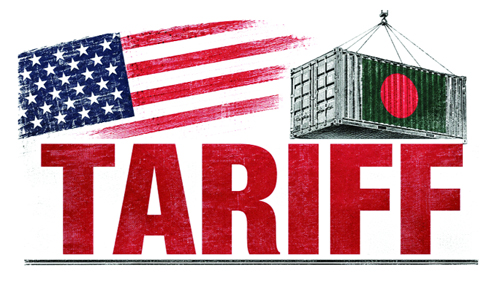
Bangladesh has once again become part of Washington’s expanding trade-policy narrative, as the Trump administration prepares to bring 16 major trading partners under fresh tariff pressure through an investigation into alleged excess industrial capacity.
The initiative, which comes after the US Supreme Court struck down a major part of Trump’s earlier tariff measures, has raised questions about the use of trade restrictions as an instrument of economic and geopolitical leverage.
The proposed measures, expected to be announced shortly, are part of President Donald Trump’s efforts to restore his controversial global tariff regime after the US Supreme Court struck down a major part of his second-term duties in February.
The move could have significant implications for Bangladesh’s export-dependent economy, particularly as the country seeks to maintain favourable access to the US market amid growing trade and diplomatic pressures.
Three people familiar with the matter told Reuters on Tuesday that the US Trade Representative’s (USTR) office was preparing to release the findings of its investigation into 16 major trading partners. New duties covering a broad range of imported goods are expected to be proposed on a country-specific basis.
The findings could be published as early as Tuesday afternoon, the sources said. The proposed duties would be imposed in addition to tariffs already introduced by the Trump administration during his second term.
The latest initiative is partly intended to replace duties invalidated by the Supreme Court. Trump’s tariff policies have contributed to higher prices for consumer goods in the United States.
A Reuters/Ipsos opinion poll conducted after November’s midterm elections found that 62 per cent of respondents supported efforts to repeal the tariffs.
Although the proposed rates remain unclear, one source said the duties would be tailored to individual countries. Imports from Mexico and Norway are unlikely to face immediate additional levies.
The USTR launched the investigation in March under Section 301 of the Trade Act of 1974, citing alleged evidence of excess industrial capacity among major trading partners.
Washington is expected to maintain the maximum tariff rates agreed under recently concluded trade arrangements with several partners, according to one of the sources. These include a 15 per cent ceiling on imports from the European Union, Japan and South Korea, and 19 per cent for Malaysia.
The United States is also expected to retain the 20 per cent ceiling on tariffs imposed on Chinese goods during Trump’s second term, provided the existing trade truce between Washington and Beijing, due to expire on January 10, is extended. If the agreement lapses, the tariff rate linked to China’s alleged excess capacity could rise.
The USTR and the White House did not respond to Reuters’ requests for comment on the expected announcement.
Ryan Majerus, a former senior Commerce Department trade official, said the investigation could produce an extensive report recommending different tariff measures for each of the 16 trading partners.
Majerus, now a partner at law firm King & Spalding, said the administration might propose additional duties ranging from 15 per cent to 25 per cent on imports from countries identified as having excess production capacity in particular sectors.
Such duties could be added to existing levies of 10 per cent or 12.5 per cent imposed under a separate investigation into inadequate enforcement of anti-forced labour laws.
However, he said Washington could also opt for lower initial rates accompanied by escalation clauses, allowing duties to increase gradually unless the countries concerned take measures to address excess production capacity.
The countries covered by the investigation are Bangladesh, China, India, Japan, South Korea, Mexico, Vietnam, Taiwan, Thailand, Malaysia, Indonesia, Switzerland, Norway, Singapore and Cambodia, alongside the European Union.
The Wall Street Journal earlier reported that the findings of the investigation could be made public as early as this week.
The excess-capacity investigation was launched alongside a separate inquiry in March into the enforcement of laws against forced labour in 59 countries and the European Union.
The two investigations are intended to help reconstruct Trump’s so-called ‘Liberation Day’ tariff framework, which was struck down by the US Supreme Court in February.
China has been identified by the Trump administration as the principal source of excess industrial capacity.
Washington alleges that Chinese manufacturers are producing more than domestic and international markets can absorb, thereby flooding global markets with steel, aluminium, electric vehicles, household appliances, solar products and other goods.
Beijing has rejected the allegations, arguing that its exports reflect competitive advantages rather than excessive production.
The investigation also focuses on Chinese investments in Southeast Asian countries, particularly Vietnam, Indonesia and Cambodia, which Washington suspects are being used as manufacturing bases to supply the US market while circumventing existing American tariffs.
Under the current US-China trade truce, which is due to expire on January 10, Washington has capped additional tariffs introduced during Trump’s second term at 20 per cent.
These are separate from duties of around 25 per cent imposed on Chinese products during his first presidency.
The United States has already imposed an additional 12.5 per cent duty on Chinese imports under its anti-forced labour initiative, leaving a further 7.5 percentage points before reaching the agreed 20 per cent ceiling.
Meanwhile, Washington and Beijing are also working towards reducing tariffs on around $30 billion worth of non-strategic imports from each country.
For Bangladesh, inclusion in the investigation adds another dimension to its trade relationship with the United States, as the country remains exposed to Washington’s evolving tariff policies and the wider geopolitical contest over global manufacturing and supply chains.