


Green dairy partnership seeks climate-resilient dairy sector

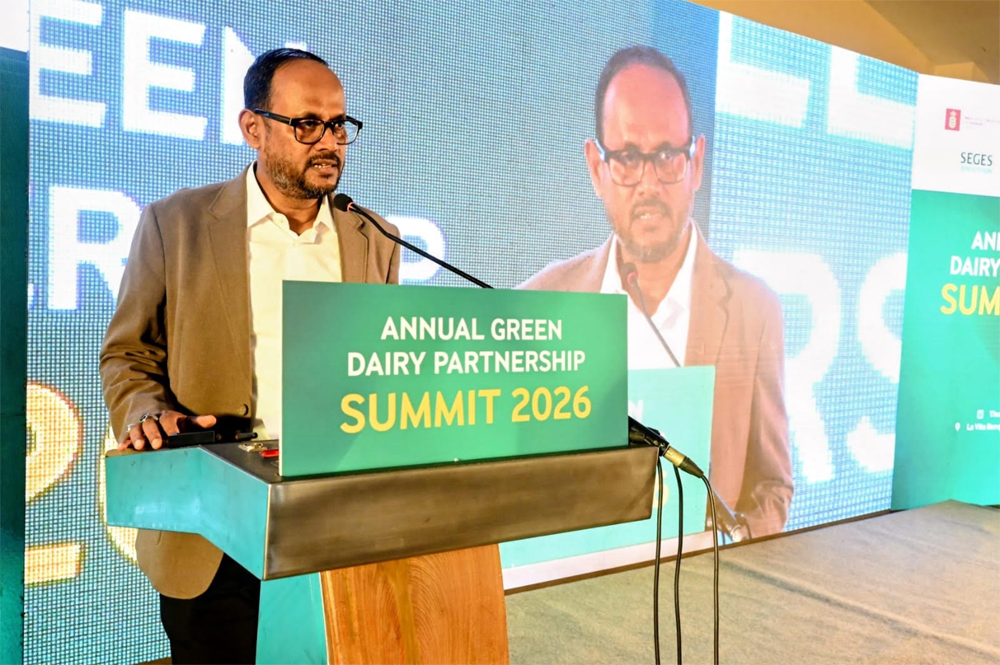
State Minister for Fisheries and Livestock Sultan Salauddin Tuku on Thursday stressed the need to reduce emissions, increase farmers’ incomes and narrow Bangladesh’s milk supply gap to ensure sustainable growth in the dairy sector.
Speaking as the chief guest at the annual Green Dairy Partnership Summit 2026, he said dairy farming supported around 1.5 million smallholder families across the country.
He highlighted the Danida Green Dairy Partnership as an example of how cooperation, innovation and farmer empowerment could help expand the sector.
Tuku also called for greater investment in milk collection infrastructure and improved market access. He emphasised the sector’s “30/30 vision”, which aims to reduce emissions while increasing farmers’ incomes through climate-smart practices.
Government officials, development partners, researchers and dairy industry representatives attended the summit to discuss ways to build a climate-resilient, low-carbon and commercially viable dairy sector.
Held under the theme “Pioneering a Low-Carbon, Climate-Resilient, and Viable Dairy Sector in Bangladesh”, the event highlighted how innovation and farmer-led initiatives could improve productivity, rural livelihoods and long-term food and nutrition security.
Supported by the Danida Green Business Partnerships under Denmark’s Ministry of Foreign Affairs, the initiative brings together Solidaridad Network Asia, Arla Foods Bangladesh, PRAN Dairy, SEGES Innovation and the Danish Agriculture & Food Council.
The partnership works with 10,000 dairy-farming households under PRAN Dairy’s network across southwest Bangladesh, including 8,549 women farmers. It seeks to improve farm productivity, resource efficiency and climate-friendly practices through the Arla Big 5 framework.
The framework focuses on feed efficiency, balanced nutrition, herd robustness, manure management and responsible land use.
The initiative has also contributed to women’s economic empowerment. The proportion of women who independently make decisions about dairy income increased from 23.58 per cent in 2025 to 41.66 per cent in 2026, according to the information presented at the summit.
Partners also unveiled a commemorative coffee-table book titled Feeding the Future of Bangladesh: Transforming Dairy, Nourishing Generations, documenting the experiences of smallholder farmers and the partnership’s achievements.
Md Delwar Hossain, Secretary of the Ministry of Fisheries and Livestock, stressed the importance of farmer training, knowledge sharing and effective implementation of the Bangladesh Dairy Development Board (BDDB) Act, 2023.
He said the partnership was helping strengthen farmers’ skills through practical training and improved dairy management practices.
Danish Ambassador to Bangladesh Christian Brix Møller reaffirmed Denmark’s commitment to low-carbon agricultural development through partnerships combining international expertise with local knowledge. He also stressed the need for an inclusive and resilient dairy ecosystem.
Md Shahzaman Khan, Director General (In-charge) of the Department of Livestock Services, said the dairy value chain was a top priority in developing an environmentally friendly food system.
Selim Reza Hasan, Country Manager of Solidaridad Network Asia, said greater financial independence among women and rural households would strengthen the agricultural value chain.
Laurent Ponty, Managing Director of Arla Foods Bangladesh, highlighted the potential of farmer-focused approaches such as the Arla Big 5 to improve productivity, livelihoods and emissions performance.
Uzma Chowdhury, Director of Finance at PRAN-RFL Group, stressed the need for quality infrastructure, transparent supply chains and continued investment to make the dairy industry more competitive.
The summit concluded with a shared commitment among government agencies, research institutions, development partners and private-sector representatives to expand successful initiatives and strengthen Bangladesh’s dairy sector.