


Dakar Youth Games test waters for Russia’s comeback

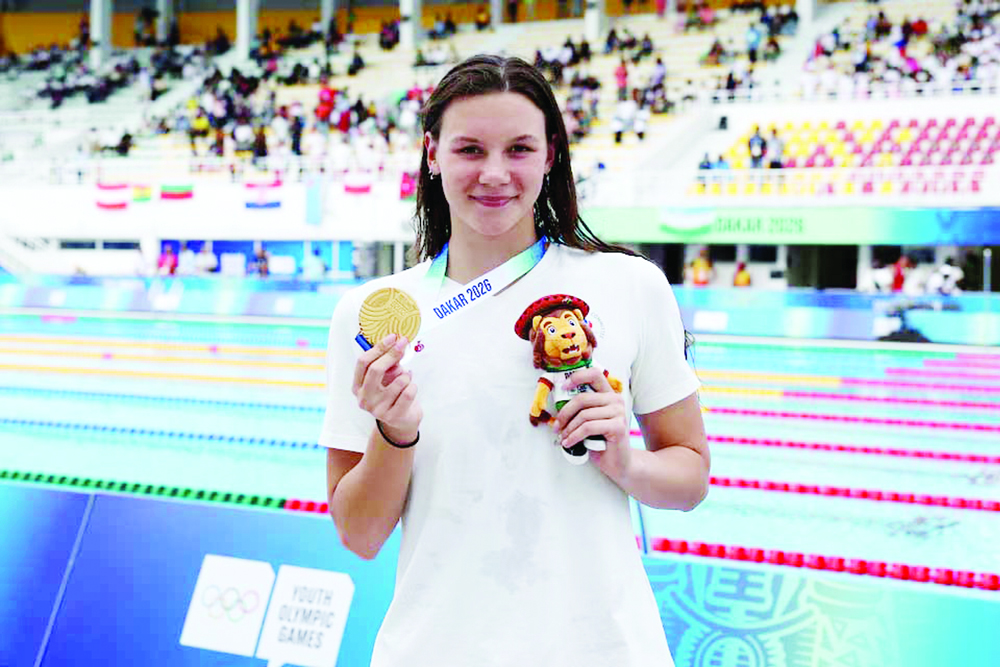
Russia’s national anthem played during the medal ceremony on the first day of the Youth Olympics at a pool in Senegal’s capital Dakar, a small but symbolic victory in Moscow’s quest to return to the international sporting stage.
The International Olympic Committee (IOC) suspended the Russian Olympic Committee (ROC) in 2023 after the ROC recognised regional Olympic councils in Russian-occupied parts of Ukraine.
Two years later, however, the IOC said youth athletes should not be held accountable for the actions of their governments, urging federations to readmit Russian youth athletes to international events without any restrictions.
The fruits of that guidance have been on display during the Games in Dakar, with 13 Russian athletes competing in nine events, including swimming, judo and skateboarding.
Serafima Fokina, a 17-year-old swimmer, finished first in the women’s 100 metres butterfly on the opening day. Standing on the podium with her gold medal around her neck, she sang along to the Russian anthem with a smile on her face.
“Of course, I was happy, how could I not be I was proud of myself and of my country,” the teenager told Reuters last week before winning gold in the women’s 50-metre butterfly.
Not everyone in the audience was pleased, however. One spectator refused to stand for the Russian anthem.
“Europeans, and in particular the European Union, are fiercely opposed to this return,” Jean-Baptiste Guegan, a French expert on the geopolitics of sport, told Reuters.
National federations in countries including Norway, Denmark and Sweden have said their teams will not play against Russia in international competitions.
The Russian government sees Russians’ participation as a political victory.
In a post on Telegram last month, Sports Minister Mikhail Degtyarev called the Olympics in Senegal “an important step towards the full return of all Russian sport to the international stage without any restrictions”.
Russian athletes competed as neutrals at the 2024 Paris Olympics and the 2026 Milano Cortina Winter Games.
The IOC provisionally lifted its ban on the ROC in July in a further step towards Russia’s return to international sport.
But it still needs to decide whether Russia can display its flag and colours and have its anthem played at the Los Angeles 2028 Games.
Sanctions-hit Moscow is trying to convince each international sports federation to allow its athletes to compete. Federations for sports including aquatics and judo have moved to loosen or remove restrictions on Russian athletes, while athletics still bans them from participating.
In Senegal, as in other African countries, many people have a more favourable view of Russia than in the West. Among young Africans who describe Russia as an influential country, 83% say that influence is positive, according to a survey released in July by the Johannesburg-based Ichikowitz Family Foundation.
This has reduced the likelihood of organised political opposition or public criticism, according to Spencer Harris, professor of sport governance and sport policy at the University of Colorado, Colorado Springs.
The Youth Olympic Games also receive little global attention compared to the other Olympic competitions, he said.
The Dakar Games have given officials within the IOC and beyond an opportunity to test public reactions to a potential change in status for Russian athletes.