

Venezuelans lead search efforts as earthquake death toll rises above 920

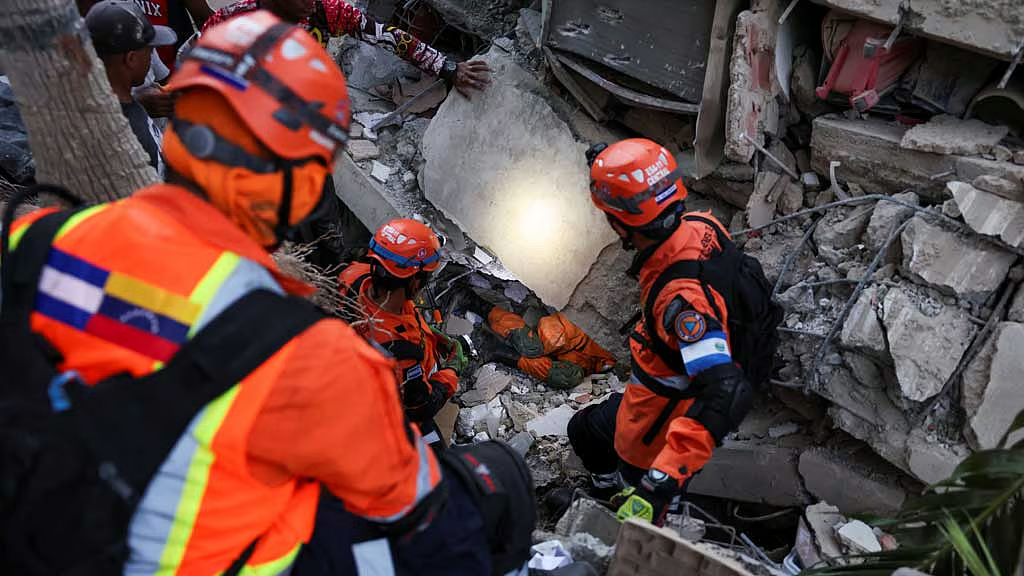
Residents in Venezuela’s earthquake-hit regions continued searching through collapsed buildings for missing relatives on Friday, saying they have received little assistance from official rescue teams as the death toll climbed to at least 920 and more than 51,000 people remained unaccounted for.
Survivors in the hardest-hit communities said neighbors, relatives and volunteers have carried out much of the rescue work themselves following the powerful magnitude 7.2 and 7.5 earthquakes that struck late Wednesday. Many complained that the government’s rescue presence has been limited despite official claims of a large-scale emergency response.
As nearly 48 hours passed since the disaster, families grew increasingly anxious to find survivors trapped beneath the rubble. Humanitarian organizations have stressed that the first two to three days after a major earthquake are critical for rescuing people alive, although survival is possible beyond that period if victims have access to food and water.
Late Friday, authorities announced restrictions on access to La Guaira, the area hardest hit by the earthquakes, citing heavy congestion and disorder that had begun to hamper rescue operations. Officials said entry would require special authorization but offered few details about how permits would be issued.
At the same time, international assistance continued to expand, with rescue teams from numerous countries arriving in Venezuela or preparing to join search operations.
“Every life saved is a miracle,” National Assembly President Jorge Rodríguez said, adding that authorities would be transparent about the scale of the catastrophe.
Families search desperately for loved ones
Across northern Venezuela, devastated families searched through piles of concrete and twisted metal for relatives while hoping to recover whatever remained of their homes.
In La Guaira, Nazareth Jimenez watched neighbors break through slabs of concrete using hammers and power tools as she feared for siblings, nieces, nephews and friends trapped inside a collapsed building.
“How are we going to get them out?” she cried, urging both Venezuelan authorities and the international community to provide heavy machinery capable of lifting collapsed structures.
“There are still people alive in there,” she said.
Government personnel distributed food and drinking water to survivors while acting President Delcy Rodríguez insisted that authorities were carrying out an intensive rescue operation during what she described as the most critical period for saving lives. She welcomed international rescue teams and aid deliveries, saying additional assistance was on the way and security forces had been deployed throughout La Guaira.
Nevertheless, many residents argued that the support reaching affected neighborhoods remained far below what was needed.
The disaster presents a major challenge for Rodríguez, who assumed office in January after former President Nicolás Maduro was removed from power by the United States. Venezuela continues to struggle with years of economic instability, while many citizens question the legitimacy of the current government.
Officials acknowledged that the number of fatalities is expected to increase. Independent online databases created by civilians listed tens of thousands of missing people, although some entries may involve duplicate reports or individuals who remain unreachable because communication networks have collapsed.
Authorities also reported that more than 3,300 people had been injured and 243 survivors had been rescued by Friday afternoon.
Millions affected by twin earthquakes
The International Organization for Migration estimated that as many as 6.76 million Venezuelans could be impacted by the disaster, including around 2 million residents of Caracas.
Experts said the destruction was intensified because both shallow earthquakes struck within a short period. Loyce Pace, regional director for the International Red Cross in the Americas, said many survivors remain too frightened to return to damaged homes.
As hope gradually faded, countless families spent another night sleeping outdoors while others mourned relatives lost in the disaster.
“I’ve been left alone,” said Omar Reyes, whose two children remain buried beneath the rubble. He estimated that about 20 members of his extended family were killed.
In Maiquetía, long lines formed outside supermarkets, pharmacies and convenience stores as businesses served customers individually behind locked doors. At one point, a woman threw herself over a package of diapers to prevent others from taking it amid growing shortages.
Rescue operations also faced repeated interruptions from heavy traffic and large numbers of motorcycles. Emergency workers from Mexico and local volunteers repeatedly called for silence so they could listen for signs of survivors beneath collapsed buildings, but many motorists continued sounding horns and revving engines despite the requests.
In Catia La Mar, near Venezuela’s main international airport, groups of people looted food and household essentials from shops. Others crowded around civilian vehicles distributing bread and bottled water until security forces restored order. Nearby, residents converted a pharmacy parking lot into a temporary shelter using tents, tarps and hammocks.
Not far away, Yuleidy Cadenas waited beside a collapsed public housing building where local and international rescue crews continued searching for survivors. She hoped her son, mother and brother would still be found alive.
The 28-year-old said she escaped barefoot from another collapsing building on Wednesday before discovering that her mother’s apartment tower had completely collapsed. Friday also marked her son’s 12th birthday.
“I climbed onto the rubble and called for them, but no one answered,” Cadenas said. “I’m still waiting for them.”
Moments later, rescuers recovered another body from the wreckage, but it was not her mother’s.
International rescue effort grows
Authorities said 861 foreign rescue specialists from countries including Mexico, the United States, El Salvador, Switzerland and Colombia were already assisting emergency operations, with many more expected to arrive in the coming days.
The United Nations announced that approximately 1,000 emergency responders from 25 international search-and-rescue teams were being deployed to Venezuela.
Acting President Rodríguez said she spoke Friday with U.S. President Donald Trump and Secretary of State Marco Rubio, who reaffirmed Washington’s commitment to sending additional rescue personnel and emergency equipment.
Across Venezuela, convoys of military vehicles, ambulances, heavy machinery and emergency crews continued moving toward the disaster zone. Civilian volunteers also joined the relief effort, transporting supplies such as mattresses, food and other essentials to affected communities.





