‘BNP leader Ilias Ali was killed after abduction’


Staff Reporter :
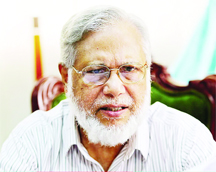
Chief prosecutor at the International Crimes Tribunal has said that senior BNP leader Ilias Ali was abducted and later killed, citing findings from a renewed investigation into enforced disappearances carried out during the previous government’s tenure.
Mohammad Tajul Islam, the tribunal’s chief prosecutor, disclosed the information on Wednesday after prosecutors submitted formal charges against Maj. Gen. (retd.) Ziaul Ahsan, a former senior Rapid Action Battalion official, in a case alleging abduction and extrajudicial killings. Investigators, he said, had found evidence linking Ziaul Ahsan to the disappearance and killing of more than 100 people. “Ilias Ali was picked up from the street, forcibly disappeared, and later killed,” Tajul Islam told reporters, describing the conclusions reached by the tribunal’s investigation wing.
Ali, a former organisational secretary of the Bangladesh Nationalist Party, was abducted in April 2012 from near his residence in Dhaka’s Banani area. A former president of the BNP’s student wing, he was elected twice as a lawmaker from the Sylhet-2 constituency. His disappearance became one of the most prominent unresolved cases during the Awami League’s years in power, drawing domestic and international criticism.
The investigation into Ali’s case gained momentum after last year’s mass uprising that led to the ouster of Prime Minister Sheikh Hasina and the formation of an interim government, which subsequently reconstituted the International Crimes Tribunal. The tribunal has since reopened inquiries into allegations of enforced disappearances that occurred under the previous administration.
Ziaul Ahsan, once an additional director general of RAB, had long been accused by victims’ families and rights groups of orchestrating enforced disappearances. After the Awami League was removed from power, he was dismissed from the army and later arrested. Tajul Islam said investigators had found evidence of his direct involvement in Ali’s disappearance, as well as in several other cases.
The prosecutor also alleged that Ziaul Ahsan played a key role in the 2015 abduction of Salahuddin Ahmed, then a BNP joint secretary general and now a member of the party’s standing committee, who was later found in India. He further said that the 2013 abduction of BNP leader Sajidul Islam Sumon and seven others from Dhaka’s Tejgaon area was carried out on Ziaul Ahsan’s orders and under his direct supervision.
During the Awami League’s rule, allegations of enforced disappearances targeting opposition figures were consistently denied by the government. Senior party leaders, including Sheikh Hasina, dismissed the claims as fabricated, even as local and international human rights organisations raised concerns over a growing pattern of disappearances.
Tajul Islam said investigators had also identified Ziaul Ahsan as a planner behind several other high-profile abductions, including those of Islami Chhatra Shibir leader Golam Kibria Mihir, Hafiz Zakir, and Chowdhury Alam. He added that prosecutors had received information suggesting as many as 500 people may have been killed following enforced disappearances, though formal charges currently focus on a smaller number of cases.
After prosecutors placed the formal charges before the tribunal, the judges took them into cognisance, allowing the case to proceed to the next stage.
Ziaul Ahsan joined the Bangladesh Army in 1991 and was deputed to RAB in 2009, when he served as deputy commander of RAB-2. He later headed intelligence operations at RAB headquarters and became an additional director general in December 2013. After being promoted to brigadier general in 2016, he briefly served as a director at the National Security Intelligence agency before being appointed head of the National Telecommunication Monitoring Center, the country’s surveillance authority. He was promoted to major general while in that post and was relieved of duty on August 6 last year, following the July uprising.
The case against him is expected to be one of the most closely watched proceedings at the tribunal, as Bangladesh confronts allegations of widespread abuses linked to enforced disappearances over more than a decade.