Infrastructure without Insight: Bangladesh’s Primary Education Dilemma

H. M. Nazmul Alam :
Bangladesh has never been shy about building schools. Concrete, brick and paint have long been treated as the most visible proof of commitment to education.
When doubts arise about learning outcomes, the instinctive response has often been to announce another grand construction plan.
The Ministry of Primary and Mass Education’s latest move fits neatly into this tradition: three new projects, together costing nearly BDT 320 billion, aimed largely at constructing, upgrading or renovating primary school buildings across the country.
The logic seems reassuringly simple. More classrooms must surely mean better education. Or at least, better photographs for annual reports.
Yet the country’s own experience stubbornly refuses to cooperate with this assumption.
Over the past decade and more, Bangladesh has already spent almost the same amount on primary education development. Two massive programmes, PEDP-3 and PEDP-4, together consumed around BDT 335 billion.
Their achievements are not insignificant. Dropout rates declined, enrolment expanded and thousands of new classrooms appeared on the landscape.
But if the ultimate test of primary education is whether children actually learn to read, write and calculate at the expected level, the results are sobering.
National Student Assessment data tell an uncomfortable story. In 2011, roughly two-thirds of class-three students achieved the expected competency level in Bangla and half did so in mathematics.
A decade later, the proportions had fallen to just over half in Bangla and below 40 percent in mathematics.
For class-five students, Bangla outcomes improved somewhat, but mathematics performance deteriorated.
In other words, after years of ambitious programmes and enormous spending, learning outcomes stagnated or even declined in key areas. This is not a minor statistical fluctuation. It is a structural signal that something fundamental is missing.
The missing element is unlikely to be bricks. Bangladesh’s primary education challenge today is less about physical access and more about academic substance.
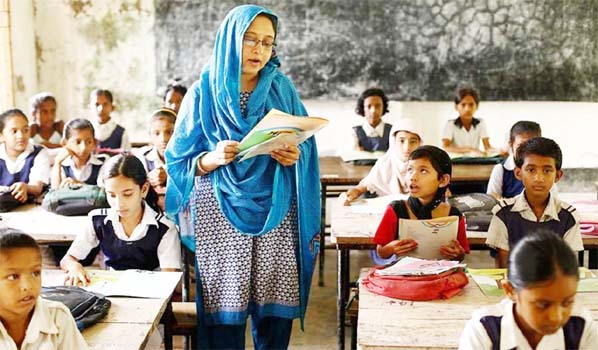
Many classrooms already exist, but too often they house undertrained teachers, outdated pedagogical methods and curricula that struggle to prepare children for a rapidly changing world.
The emphasis on infrastructure has been so dominant that it has begun to resemble a comforting ritual.
When quality lags, build more. When assessments disappoint, renovate again. The belief that walls can compensate for weak teaching is remarkably resilient.
The new projects follow this familiar pattern. Tens of thousands of classrooms are planned, along with libraries, multipurpose rooms and teachers’ rest areas in selected urban schools.
Dilapidated buildings will be renovated by 2029. All of this is necessary to some extent. No one seriously argues that children should learn in unsafe or overcrowded spaces.
But necessity does not automatically translate into sufficiency. A well-designed classroom does not teach; a teacher does.
And a teacher’s effectiveness depends on training, motivation, support and curriculum relevance, not on how recently the walls were painted.
This imbalance between hardware and software is particularly striking given Bangladesh’s fiscal reality. Financing the entire BDT 320 billion from domestic revenue places additional pressure on an already strained budget.
Revenue collection remains weak, and public expenditure demands are multiplying across health, social protection and infrastructure.
When education development relies overwhelmingly on construction-heavy projects funded by government revenue, the opportunity cost becomes unavoidable.
Money poured into cement is money not spent on teacher training, curriculum reform, classroom mentoring or assessment reform. The choice may not be explicit, but it is real.
There is also a deeper governance issue at play. Primary education in Bangladesh has long been administratively monitored but academically under-supervised.
Systems exist to count schools, classrooms and enrolment, but far fewer mechanisms rigorously track teaching quality, classroom practices or learning progression.
This creates a policy environment where success is measured by inputs rather than outcomes.
It is far easier to report how many buildings were constructed than to demonstrate how many children can read fluently or solve basic arithmetic problems.
The problem is compounded by the fragmented nature of primary education itself. Despite policy commitments to a unified system, Bangladesh continues to operate multiple curricula at the primary level.
Government schools, non-government schools, kindergartens, madrasas of different streams, NGO-run institutions, English-medium schools and Qawmi madrasas all coexist under different curricular and assessment regimes. This diversity reflects social realities, but it also undermines coherence.
A child’s learning experience depends heavily on institutional type rather than national standards.
Infrastructure projects do little to address this fragmentation. A new building does not harmonise curricula, nor does it align assessment standards across systems.
There is also the question of sustainability. Past programmes demonstrate that infrastructure-heavy investments can produce visible outputs without lasting impact on learning.
PEDP-3 succeeded in reducing dropout rates, a genuine achievement, but failed to significantly improve competencies. PEDP-4 promised a stronger focus on teaching and learning, yet by mid-implementation, learning outcomes remained stubbornly weak.
Repeating a similar approach while expecting different results would require a level of optimism that borders on faith.
None of this is to suggest that infrastructure should be abandoned. Bangladesh still has overcrowded schools, particularly in urban areas, and many rural schools remain in poor physical condition.
But infrastructure should follow pedagogy, not substitute for it. Needs-based planning requires granular data on where teacher shortages exist, where training gaps are most acute and where students are falling behind.
Only then can construction be aligned with broader educational reform rather than standing in for it.
The interim government’s formation of an advisory committee on primary education reform signals recognition of these challenges. Integrated initiatives, data-driven planning and a focus on quality rather than quantity are all steps in the right direction.
The real test, however, lies in whether these recommendations shape actual budgetary priorities. As long as the largest allocations continue to flow toward construction, scepticism will remain justified.
Bangladesh’s demographic future depends heavily on the quality of its primary education.
A workforce that struggles with basic literacy and numeracy cannot sustain ambitions of middle-income prosperity, let alone compete in a global economy increasingly defined by skills and adaptability. The tragedy is that the warning signs are not hidden.
They are documented in national assessments, visible in classrooms and acknowledged in policy discussions. What is missing is the courage to shift emphasis from what is easy to build to what is hard to improve.
In the end, the question is not whether Bangladesh should build schools. It is whether the country can finally move beyond the comforting illusion that buildings equal learning.
Until teachers are empowered, curricula modernised and academic oversight strengthened, new classrooms may continue to rise across the landscape while learning quietly stagnates inside them.
Concrete can shelter children, but it cannot teach them. That task requires investment of a different, less visible and far more demanding kind.
(The writer is an Academic, Journalist, and Political Analyst based in Dhaka, Bangladesh. Currently he teaches at IUBAT. He can be reached at [email protected])