5,000 tonnes of diesel arriving from India

Staff Reporter
Ride-sharing motorcycles can
purchase up to five litres
The government has moved to calm public anxiety over fear of fuel supplies, saying there is no shortage of petroleum products in the country despite rising tensions in the Middle East.
State Minister for Power, Energy and Mineral Resources Anindya Islam Amit said the rush at petrol pumps in recent days was largely driven by public concern over possible shortages and price hikes rather than any disruption in supply.
“There is no fuel crisis in the country. The long lines we are seeing at petrol pumps are mainly the result of public anxiety,” the state minister told the reporters at the Secretariat on Tuesday.
“Petrol and octane, which are mostly used by motorcycles and private cars, are available in adequate quantities,” he added.
The state minister further stated that the government has no plan yet to increase the prices of fuel or electricity.
Over the past couple of days, long queues were seen at petrol pumps in Dhaka and several other districts as motorists rushed to secure fuel amid fears of shortages linked to escalating tensions in the Middle East.
Due to the rush of panic buying, traffic congestion intensified in parts of the capital, including Airport Road, Rampura and Malibagh, where lines of motorcycles, private vehicles and buses stretched onto major roads.
Several filling stations temporarily halted sales after exhausting their daily allocations within hours. The situation has also affected the transport sector, with many ride-sharing drivers reporting difficulty obtaining fuel and some increasing fares to offset the disruption.
Officials, however, insist that the country’s fuel supply remains stable. “Petrol is almost entirely refined domestically, and most of the octane is also produced locally, with only a small portion imported,” Anindya Islam said.
“Our higher dependence on imports is mainly for diesel and furnace oil,” he pointed out.
To manage the sudden surge in demand, the Bangladesh Petroleum Corporation (BPC) has introduced a rationing system for fuel sales at filling stations.
Under the temporary limits, motorcycles can purchase up to two litres of petrol or octane, private cars up to 10 litres, while larger vehicles such as SUVs and microbuses are allowed between 20 and 25 litres.
Diesel allocations for buses and trucks have also been capped depending on the type of vehicle.
At the same time, the government has announced a special provision for ride-sharing motorcycles operating in metropolitan areas. These motorcycles have now been allowed to collect up to five litres of petrol or octane per day.
According to a BPC notification signed by Secretary Shahina Sultana on Tuesday, drivers must collect a purchase receipt mentioning the fuel type, quantity and price when buying fuel.
They will also have to submit a copy of the previous receipt during their next purchase, while filling stations will verify the motorcycle registration number and driver details through ride-sharing app databases before supplying fuel.
Authorities have also authorised mobile courts across the country to enforce the restrictions and prevent hoarding or black-market trading. Action will be taken against anyone selling fuel above the fixed price or illegally stockpiling it.
Meanwhile, the government is moving quickly to strengthen fuel reserves through additional imports.
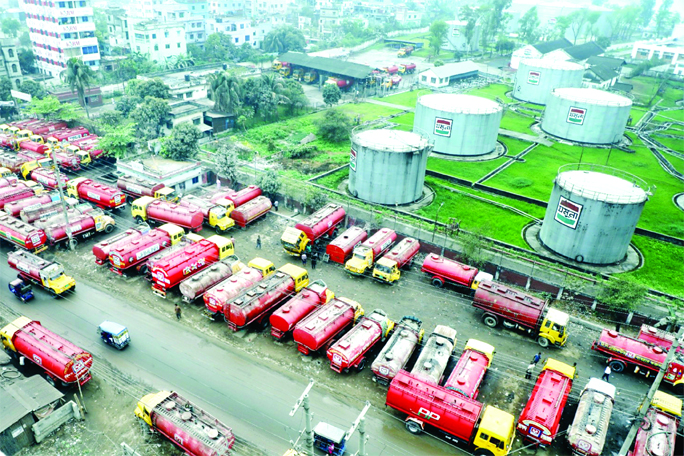
A shipment of around 5,000 tonnes of diesel from India’s Numaligarh Refinery Limited is expected to reach Bangladesh through the cross-border pipeline on Tuesday. Dhaka has also requested an additional 50,000 tonnes from India over the next four months to bolster reserves.
Earlier this week, an international tanker carrying 27,000 tonnes of diesel arrived at Chattogram Port. Another vessel is currently at the outer anchorage and unloading is expected to begin soon, while an additional tanker is scheduled to arrive on March 12.
Energy ministry said the government has also approved the purchase of 300,000 tonnes of diesel through direct procurement to speed up supply.
“To ensure a smooth Ramadan and Eid period, the government is taking all necessary measures,” the state minister said. “Fuel and electricity supplies were not disrupted in the past, and they are not under threat now.”
He acknowledged that international oil prices have recently increased, noting that Brent crude had risen to around $115 per barrel before easing to about $106.
“The global market is under pressure, which inevitably affects our economy,” he said. “However, the government is not considering any increase in fuel or electricity prices at this moment.”
To safeguard supply infrastructure amid heightened demand, the authorities have also deployed the army to guard major oil depots designated as Key Point Installations, including facilities in Chattogram’s Patenga area, Daulatpur in Khulna, Baghabari in Sirajganj, as well as depots in Narayanganj, Dinajpur and Barishal.
Officials said these measures aim to ensure stable distribution and prevent any disruption at storage and supply points while urging the public to avoid unnecessary purchases.
“People should not panic,” the state minister said. “Fuel supply remains normal, and the government is fully prepared to meet the country’s demand.”