Mosquitoes, True Beneficiaries of Climate and Chaos


H. M. Nazmul Alam :
Dhaka does not need opinion polls to measure public dissatisfaction. It needs a mosquito count.
When a city records an average of 850 mosquito bites per hour in February, up from 400 to 600 just a month earlier, it is no longer dealing with a seasonal nuisance.
It is confronting an urban verdict delivered in wings and welts.
The latest entomological findings reveal that mosquito density increased by more than 40 percent within a single month.
Ninety percent of the captured species were Culex, the mosquito that flourishes in polluted water, clogged drains and unmanaged waste.
Larval density rose from an average of 850 per 250 millilitres of sampled water in January to 1,250 in February.
These figures are disturbing, but the real discomfort lies elsewhere. Globally, five mosquito bites per hour are considered excessive. Dhaka is currently hosting 850.
There is something almost darkly comic about this contrast. We debate economic growth rates in decimals.
We celebrate infrastructure expansion in kilometres. Yet the most dramatic growth indicator in February was biological.
The mosquito population, it seems, has more coherent development planning than the city it inhabits.
Culex is not the glamorous villain of public health campaigns.
That title usually goes to Aedes because of dengue, or to Anopheles because of malaria. Culex is quieter, more unassuming, and deeply opportunistic.
It thrives in sewage, stagnant drains and neglected canals. It does not require pristine water.
It requires indifference. While diseases like Japanese encephalitis remain relatively rare in Bangladesh, the estimated mortality rate of that infection is around 25 percent.
The fact that it is not widespread should not breed complacency. It should highlight how close the margins can be when environmental conditions shift.
Why did February become so hospitable to mosquitoes. Part of the answer lies in climate variability.
January’s maximum temperature was 1.2 degrees Celsius above normal, the minimum 0.4 degrees higher and the overall average 0.8 degrees higher.
These may seem trivial deviations in a meteorological report. In the life cycle of a mosquito, they are accelerants.
Warmer temperatures speed up larval development and increase the feeding frequency of female mosquitoes.
More feeding means more protein. More protein means more eggs. The system scales itself with ruthless efficiency.
But weather alone cannot explain 850 bites per hour. Temperature creates opportunity. Urban management determines outcome.
Dhaka’s open sewers, stagnant water bodies and chronic waste mismanagement provide an uninterrupted chain of breeding grounds.
Approximately 8,000 bighas of water bodies exist within the Dhaka North City Corporation area.
A significant portion effectively functions as mosquito incubators. Even when cleaned, many quickly refill with garbage.
Fish farming in certain areas limits intervention. Open drains remain open. Waterlogging becomes semi permanent.
The mosquito does not need an invitation. It needs only consistency.
Governance gaps amplify this consistency. Without elected local representatives in city corporations, community level coordination weakens.
Bureaucratic machinery can deploy fogging drives and issue directives, but sustainable mosquito control requires neighbourhood level persuasion and accountability. Residents must prevent waste dumping.
Water bodies must be monitored continuously. Drains must be maintained beyond ceremonial cleanups.
Mosquito distribution also mirrors inequality. Peripheral and densely populated areas such as Kamrangirchar, Lalbagh, Shanir Akhra, Shyampur, Rayerbazar, Uttara and parts of Savar show higher densities. Central zones like Shahbagh and Paribagh report relatively lower counts.
This pattern is neither accidental nor mysterious. Poorer drainage, unmanaged waste and crowded living conditions provide more favourable habitats.
The mosquito exposes the geography of neglect with statistical clarity.
There is also a behavioural paradox in our response. Household defence mechanisms have intensified. Coils burn nightly.
Aerosols are sprayed liberally. Electric bats crackle in living rooms. Mosquito nets are reinforced.
Yet these are individual adaptations to a collective failure. When exposure reaches 850 bites per hour, personal protection becomes symbolic resistance.
It may reduce discomfort temporarily, but it does not alter the breeding ecosystem.
Moreover, heavy reliance on chemical repellents introduces secondary concerns. Continuous aerosol use degrades indoor air quality.
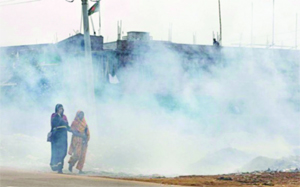
Coils emit particulate matter. Families attempt to secure their homes from insects while inadvertently inhaling pollutants.
The city thus creates a layered vulnerability where environmental neglect triggers biological proliferation, which in turn prompts chemical coping strategies.
The mosquito problem also reveals how urban policy often prioritises spectacle over maintenance. Flyovers, expressways and mega projects attract headlines.
Drainage repair and waste management rarely do. Yet civilisation is measured as much by the invisible systems beneath our feet as by the structures above our heads.
A city that cannot prevent 1,250 larvae in a cup of water will struggle to prevent broader systemic crises.
There is an almost philosophical irony here. The mosquito is fragile. It can be crushed between two fingers. Its lifespan is short. Yet collectively, it overwhelms a megacity.
The contrast is instructive. Strength is not always about size. It is about organisation and environment.
The mosquito’s environment has been curated by human inattention.
Some may argue that mosquito surges are seasonal and inevitable.
That is partly true. But seasonality does not justify extremity. Five bites per hour are considered excessive globally.
Dhaka records 850. This is not inevitability. It is amplification. It is what happens when mild climate shifts intersect with structural urban neglect.
The coming months may see further increases. Historically, Culex populations intensify from March and persist until seasonal storms disrupt breeding sites.
If February already marks a 40 percent rise from January, complacency would be less a mistake and more a decision.
Dhaka often frames its challenges in grand narratives of development and global positioning.
Yet the mosquito reduces the conversation to basics. Can the city manage its waste. Can it maintain its drains. Can it coordinate between agencies.
Can it adapt to modest temperature increases. If the answer to these questions is weak, the mosquito will continue to deliver its verdict in numbers that embarrass every speech about progress.
An average of 850 bites per hour is not merely an entomological finding. It is a civic metaphor. It tells us that neglect accumulates quietly until it hums loudly in our ears.
It reminds us that climate change is not an abstract coastal threat but an urban multiplier. It exposes how governance gaps translate into biological consequences.
The mosquito does not threaten Dhaka’s skyline. It threatens its comfort, productivity and public health.
It interrupts sleep, irritates skin and amplifies disease risk. It forces families into chemical defence routines.
It chips away at quality of life in ways too mundane for headlines yet too persistent to ignore.
The real challenge lies in whether the city chooses maintenance over rhetoric, coordination over ceremony and prevention over reaction.
Until then, the arithmetic remains humiliatingly simple. Five bites per hour are excessive. Eight hundred and fifty is a confession.
(The writer is an Academic, Journalist, and Political Analyst based in Dhaka, Bangladesh. Currently he teaches at IUBAT. He can be reached at [email protected])