Vote will shape next 50 yrs: Fouzul

Staff Reporter :
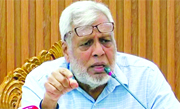
Bangladesh’s forthcoming national election and referendum will determine the country’s direction for the next half century, not merely the next five years, Muhammad Fouzul Kabir Khan, adviser to the Ministry of Power, Energy and Mineral Resources and the Ministry of Road Transport, Bridges and Railways, said on Friday, underscoring the high stakes attached to the February vote.
“This election is not only about forming a government,” Mr. Khan said. “Because there is also a referendum, the decision will shape the country’s destiny for the next 50 years.”
He was speaking at a public gathering at Gor-e-Shahid Boro Maidan in Dinajpur, where officials organized an awareness program ahead of the 13th Jatiya Sangsad election and the nationwide referendum. Mr. Khan sought to distinguish the coming polls from previous national contests, noting that they are being held under an interim administration rather than a political government.
“All previous elections were conducted under political governments. This one is being conducted under an interim government,” he said. “We do not belong to any political party.
We are a government for everyone. We will not take sides for or against anyone. With the collective efforts of all of you, a credible election will be held, and those who are truly deserving will be elected as public representatives.”
Turning to the referendum, the adviser said voters would be asked to respond to four questions that have been presented as a single package. Casting a “yes” vote, he said, would signal support for reform, while a “no” vote would reject it. “If ‘yes’ wins, various reforms will be implemented,” he told the crowd.
Mr. Khan framed the election as a test of popular sovereignty, repeatedly emphasizing the centrality of free choice. “The most powerful force in this country is the people,” he said. “The day to demonstrate that power is February 12.”
Referring to last year’s mass uprising, he said it erupted because citizens were unable to vote freely and see their preferred candidates elected. “The February election will be entirely different,” he said.
“Whoever you wish to elect—regardless of party, religion, race or community—we want to see that person declared the winner.”
To that end, he added, instructions have already been issued to deputy commissioners and superintendents of police to ensure that voters can cast their ballots freely and without obstruction.
Several senior officials also addressed the event, including Abdul Jalil, deputy director of the Ministry of Information and Broadcasting; Rafiqul Islam, deputy commissioner of Dinajpur; and Riaz Uddin, additional deputy commissioner (general).
Among those present were Rezanur Rahman, chairman of the Bangladesh Oil, Gas and Mineral Resources Corporation; Abdul Jalil, director general of the Department of Mass Communication; and Enamul Ahsan, deputy commissioner of Rangpur.
With the interim government promising neutrality and the referendum set to accompany the parliamentary race, the coming weeks are expected to intensify political mobilization and public debate over both the credibility of the process and the substance of the proposed reforms.