Pulse Prices Drop: Sugar, soybean oil spike
Esrat Jahan Maria :
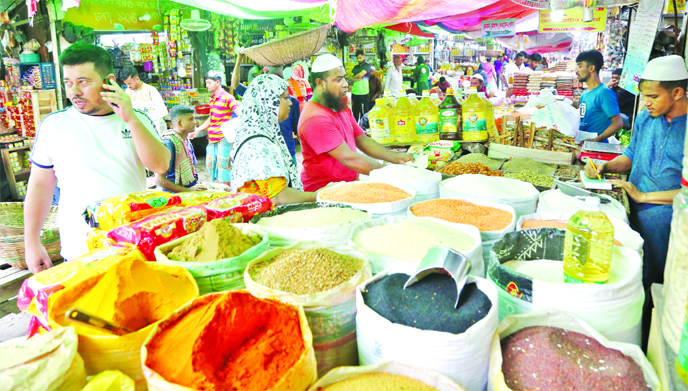
With Ramadan approaching, price fluctuations have begun to emerge in the market for essential commodities. At the start of the New Year, the prices of pulses – widely consumed during the fasting month – have declined, while the cost of edible oil and sugar continues to rise.
Traders attribute the fall in prices of chickpeas, peas and Australian masoor (red lentils) to sufficient stock and increased imports. They say there is little scope for prices of these items to rise before Ramadan.
In contrast, sugar and edible oil prices are climbing, which traders allege is the result of manipulation by mill syndicates. Millers, however, claim a shortage of Letters of Credit (LCs) has limited access to raw sugar, constraining production and reducing supply.
The Consumer Association of Bangladesh (CAB) has warned that some traders may be attempting to destabilise the market ahead of the national elections and urged the authorities to step up monitoring before Ramadan.
Demand for essential food items traditionally rises ahead of the fasting month. Chickpeas are a staple for iftar meals, peas are used in popular snacks such as pakoras and chotpoti, and masoor dal is a regular feature on dinner tables. As a result, their prices typically surge during this period.
This year, however, the trend is mixed. While pulse prices are lower than last year, the prices of sugar and edible oil have started to increase.
A market survey on Thursday in Chattogram’s Khatunganj wholesale hub shows that all pulses available are imported. Peas, mainly sourced from Canada and Ukraine and known locally as “anchor peas”, are currently selling for Tk 44.50 per kg, compared to Tk 65-70 per kg during last year’s Ramadan.
Good-quality Australian chickpeas are being sold at Tk 74-75 per kg in Khatunganj, a significant drop from Tk 105-110 per kg last year. Australian masoor dal prices have also fallen, from Tk 95 per kg last year to Tk 73-75 per kg this year. In contrast, Indian masoor dal prices have risen sharply, climbing to Tk 155 per kg from Tk 115 a year earlier.
Mohiuddin, General Secretary of the Chaktai-Khatunganj Aratdar Samiti, said: “During Ramadan, the demand for pulses – especially chickpeas and masoor – is high. This year, there is sufficient stock and new imports are arriving. Prices have therefore decreased, and there is no scope for them to rise before Ramadan.”
He added that some profit-driven traders are taking advantage of the government’s focus on the upcoming elections to destabilise the market. CAB divisional president SM Nazer Hossain echoed this, urging the authorities to strengthen monitoring. He noted that the government’s imposition of a 2 per cent supplementary duty on imported essentials has pushed up prices by Tk 2 per kg.
Traders say last year’s higher level of masoor imports has left a surplus that is now helping keep prices down. Australian masoor is currently selling at Tk 73 per kg wholesale, compared to Tk 95 last year, while peas are selling at Tk 45 per kg, down from Tk 65-70 during last year’s Ramadan. Indian masoor, however, remains expensive.
Sugar prices in Khatunganj have been rising over recent weeks. Millers say several factories are unable to refine sugar due to a shortage of raw sugar. On Thursday, ready sugar was selling for Tk 3,540 per maund (about 37 kg), up from Tk 3,410 a week earlier and Tk 3,210 in November.
Mohiuddin said: “Sugar prices are rising because five mills are controlling the market. The government has no control over this. Allowing sugar imports would break the millers’ syndicate.”
Shahidul Alam, owner of RM Enterprise, said two major mills are not supplying sugar at present. “We hope supply will normalise within two weeks,” he said.
City Group, one of the largest players in the sugar and edible oil markets, currently has no sugar supply. “We have no sugar in stock. We hope to supply again next week,” said Pradip Karan, the group’s Chattogram sales head.
Soybean oil prices have also increased over the past month. Household demand for soybean oil is higher during winter, as palm oil becomes cloudy in lower temperatures. In Khatunganj, soybean oil was selling at Tk 6,800 per maund in December. Prices have since increased by Tk 70-80. On Thursday, TK Group’s Be-Fishing brand sold for Tk 6,870, Abul Khayer Group’s Butterfly brand for Tk 6,880, and City Soybean for Tk 6,910.
Rafiqul Alam of MK Trading said: “Sugar prices are rising mainly due to non-supply from two mills. Once they resume operations, the sugar market will stabilise. Although palm oil becomes cloudy in winter, soybean oil prices have remained stable for the past two weeks.”
According to the Trading Corporation of Bangladesh (TCB), retail prices of loose soybean oil on Thursday ranged between Tk 174 and Tk 185 per kg, compared to Tk 170-180 per kg last year. Sugar was selling for Tk 100-115 per kg, up from Tk 90-100 last year. Chickpeas were priced at Tk 80-95 per kg, down from Tk 95-110, while peas were selling for Tk 50-65 per kg, compared to Tk 50-75 a year earlier. Medium-grade masoor dal was selling for Tk 110-130 per kg, compared to Tk 115-150 last year.
CAB has reiterated its call for intensified monitoring of essential commodity markets ahead of Ramadan to prevent price manipulation and ensure relief for consumers.