Ishwardi Boro rice seedbeds spoiled
Pabna Correspondent :
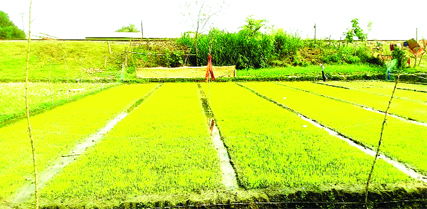
Boro rice seedbeds in Ishwardi are being severely affected by continuous dense fog and a cold wave. According to the Agriculture Department, when temperatures fall below 18 degrees Celsius, seedbeds of boro and almost all other crops become vulnerable to damage. Since the beginning of the Bengali month of Poush, temperatures in Ishwardi have been dropping to alarmingly low levels.
On Wednesday (23 Poush), the minimum temperature in Ishwardi was recorded at 7.3 degrees Celsius, whereas it was 13.8 degrees at the beginning of Poush. Under these conditions, tender boro rice seedlings are losing their deep green color and gradually becoming shriveled and yellowish due to the combined impact of the cold wave and dense fog.
According to the Agriculture Office, the target for this season was to prepare boro rice seedbeds on 45 hectares of land in Ishwardi. However, due to persistent fog and falling temperatures, seedbeds have so far been prepared on only 18 hectares. Seedlings could not be planted on the remaining land. Even among the prepared seedbeds, a large portion has been damaged by the cold wave. If this situation continues for another week, the seedlings will become unsuitable for transplantation.
Farmers say that despite taking extra care, they are unable to prevent the seedlings from turning yellow. The Agriculture Department has advised covering the seedbeds, shaking off accumulated fog from the seedlings every morning, ensuring regular irrigation, and applying fungicides as needed.
Sources from the Ishwardi Meteorological Office said that the area has been experiencing intense cold and dense fog continuously for the past 15 days. During this period, the minimum temperature has fluctuated between 11 degrees and as low as 7.3 degrees Celsius.
A moderate cold wave is currently sweeping over the area. On December 16 (1 Poush), the minimum temperature was 13.8 degrees Celsius. It dropped to 10 degrees on December 26, and a mild cold wave began on December 31 when the temperature fell to 9.2 degrees Celsius. Since early January, temperatures have continued to decline. On Wednesday (January 7), the season’s lowest minimum temperature of 7.3 degrees Celsius was recorded.
Due to this situation, farmers are facing severe hardship not only with boro rice seedbeds but also in their daily lives and in caring for livestock.
Farmer Adam Ali of Umirpur village said, “The seedlings are turning yellow even before they become suitable for transplantation. There is no way to protect them from the effects of the fog.”
Ishwardi Upazila Agriculture Officer, Agriculturist Abdul Momin, said that seedbeds suffer serious damage when temperatures fall below 18 degrees Celsius. “In Ishwardi, the temperature has dropped to as low as 7.3 degrees,” he said. “Out of the targeted 45 hectares, boro rice seedlings have so far been prepared on only 18 hectares. To protect the seedbeds, farmers are being advised to irrigate regularly, remove fog from the seedlings, apply sulfur-based fungicides, and cover the seedbeds with white polythene sheets at night.”