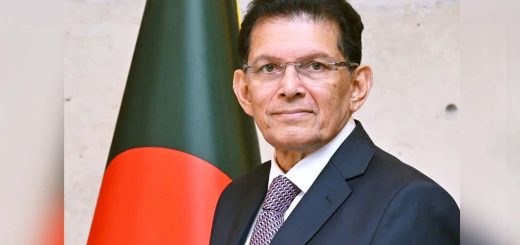
India, Pakistan leaders exchange greetings at Khaleda’s janaza

Diplomatic Correspondent :
Amid the diplomatic strained relations, senior leaders from India and Pakistan exchanged greetings in Dhaka on Wednesday while attending the state funeral of former Bangladesh prime minister and BNP chairperson Begum Khaleda Zia.
Speaker of Pakistan’s National Assembly Sardar Ayaz Sadiq and Indian External Affairs Minister S Jaishankar met ahead of the Namaj-e-Janaza of the three-time former Prime Minister Khaleda Zia, marking an unusual show of civility at a time when relations among Bangladesh, India and Pakistan remain tense.
Both leaders arrived in Dhaka on Wednesday morning to represent their respective governments at the funeral of Khaleda Zia, a veteran political figure widely regarded as a central force in Bangladesh’s democratic journey.
Before the funeral prayers, Sadiq and Jaishankar separately conveyed condolence messages to BNP Acting Chairperson Tarique Rahman, expressing their countries’ respect for Khaleda Zia and her political legacy.
Their presence carried added significance as Bangladesh is currently being run by an interim government led by Nobel laureate Dr Muhammad Yunus, following the fall of the Sheikh Hasina government.
Regional relations have been under severe strain in recent months, exacerbated by domestic unrest and cross-border tensions.
Relations between Dhaka and New Delhi deteriorated after a series of violent incidents, including the killing of Sharif Osman Hadi and the lynching of a Hindu man in Mymensingh.
The situation escalated further with attacks on the Bangladesh High Commission in Delhi and protests in Dhaka, where demonstrators marched toward the Indian High Commission.
Both countries summoned each other’s envoys, while protests, demonstrations and the suspension of visa issuance pushed bilateral ties to a boiling point. Despite the change in government, relations between Bangladesh
and India have yet to show signs of recovery. At the same time, ties involving Pakistan have also remained fraught, particularly following the recent India-Pakistan military confrontation over the Pahalgam incident.
Against this tense backdrop, the brief exchange of greetings between the Indian and Pakistani leaders in Dhaka stood out as a rare and symbolic gesture.
Observers see the moment as a reminder that even amid deep political and diplomatic rifts, shared respect on humanitarian occasions can still open space for civility in South Asia’s often volatile regional politics.