Shooting of Hadi sparks fears of election sabotage

Abu Jakir :
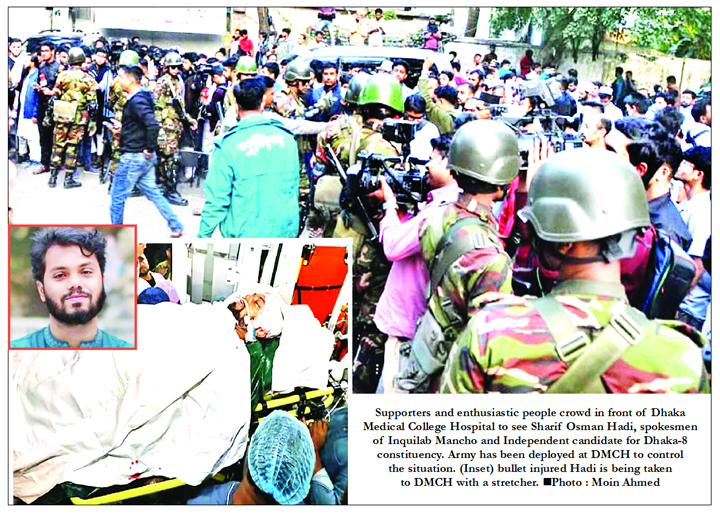
The shooting of Dhaka-8 aspiring independent candidate and Inqilab Moncho spokesperson Sharif Osman Hadi — less than 24 hours after the announcement of the national election schedule — has triggered a wave of alarm across Bangladesh’s political spectrum, deepening fears that destabilising forces are attempting to derail the February polls.
Hadi, who was shot in the head by unidentified assailants at Bijoynagar’s Box Culvert Road on Friday afternoon, is now fighting for his life in Evercare Hospital in the city.
Police have termed the attack a “target killing,” warning that a group intent on creating an anarchic pre-election atmosphere may be behind it.
Shafiqul Islam, chief of the Detective Branch of Dhaka Metropolitan Police, told this correspondent that the assault appeared to be “part of a broader plan to sow chaos ahead of the polls.”
Investigators, he added, are examining whether elements of the “fascist forces” removed from power after the July uprising played a role.
A Surge of Political Condemnation
The attack has sparked sharp reactions, particularly from parties that emerged as key actors during and after the July uprising.
BNP’s acting Chairman Tarique Rahman, speaking at a discussion in Dhaka on Friday, condemned the shooting as “a conspiracy against democracy.”
Referring to previous attacks on opposition hopefuls — including the recent shooting of BNP candidate Ershadullah in Chattogram — he said: “Such incidents are part of a larger plot. What happened today to Sharif Osman bin Hadi is not isolated.”
BNP Secretary General Mirza Fakhrul Islam Alamgir echoed this fear, calling the shooting an “ominous sign” just a day after the election schedule was announced.
“I see a dark warning,” he said. “Those forces that want to sabotage the election have started their conspiracy again.”
BNP has announced demonstrations nationwide for Saturday, demanding the arrest of those responsible.
Senior Joint Secretary General Ruhul Kabir Rizvi accused “blueprint actors” of trying to destroy the electoral environment.
“A free and fair election is being targeted. Hadi was shot as part of that wider plan,” he said.
Interim Government Vows Firm Action Chief Adviser’s Press Secretary Shafiqul Alam dismissed the notion that the polls could be derailed.
Speaking to journalists in Shariatpur, he said, “No force on earth can obstruct the upcoming national election.” The “fallen autocratic quarters,” he warned, may attempt disruption, “but they will not succeed.”
He argued that citizens, having been deprived of “proper elections for the last 15 and half years under the ousted Hasina government,” are now eager for a credible vote.
In a separate statement issued late Friday, Chief Adviser Professor Muhammad Yunus expressed “deep concern” over the shooting, calling such violence “absolutely unacceptable in an electoral environment.”
He ordered authorities to ensure the highest level of medical care for Hadi and instructed the health ministry to closely monitor his treatment.
Concerns from Student Leaders and Uprising Activists Md Abu Shadik Kayem, Vice President of DUCSU and a prominent figure in the July uprising, described the assault as an “ominous signal” for the electoral process.
In a Facebook post, he warned that “fallen fascists” and their allies — both domestic and foreign — were working to impede the vote. He urged the interim administration to swiftly reveal any political motive behind the attack.
Gono Odhikar Parishad General Secretary Rashed Khan, speaking at an election street rally in Jhenaidah, claimed that a list of around 50 potential candidates had reportedly been marked for targeted killings. “This is part of a plan to sabotage the election,” he alleged.
Khan also insisted that the government bears the responsibility for ensuring the safety of all candidates.
Statements of concern poured in from across the political spectrum.
Jamaat-e-Islami Ameer Dr Shafiqur Rahman said any violence driven by political rivalry is “never acceptable,” calling for a “quick, impartial, transparent probe.”
Nahid Islam, convener of the National Citizen Party (NCP), accused the interim government of failing to ensure public safety, saying it has “consistently taken a weak stance” on protecting citizens.
His remarks came after the broad-daylight shooting of Sharif Osman Hadi, the Dhaka-8 aspiring candidate and spokesperson of Inqilab Moncho, who was attacked by unidentified assailants in Paltan earlier in the day.
Speaking at Dhaka Medical College Hospital, Nahid warned that if the government cannot provide security or bring the perpetrators to justice, “we will have to take action against them.” He also voiced concern over rising threats against political activists and urged the authorities to respond swiftly.
NCP Member Secretary Akhter Hossen, speaking to the media, said the attack “reflects a deteriorating law and order situation.”
He accused the authorities of failing to act on threats faced by leaders of the July uprising: “We demand the immediate arrest of those responsible.”
BNP’s Fakhrul, in a Facebook post, wrote: “No matter our beliefs, anyone who uses fear or force must be rejected.” He extended prayers for Hadi’s recovery.
A Test for the February Polls
The shooting has heightened anxieties at a moment when the country stands at a critical political juncture.
Supporters of the democratic transition warn that destabilising forces — particularly those displaced from power — may attempt to plunge the country into unrest to delegitimise or disrupt the election.
While investigation into the attack continues, Friday’s events have underscored the fragility of the pre-poll environment, raising urgent questions about the safety of candidates, the neutrality of law enforcement, and the capacity of the interim government to deliver the participatory and peaceful election it has promised.
For now, Bangladesh waits anxiously—watching whether the Hadi shooting becomes an isolated tragedy or the first tremor in a more dangerous pre-election pattern.