Economic recovery on track
Staff Reporter :
Finance Affairs Adviser Salehuddin Ahmed on Tuesday likened Bangladesh’s economic recovery to a patient’s gradual improvement, saying it had moved “from the Intensive Care Unit (ICU) last year to the High Dependency Unit (HDU) now.”
Speaking at a press conference at the Secretariat, he elaborated on the analogy: “For a country like ours, the economy will not move directly to a private cabin – it will first progress to a paying bed or ward before eventually returning home.” He expressed optimism that by January next year, the economy would be in a “ward-level” condition.
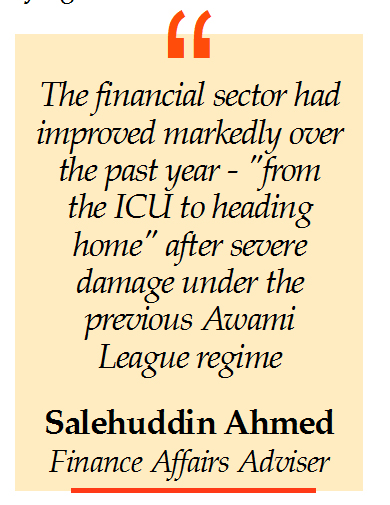
On 4 August, the adviser had made a similar comparison, noting that the financial sector had improved markedly over the past year – “from the ICU to heading home” – after what he described as severe damage under the previous Awami League government. He said the past year had seen the sector “pulled back from the brink” and placed on a “path towards stability.”
While acknowledging that “complete restructuring” is still underway, he said the government aims to finalise key reforms by December. “With elections due in February, reforms will continue until January. We have also advised political leaders that creating obstacles would ultimately damage their own future governments,” he said.
Responding to comments by Bangladesh Bank Governor Ahsan H Mansur on bank restructuring, Mr Ahmed – who described the governor as “my student” – cautioned against publicly naming banks to avoid deposit withdrawals. He confirmed that merger discussions are ongoing, with some resistance, but assured depositors that “no one will lose their money.”
Regarding budget allocations and timelines for restructuring, he said funds have been set aside but the amounts cannot yet be disclosed. An internal plan is already in place, he added.
The adviser also flagged the precarious condition of many of the country’s 35 non-bank financial institutions (NBFIs), some of which have failed to return depositors’ funds.
He cited the case of PK Halder, accused of misappropriating large sums from NBFIs, and said the central bank has been instructed to assess outstanding liabilities and arrange repayment plans, with government support if necessary.
He acknowledged that some banks are still struggling to return deposits. “One bank received a substantial sum specifically for repayments but has yet to disburse the funds. We will investigate where that money went,” he said.
Mr Ahmed stressed that rebuilding private sector confidence remains a key challenge, with much depending on the economic policies of the incoming government after the February polls.
“Uncertainty over future policy keeps businesses cautious. Compared with a few months ago, when they were very vocal, business leaders are now more reserved,” he observed.
He added that no economy in the world offers complete certainty, pointing to high global volatility and remarking that “Donald Trump is probably the biggest source of it.”
Reviewing the past year, the adviser described the economy as “reasonably stable and satisfactory,” citing lower inflation, signs of stability in the banking sector, and improvements in the balance of payments, exchange rate, and foreign reserves. “We have not achieved everything, but the direction is positive,” he concluded.