Global debt to IMF drops

Farrukh Khosru :
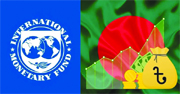
As of 25 February 2025, the total global outstanding debt owed to the International Monetary Fund (IMF) stood at $144.9 billion, or 110.3 billion Special Drawing Rights (SDRs), reflecting a slight decline from the 112.8 billion SDRs recorded at the end of February 2024.
This dollar valuation was derived using IMF data on the SDR’s value as of 25 February 2025, which stood at $1.314, down from $1.328 a year earlier. The SDR serves as the IMF’s unit of account to determine the value of financial support extended to its member states, based on market exchange rates.
Despite 93 countries being indebted to the IMF, the ten largest debtors collectively account for over two-thirds (69.3 per cent) of the total outstanding balance. Yemen has now exited the list of IMF debtors, having previously owed $6.4 million in fDi’s (fdiintelligence.com) last update in April 2024.
Argentina remains the IMF’s largest debtor, with an outstanding balance of $40.9 billion -approximately $2 billion less than a year ago – signalling a shift in the country’s long and fraught relationship with the Fund. At the turn of the century, the IMF provided Argentina with an $88.3 billion bailout to rescue its struggling economy.
Despite political turmoil and public dissatisfaction, then-President Néstor Kirchner repaid the debt in full by 2006. However, in 2018, President Mauricio Macri secured a record-breaking $50 billion bailout from the IMF, only for Argentina to require a further $44 billion loan in 2022.
Under the leadership of libertarian President Javier Milei, who assumed office in 2023, Argentina’s economic outlook has improved, earning praise from the IMF. His government is currently in discussions regarding a potential new IMF loan this year.
Ukraine has surpassed Egypt to become the IMF’s second-largest debtor, with its outstanding balance rising to $14.6 billion from approximately $12 billion a year ago, reflecting increased international financial support for the war-torn nation.
In December 2024, the IMF disbursed $1.1 billion (834.9 million SDRs) to Ukraine as part of a $15.5 billion programme agreed upon in March 2023, nearly a year after Russia launched its full-scale invasion. This financing forms part of a broader $148 billion international support package, marking the first instance of the Fund extending significant conventional financial aid to a country engaged in full-scale conflict.
Egypt is the third-largest debtor, with an outstanding balance of $10.7 billion, down from $14.9 billion in April 2024. The country’s economic struggles stem from the 2011 revolution and declining revenues from the Suez Canal, prompting the government to secure a $12 billion IMF loan in 2016. Subsequent loans of $2.72 billion and $5.2 billion were approved in 2020 to mitigate the economic impact of the Covid-19 pandemic.
In December 2024, Egypt reached a staff-level agreement with the IMF to unlock approximately $1.2 billion in funding. At the time of writing, the deal awaited IMF board approval, but it signals progress in the country’s financial reforms.
Ecuador now ranks as the fourth-largest debtor, having overtaken Pakistan since fDi’s last assessment. The Latin American nation owed approximately $8.6 billion to the IMF as of February 2025, up from around $7.7 billion in April 2024. In December 2024, the IMF disbursed about $500 million to Ecuador as part of a $4 billion loan programme approved in May.
Pakistan is the IMF’s fifth-largest debtor, with an outstanding balance of $8.3 billion, up from approximately $7.7 billion a year earlier. In September 2024, the IMF approved a $7 billion loan for Pakistan, immediately disbursing around $1 billion following economic stabilisation efforts and a rebound in growth.
Bangladesh is the other South Asian country featured among the top ten IMF debtors, with an outstanding balance of $2.69 billion. The nation has a long history with the IMF, having first received a loan in 1980.
Student-led protests in 2024 led to the ousting of long-serving Prime Minister Sheikh Hasina. The IMF projected real GDP growth to slow to 3.8 per cent in the 2025 fiscal year due to economic disruptions caused by the protests, floods, and tighter fiscal policies.
The remaining four spots in the top ten debtors list are occupied by Sub-Saharan African economies: Kenya, Angola, Ivory Coast, and Ghana. Each of these nations received IMF support during the Covid-19 pandemic in 2020.
In October 2024, the IMF forecasted that economic growth in Sub-Saharan Africa would rise to 4.2 per cent in 2025, up from an average of 3.6 per cent over the previous two years. However, the economic outlook remains mixed across the diverse region of 48 economies.