SME lending hits four-year low amid economic uncertainty

Staff Reporter :
Banks’ lending to small and medium-sized enterprises (SMEs) has dropped to a four-year low, halting the upward trend in loan disbursements as political uncertainty and an economic slowdown dampen entrepreneurs’ borrowing appetite.
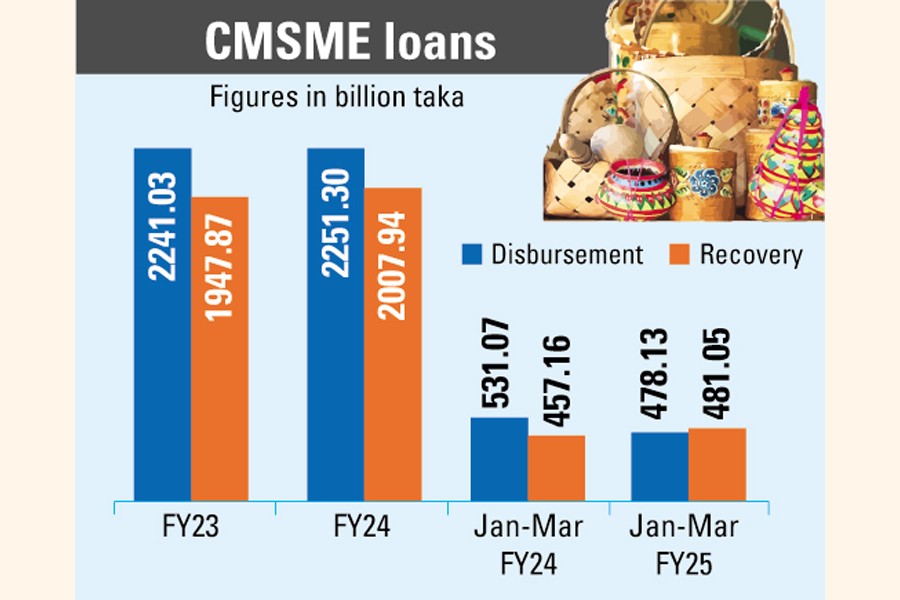
During fiscal year 2024-25, banks disbursed Tk 2.05 lakh crore in SME loans, down 9 percent from the previous year, according to Bangladesh Bank (BB) data.
“Businesses do not want to invest in times of uncertainty. Right now, firms are focused on survival, not expansion,” said Syed Abdul Momen, additional managing director and head of SME Banking at BRAC Bank PLC, one of the country’s leading SME financiers.
SMEs, which include around 78 lakh cottage, micro, small, and medium enterprises, are considered the backbone of Bangladesh’s industrial sector and contribute roughly one-fourth of the country’s GDP.
Lending to SMEs had been steadily growing since 2021, following a dip in 2020 when Covid-19 restrictions hit small businesses hard. “Since Covid, the war in Ukraine, and the political unrest and mass uprising last year, businesses have not had any respite,” said Kamrul Mehedi, deputy managing director and head of SME and Agent Banking at City Bank PLC.
“Small businesses, in particular, have low resilience and are vulnerable to shocks. Nearly one-fourth of them have shut down since the pandemic.” He added that many previously financed small businesses are not returning for new loans.
Bankers attribute the weak loan demand not only to political uncertainty, slow economic growth, and high inflation but also to the fragility of nearly a dozen banks, which has limited credit availability for small and micro businesses.
Outstanding SME loans stood at Tk 3.10 lakh crore as of June 2025, slightly up from a year earlier.
“Some banks have collapsed due to loan irregularities and are barely active now,” said Syed Mahbubur Rahman, managing director and CEO of Mutual Trust Bank PLC.
“Around 10–12 banks, including several shariah-based ones, were once active in SME financing but are no longer participating.”
Salekeen Ibrahim, executive vice president of Eastern Bank PLC, said SME loan disbursement has reached its lowest point in recent years, reflecting the challenging economic climate.
“Tight liquidity and high non-performing loans (NPLs) are major obstacles. Many banks face capital shortages and rising bad loans, making them risk-averse. Private sector confidence remains weak, and uncertainty continues to delay new business plans and expansions,” he added.
Despite the current slowdown, bankers remain optimistic that both loan demand and disbursements will recover after the national election scheduled for February next year.
“Businesses will regain confidence after the election. The economy usually sees a surge when a political government comes to power following polls,” said Momen.