



Wage deal fails to calm RMG unrest

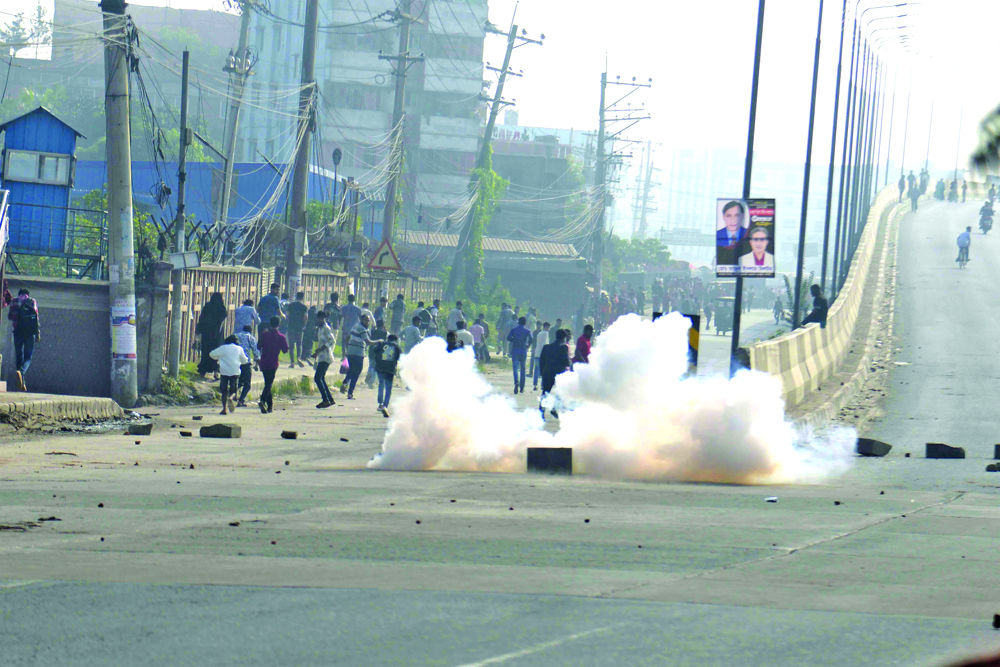
The Minimum Wage Board’s decision to raise the lowest monthly salary of garment workers to Tk17,000 has failed to calm industrial unrest, with protesters continuing to demand Tk30,000, block highways and disrupt production in Gazipur, Savar and Ashulia.
The continuing demonstrations have raised fresh concerns over stability in the country’s export-oriented garment industry, as factory closures, work stoppages and clashes with law enforcement agencies persist despite the government’s announcement of a revised wage structure.
On Wednesday morning, groups of workers blocked roads in parts of Gazipur and Hemayetpur. Police used tear gas and sound grenades to disperse the protesters, while a factory was attacked and vandalised during the unrest.
At least 10 police and Ansar personnel were injured by bricks thrown by workers.
At least 20 factories in Gazipur declared holidays amid the tension. Vehicles remained stranded on several sections of the Dhaka-Tangail Highway until around 11:30am, although traffic later returned to normal. Blockades were also reported on the Dhaka-Mymensingh Highway, causing long tailbacks and suffering for passengers and drivers. Several vehicles were vandalised.
Gazipur Industrial Police Superintendent Amjad Hossain said workers had launched demonstrations in several areas from the morning, adding that police dispersed protesters with tear gas in some locations.
Mohammad Mominul Islam Bhuiyan, superintendent of police of Ashulia Industrial Police-1, said 22 factories in Savar and Ashulia had been closed under Section 13(1) of the Labour Act.
Workers at another 10 factories had stopped work, while general holidays were declared at 10 factories. Two more factories were closed for other reasons.
Meanwhile, Home Minister Salahuddin Ahmed said the minimum wage had been determined democratically through the wage board, with the consent of representatives of both employers and workers.
He said genuine workers and factory owners were satisfied with the decision, while those spreading rumours and creating disorder in industrial areas were not genuine workers. He alleged that a particular quarter was trying to exploit the issue for political purposes.
Law enforcement agencies were handling the situation patiently, he said, adding that those instigating unrest from behind the scenes were under investigation.
Labour and Employment Minister Ariful Haque Chowdhury said the government had introduced several reforms for workers’ welfare, including amendments to the Labour Act that reduced the interval for minimum wage reviews from five years to three.
He said the three-year review mechanism would help workers maintain financial security and adjust to rising living costs.
The minister also said the Prime Minister had pledged to establish specialised hospitals in seven industrial areas-Tongi, Ashulia, Kaliakoir, Narayanganj, Savar, Bhaluka and Chattogram-to improve workers’ access to healthcare. The foundation stone for the hospital in Tongi is expected to be laid by December 15.
Wage decision
The unrest continued despite the Minimum Wage Board’s decision, reached through a majority vote after nearly 14 hours of negotiations, to raise the lowest monthly wage from Tk12,500 to Tk17,000.
The decision was taken at the board’s fourth meeting, which began at 3:15pm on Tuesday at its Segunbagicha office and ended at around 1:30am on Wednesday.
Of the six board members, four voted in favour of the Tk17,000 minimum wage, while the two workers’ representatives supported Tk18,000. Board Chairman Syed Azad Subhani announced the revised structure, saying the agreement followed lengthy discussions between employers and workers.
Under the new structure, Grade 4 helpers, thread cutters and line assistants will receive Tk17,000 a month. Grade 3 junior operators, experienced helpers, folders, packers, tagging workers and sewing assistants will get Tk19,200.
Grade 2 sewing, cutting, finishing and quality control operators will receive Tk20,000, while Grade 1 senior operators, pattern makers, sample makers, screen printers and senior dyeing operators will earn Tk21,500.
Workers currently earning above the revised minimum will receive an adjustment of at least Tk2,000, according to the board chairman. Employers may offer higher increases depending on their financial capacity.
Subhani said the new wage structure had been finalised within 20 days of the board’s formation, describing the process as an achievement following prolonged negotiations. The structure will be sent for publication in the official gazette.
The new rates will take effect from December, with payments reflecting the revised wages expected from January.
The government reconstituted the Minimum Wage Board on November 1 amid mounting demands for higher salaries.
Workers initially proposed a minimum wage of Tk30,000 to Tk32,000 before revising their demand to Tk18,000. Employers, meanwhile, raised their offer from Tk15,700 to Tk17,000.
The latest unrest follows nearly a month of industrial disruption that has affected production and reportedly diverted some export orders to competing countries.