


50th Death Anniv Bhashani remembered for lifelong fight for people’s rights

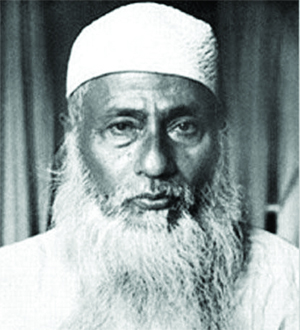
The 50th death anniversary of Maulana Abdul Hamid Khan Bhashani, a lifelong campaigner for the rights of exploited, deprived and underprivileged people, is being observed on Tuesday.
Various political and social organisations have taken programmes to mark the occasion, including placing wreaths at his grave in Santosh, Tangail, holding doa mahfils and organising discussions.
Maulana Bhashani Science and Technology University has also arranged various programmes to observe the anniversary.
Born on December 12, 1880, in Dhangara village of Sirajganj, Bhashani was the son of Sharafat Ali Khan and Mosammat Majiron Bibi.
He received religious education in his early years and later studied at Deoband in India. However, his political outlook extended far beyond religious studies. His concern over social injustice, class discrimination and the suffering of ordinary people drew him into political and social movements.
From the anti-British struggle to the movement against Pakistani rule and exploitation, and later the struggle for Bangladesh’s independence, Bhashani remained a prominent voice for the rights of the common people.
His political philosophy centred on human rights, social justice and economic equality. He believed independence should bring not only national sovereignty but also economic and social freedom for ordinary citizens.
Bhashani’s political strength came largely from his close ties with farmers, labourers, landless people and the poor. He consistently placed their demands and struggles at the centre of his political activities.
During British rule, he participated in the Khilafat and Non-Cooperation movements and campaigned against zamindari exploitation, feudalism and oppression of peasants.
He also played a significant role in defending the rights of Bengali farmers in Assam, particularly their access to land, shelter and livelihoods. His leadership in the movement against the ‘Line System’ in Assam earned him widespread recognition. His activities in the Bhasan Char region also contributed to the origin of the name ‘Bhashani’.
After the creation of Pakistan in 1947, he emerged as a leading figure in the movement for the political, economic and cultural rights of people in East Pakistan.
On June 23, 1949, he was elected the first president of the Awami Muslim League, founded at Rose Garden in Dhaka. He strongly opposed the discriminatory policies and economic exploitation of the Pakistani ruling class and spoke out against the suppression of the political rights of people in East Pakistan.
He also supported the Bengali language movement and the growing demand for national rights.
Bhashani played an important role in forming the United Front (Jukta Front), which contested the Muslim League in the 1954 provincial elections.
The alliance’s landslide victory became a major expression of public support for greater autonomy and political rights in East Pakistan.
Another significant chapter in his political life was the Kagmari Conference in Santosh, Tangail, in 1957.
There, he protested against economic disparities between the two wings of Pakistan and the dominance of the West Pakistani ruling elite. His historic utterance of ‘Assalamu Alaikum’ at the conference was widely interpreted as a warning of a possible political separation of East Bengal.
In the same year, he founded the National Awami Party (NAP), continuing his campaign against imperialism, feudalism and exploitation.
His political beliefs combined religious values with social justice, equality and the struggle for the emancipation of oppressed people. His followers consequently came to know him as the ‘Red Maulana’.
During Ayub Khan’s military rule, Bhashani led movements demanding democracy and autonomy. He also supported the mass uprising of 1969 against military rule, standing alongside students and the general public.
He regarded voting rights, democracy and economic emancipation as essential conditions for genuine freedom. When the Liberation War began in 1971, he firmly supported Bangladesh’s independence.
During the war, he helped mobilise international public opinion against the genocide and atrocities committed by Pakistani forces. While staying in India, he was associated with the advisory council of Bangladesh’s government-in-exile.
He returned to Bangladesh on January 22, 1972, after independence and resumed his campaign for public rights and government accountability.
In independent Bangladesh, he continued to speak against economic inequality, discrimination and policies that harmed ordinary people. He also advocated food security, economic justice and democratic accountability. His hunger strike in 1973 demanding food for the people reflected his commitment to the cause of the underprivileged.
On the international front, Bhashani remained a vocal opponent of imperialism and political domination. He also expressed solidarity with oppressed people around the world, including Palestinians.
One of the final major chapters of his political career was the historic Farakka Long March on May 16, 1976. He led thousands of people from Rajshahi towards Kansat in Chapainawabganj to demand a fair share of Ganges water and protest the adverse effects of the Farakka Barrage.
The movement highlighted Bangladesh’s demand for equitable sharing of transboundary river waters and protection of its national interests.
Maulana Bhashani died on November 17, 1976, while undergoing treatment in Dhaka.
Five decades after his death, his legacy as a champion of farmers, workers and disadvantaged communities continues to draw attention.
His lifelong struggles against economic inequality, political oppression and imperialism remain significant chapters in the political history of Bangladesh.