Divisional Sexual and Reproductive Health Knowledge Fair Held in Khulna


With a vibrant call for structural alignment, youth-led advocacy, and robust policy execution, the Divisional SRHR Knowledge Fair 2026 was held today (16 June 2026) at the Khulna Shilpakala Academy.
Under the central campaign tagline, “Dream, Dare, Do – Sexual and Reproductive Health and Rights,” the event targeted the critical issues surrounding adolescent health, menstrual hygiene, early marriage, and teenage pregnancy.
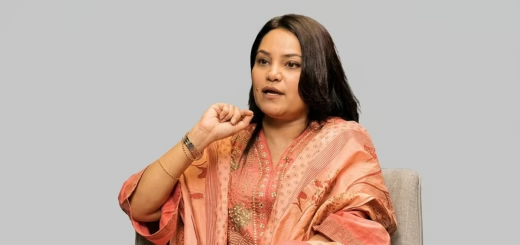
The Plannery session-1, titled “Youth Vs Dream: Together for a Period-Friendly World”, was chaired and moderated by Mst. Laila Khatoon, Project Manager, DALIT. The session explored the theme of “Youth Vs Dream” to break down societal stigmas and build actionable solutions for menstrual health and rights. Reflecting on the discussion, Mst. Laila Khatoon, Project Manager, DALIT, and the panellists, including Jannatul Nayma Nafsi, Pranto Das, Sabrina Akter Shanta, and Nurjahan Nipa, emphasised that achieving a period-friendly world requires a mixture of targeted resource distribution, intensive local volunteering, and a structural shift to end school and community taboos.
The Plannery session-2, focused on the realities and risks associated with child marriage under the title “Share Vs Dare: No More Child Marriage.” Led by Session Chair and Moderator Babul Hawlader, Senior Advocate at the Khulna Judge Court, the discussion brought together administrative, academic, and legal perspectives, starting with a research presentation on local socio-economic drivers by Assistant Professor Sadhon Chandra Swarnokar of Khulna University. Panellists Md. Mozammel Haque, Bitan Kumar Mandal, Additional Deputy Commissioner (General), Khulna; and Professor Md. Sirajul Islam, Department of Political Science, Government Brajalal College, Khulna, highlighted how strict legal enforcement, education, and institutional protections must be actively coordinated to dare to disrupt the deep-seated cultural norms that allow child marriage to persist.
The Plannery session-3, “Networking Vs Do: No More Teenage Pregnancy”, featured a core focus on the theme “Government Plan of Action Coordinated on SRHR.” The session was chaired and moderated by Swapon Kumar Das, Executive Director, DALIT. Emphasising systemic coordination among key institutional stakeholders—such as panellists Md. Mahedi Al Masud, Suraiya Siddiqa, Dr. Bani Saha, and Md. Saiful Alam Babu noted that aligning social services, medical facilities, and grassroots youth networks into a cohesive regional response is essential to ensure adolescent girls have the reproductive health access and protection they deserve.
The final segment of the day, “Voices to Action: Shaping the Khulna Declaration on SRHR,” translated the day’s findings and the collective findings from the Divisional Knowledge Fairs in Mymensingh and Chittagong into long-term systemic accountability. Aruja Islam Sifat, Project Officer for Share-Net at RedOrange, presented a unified set of programmatic recommendations generated by the fair’s participants. The fair closed with formal institutional commitments from government representatives and development partners, alongside an official vote of thanks delivered by Shib Prosad Das, Head of Finance and Admin, DALIT.
Throughout the daylong event, 7 interactive exhibition stalls actively showcased distinct SRHR initiatives, educational literature, and community-led toolkits. The Knowledge Fair reached its festive conclusion with a traditional Pot song performance by Shushilan group titled “Shastho Hok Shobar, Odhikar Hok Nischit” (Health for All, Rights Secured), encapsulating the collective community promise to turn regional dialogue into lasting protection.