
Cockroach has become an unlikely symbol of dissent among India’s Gen Z

Now the entire Southeast Asia eyes on the sudden social and political development in the form of street protest in New Delhi, India, the largest democracy in the world.
Hundreds of young students gathered in New Delhi on 06 June for the first street protest by the satirical “Cockroach People’s Party” over alleged irregularities in recent major examinations.
Carrying paper cockroach masks and pamphlets, the protesters called for the resignation of Education Minister Dharmendra Pradhan who has faced criticism over the irregularities, including question paper leaks and technical problems.
Cockroach People’s Party is an Indian satirical political movement founded on 16 May 2026 by Abhijeet Dipke, a political communications strategist who formerly worked with the Aam Aadmi Party.
During a Supreme Court hearing concerning fake professional degrees and institutional criticism, CJP emerged in response to remarks made by the incumbent Chief Justice of India (CJI) Surya Kant, on 15 May 2026, in which he criticized fraudulent credentials by drawing an analogy that compared certain confrontational activists and unemployed youth to “cockroaches” and “parasites of society”, an analogy that sparked immediate national outrage and led to the creation of the satirical protest movement.
Within days of its founding, the movement garnered over 350,000 sign-ups and over 20 million followers on Instagram. The movement has also engaged in offline activities, with volunteers participating in protests and clean-up drives dressed in cockroach costumes. It campaigns against broader societal, economic, and political issues affecting the Indian youth in spite of its not having any registration as a political party with the Election Commission of India.
Utkarsh Raj, a medical college aspirant commented “We want accountability from the government,”. The police has shown restraints towards the protesters most probably taking learning from the similar incidents that engulfed the neighboring countries namely Sri Lanka, Bangladesh and Nepal.
The movement has gained significant traction, amassing over 22 million followers on social media and leading to protests in New Delhi. Protesters were led by Abhijeet Dipke, a 30-year-old Boston University graduate who arrived in New Delhi from the United States on 06 June with the parody “Cockroach Janta Party” (CJP), a play on Prime Minister Narendra Modi’s Hindu-nationalist Bharatiya Janata Party (BJP) — has won millions of followers on social media since its launch last month.
Last month, authorities scrapped the nationwide medical college entrance exam after investigators uncovered a question paper leak. Indian media reported suicides of teenagers following the fiasco over the National Eligibility Entrance Test (Neet), one of the country’s most competitive exams.
That came on top of another scandal related to the online marking system in tests taken by nearly two million high school students. “Young people have to give these exams and they can’t have a situation where these exam systems have no credibility left,” said one guardian whose sons became the victim of this anomaly and who joins the protest.
As its first action, the party is circulating a petition calling for the resignation ofIndia’s education minister, Dharmendra Pradhan, under whose watch the recent medical school exam was allegedly mishandled. Dipke said he plans to keep “cockroach” in the party’s name as a reminder that the insect, which arouses visceral disgust in many people, is also nearly indestructible.
“What was thrown at them as an insult, now they are carrying it with pride,” he said of the C.J.P.’s members that actually reminds us of the Gen Z protest of Bangladesh which did the same thing in response to the then Prime Minister’s remarks towards them.
In its manifesto, the Cockroach Janta Party said it will cancel the licenses of “all media houses owned by Ambani and Adani,” referring to two of India’s richest men – Mukesh Ambani and Gautam Adani – who own prominent television channels and are seen as being close to Modi, “to make way for a truly independent media.” the party’s founder said. He continued “five years ago, nobody was ready to speak up against Modi or the government,” adding that the times are now “changing.”Competition for jobs is truly fierce in both the private and government sectors. In 2022, 10 million people competed for 35,000 railway jobs, according to the state-owned Indian Railways.
Roopak Yadav, 22, has a bachelor’s degree but is working as a delivery person in Delhi for Swiggy, a popular online platform.This picture mirrors the educated unemployed people’s miserable situation. According to India’s 2025 Periodic Labor Force Survey, the rate of unemployment for people aged between 15 and 29 — more than a quarter of India’s population roughly 10 percent last year, far higher than the overall unemployment rate of around 3 percent.
Youth unemployment in the country, typically covering people aged 15 to 24, was estimated at around 16%, according to the International Labor Organization. “The youth of the country will no longer fear anyone, they will fight. Cockroaches don’t ever fear, they never die either” –Dipke emphasized in response to the current societal and political inaction towards the youth.
He said disbelief and disappointment at Mr. Kant’s comments drove him to write the X post that has created the current challenging situation for the government. In a hearing, the judge had launched into a broadside about “youngsters like cockroaches who don’t get any employment,” some of whom turn to social media and activism and start “attacking everyone.”
Last week, Indian government officials directed X to block the “Cockroach Janta Party” handle, citing a threat to national security, according to Indian media reports. Mr. Dipke created a second handle, “Cockroach is Back,” which remains active. Under Indian law, social media companies operating in the country must take down content that could pose a risk to national security.
The ongoing street movement of New Delhi draws a parallelism with the student-led uprising of tens of millions in Bangladesh in 2024 that hastened to topple the autocratic government of Sheikh Hasina, forcing her to flee to neighboring India, where she’s been living in self-exile ever since. And in Nepal last year, youth-led activism toppled the previous government, paving the way for rapper turned politician Balendra Shah to be elected to power.
We can conclude that the people in the position must restrain their speech and comments making them much more polite, reliable and meaningful and they must show respect to the citizens belonging to any age or status. We have recently observed the unbridled comments of the people in positions that tantamount to criticizing the unemployment situation of the youths even though it’s state failure. Similar things continue happening in most developing countries due to the faulty state policy.
Whereas, the state machinery itself tries to evade the responsibility making the youth fully responsible for it and more so, it criticizes the youth and their unemployment status or their rightful demands. They hardly fathom the depth of its consequences, when things go beyond control, more and more illogical things happen at the cost of millionpeople’s irreparable loss and even the entire state. So, ample learning exists in any such incident that we currently see in the largest democracy in the world and it repeats time and again in many parts of this troubled earth. We need to be careful of it and rein our derogatory remarks focusing on the reasons for such glitches.
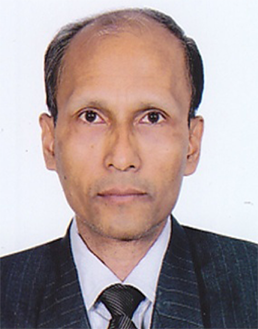
(The writer: President- English Teachers’ Association of Bangladesh (ETAB. Former faculty member of Ghatail Cantonment College, Sylhet, Cumilla and Mirzapur Cadet College, Rajuk Uttara Model College, BOU, Education Expert- BRAC Education and Country Director- VAB Bangladesh, Email: masumbillah65@gmail.com)


