Nation mourns as Martyr Osman Hadi’s body arrives

Staff Reporter :
The body of Sharif Osman Hadi, spokesperson of the Inqilab Mancha and a prominent figure of the July Uprising, arrived in Dhaka on Friday evening in a coffin draped with the national flag, plunging the nation into grief a day after his death in Singapore while undergoing treatment for gunshot wounds.
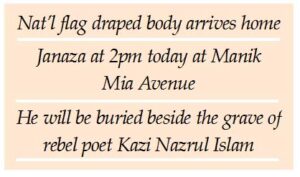
According to the Chief Adviser’s Press Wing, the Biman Bangladesh Airlines flight carrying Hadi’s body landed at Hazrat Shahjalal International Airport at 5:48pm on Friday.
As the coffin was brought out of the aircraft, advisers of the interim government and leaders from various political parties paid their respects, reflecting the widespread political and public significance of Hadi’s life and death.
Among those present at the airport were Local Government Adviser Adilur Rahman Khan, BNP Standing Committee member Salahuddin Ahmed, Jamaat-e-Islami Secretary General Mia Golam Parwar, Amar Desh editor Mahmudur Rahman, National Citizen Party (NCP) Member Secretary Akhtar Hossain, NCP Chief Organizer (South Region) Hasnat Abdullah, and Dhaka University Central Students’ Union (Ducsu) Vice-President Md Abu Shadik Kayem.
Leaders of the BNP, Jamaat, NCP and other political groups, along with government officials, placed floral tributes on Hadi’s coffin.
The interim government, led by Chief Adviser Professor Muhammad Yunus, declared a one-day state mourning on Saturday in honour of Hadi, whom the government described as a “martyr” of the July movement.
In a televised address on Thursday night, Dr Yunus referred to Hadi as a “fearless fighter” and an “immortal soldier in the struggle against fascism and hegemony,” saying his death was an irreparable loss to the country’s political and democratic landscape.
As part of the state mourning, the national flag will be flown at half-mast at all government, semi-government and autonomous institutions, educational establishments, private buildings, and Bangladesh missions abroad.
According to the Chief Adviser’s Press Wing, Hadi’s funeral prayer (janaza) is scheduled to be held today at 2pm at the South Plaza of the Jatiya Sangsad.
Authorities have requested those wishing to attend the janaza not to carry bags or heavy items, while flying drones in and around the parliament complex has been strictly prohibited for security reasons.
Meanwhile, Inqilab Mancha said in a Facebook post that the vehicle carrying Hadi’s body left the airport for a mortuary. The platform announced that its activists would gather at Shahbagh and later escort the body as part of the funeral arrangements.
Following the wishes of Hadi’s family, a decision was taken to bury him beside the grave of national poet Kazi Nazrul Islam. His funeral prayer will be held after Zuhr today at Manik Mia Avenue.
The platform also announced changes to the earlier programme, saying a procession would be taken to the Dhaka University Central Mosque today instead of Friday.
Inqilab Mancha urged students and supporters to continue their movement peacefully and with discipline, warning against any attempt by groups to infiltrate the programme or incite violence.
It also said there would be no public viewing of the body and requested people to pray for Hadi while maintaining order.
Ahead of the arrival of the body, heightened security measures were put in place at Hazrat Shahjalal International Airport. Members of the Airport Armed Police and the military were deployed both inside and outside the terminal to maintain law and order.
Sharif Osman Hadi was critically injured in a gun attack on December 12 and was initially treated in Dhaka before being flown to Singapore for advanced medical care. He died on Thursday night at Singapore General Hospital.
Following the news of his death, widespread protests erupted across Dhaka and several districts late Thursday night, continuing into the early hours of Friday.
Students and members of the public took to the streets, expressing grief and anger over the killing of one of the most visible figures of the July Uprising, as the country now prepares to bid farewell to a man many have come to regard as a symbol of resistance and sacrifice.