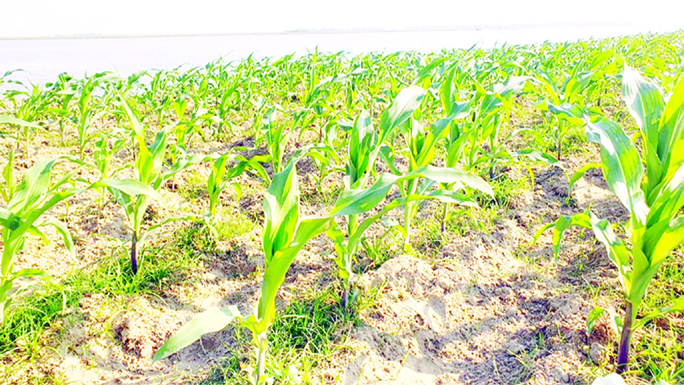
Maize cultivation increases in haor areas

Sr.Staff Reporter, Kishoreganj :
Haor people are expecting a bumper production of maize in the vast haor rejoin in the country. The overall agricultural picture of the region is changing rapidly due to the benefits of information technology. Where once only unripe paddy fields were visible, now maize seedlings are visible. Due to the lack of fair price for paddy, increasing production costs, and the risk of diseases and natural disasters, the farmers of the haor have become increasingly interested in maize cultivation.
As a result, the cultivation of Boro paddy has started to decline!
In Kishoreganj, Department of Agricultural Extension (DAE) office sources, In 2007, out of the 13 upazilas of the district, maize was cultivated on only 165 hectares of land in Itna, Mithamoin, Ashtagram, Nikli and Bajitpur upazilas. That number has increased to 9,013 hectares. Currently, although the target of cultivating maize in the district by 2025 is 12,100 hectares, in the end, 12,210 hectares were cultivated, which is beyond the target.
On an upazila-wise basis, maize has been cultivated on 980 hectares of land in Ashtagram, 725 hectares in Itna, 2,885 hectares in Mithamoin and 3,110 hectares in Nikli this year. Which is significantly more than last year. On the other hand, the total cultivable land in the same four upazilas is about 100,000 hectares. Of this, Boro paddy has been cultivated on 27,400 hectares in Itna, 15,690 hectares in Mithamoin, 24,170 hectares in Ashtagram and 14,380 hectares in Nikli.
In total, 81,640 hectares of land. Which is less than last year. Earlier in 2024, Boro paddy was cultivated on 103,620 hectares of land in this region. That is, paddy cultivation has decreased on about 22,000 hectares of land in a year.
Haor farmers said that maize is less risky than paddy and the cost is also relatively low. Due to excessive rainfall, early floods, and diseases, rice production has become uncertain. On the other hand, corn is tolerant and yields quickly. Since the price of corn is stable in the market, farmers have a high profit margin.
Abdul Mannan, a farmer of Nikli haor said, “I get much more corn by cultivating it than what I get by cultivating rice on one bigha of land. Moreover, I am leaning towards corn cultivation because the cost and risk are low.”
Upazila Agriculture Officer (UAO) of Austagram, Obaidul Islam Khan Apu said that corn cultivation has increased rapidly in the Haor area in the last three years. Initially, corn cultivation started on uncultivated land.
Later, as corn cultivation was profitable, farmers gradually started cultivating it in rice fields as well.
Agriculture Department does not want corn cultivation to expand further. Because if corn cultivation continues to increase in this way, it may affect rice fields. He further said that most of the lands currently being cultivated with corn are not suitable for rice production. However, in some parts, rice land is also being taken over by corn. For this reason, farmers are being discouraged from cultivating corn except on uncultivated land.
In this regard, Deputy Director (DD) of Department of Agricultural Extension (DAE) of Kishoreganj, dr. Sadequr Rahman, told the New Nation that, farmers are being encouraged to adopt new high-yielding rice varieties. Technological support and training are being provided. Therefore, there is no risk of loss in the production of Boro rice. However, the opinion of farmers and agronomists at the field level is that if fair prices cannot be ensured, it is not possible to return farmers to rice cultivation just by encouraging them, DD in DAE added.