July–August Uprising: A Journalist’s Perspective

Md Nora Alam:
“We wanted our rights; we became ‘rajakar.’ ‘Who are you, who am I? Rajakar.’ Surely the nation has not forgotten that earth-shattering slogan that rang out deep into the night at Dhaka University just a year ago. In fifteen and a half years, there were extrajudicial killings, enforced disappearances, murders, secret killings, jailings, torture, and oppression — a steamroller of tyranny, even judicial killings of those with different ideologies. The trauma of that reign of terror still flows in the hearts of the ordinary people of this country.
Through a bloody mass uprising of students and the public, Sheikh Hasina became the only autocratic head of government in Bangladesh’s history to be ousted from power and forced to flee the country — on August 5, 2024. Even visible infrastructure development could not hide the authoritarian rule of Sheikh Hasina. The public fury was so intense that not even the military could prevent the final downfall of the Awami League government. To ensure such events never happen again, we as a nation must learn from the tyranny of Sheikh Hasina’s rule.
In the 53 years since the Liberation War, Bangladesh has seen many movements and struggles, but it can safely be said that no mass uprising like the Revolution of 2024 has ever occurred. After the partition of the country in 1947 and enduring 24 years of Pakistani rule and exploitation, we won independence in 1971 through the Great Liberation War — with India’s direct and indirect conspiracies and assistance. West Pakistan was defeated, and on December 16 at the Racecourse Ground, Pakistan’s Governor of East Pakistan, Martial Law Administrator, and Eastern Command Commander Lieutenant General A. A. K. Niazi (1915–2004) surrendered to India’s Eastern Command chief, General Jagjit Singh Aurora. This marked the burial of Pakistan’s narrative in Bangladesh.
Since independence, there has been much discussion and criticism about the role of the Indian army. Historical evidence shows that after independence, a vast amount of Bangladesh’s resources were looted by the Indian forces and other groups. Just after the war, about 200 railway wagons loaded with arms and military equipment worth around 2,700 crore taka were allegedly looted by the Indian army. (Source: The Amrit Bazar Patrika, 12 May 1974.) In today’s value, that would be about 13 billion US dollars. That was only in terms of weaponry — if other resources are considered, the value would reach several thousand billion dollars. Over the past 54 years, Bangladeshi people have been plagued by Indian hegemonic propaganda. Indian economic aggression has cast its greedy shadow over local production and industry.
On August 5, 2024, 53 years of deprivation and humiliation came to an end. A slap landed on the face of Indian hegemony. It was a victory for the patriotic people. Now Bangladesh will stand on its own feet, strengthened by its own power. After the fall of Awami fascism, the interim government set up several investigation commissions. In cases ranging from disappearances, murders, to the BDR massacre, the shadow of Indian involvement has been visible. Even during the July–August Revolution of 2024, field activists reported hearing Hindi conversations from Indian covert operatives — eyewitness accounts that have been recorded by the government’s investigation committee.
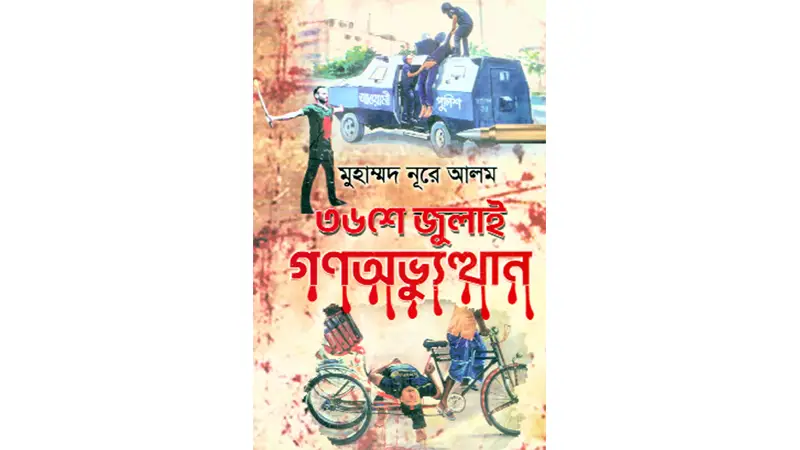
Amid this backdrop, former brilliant Dhaka University student, diplomatic journalist, and creative writer Muhammad Nure Alam wrote “The 36th of July Uprising.” His writing shows great mastery. Being a field journalist, he saw the events up close, observed them, and followed up with deep interest and dedication.
The book is divided into five chapters that detail the 2024 mass revolution. It describes how Sheikh Hasina — the infamous dictator and mass murderer — along with her party loyalists, Awami League, Jubo League, Chhatra League, Swechchhasebak League, police, and RAB, opened indiscriminate fire on students and the public, killing nearly two thousand people and injuring around 40,000, many of whom were permanently disabled. About 2,000 people lost sight in one or both eyes. Some still carry more than a hundred rubber bullets in their bodies. The book contains illustrated reports, statistics of the martyrs and injured, and narratives of their heroic lives.
The author also covers global examples of uprisings and revolutionary slogans, including “Who are you, who am I? Rajakar! Rajakar!”— A slogan that became the voice of the 2024 uprising. Topics include:
* How the state system collapsed under autocratic Hasina.
* How the Chhatra League turned into a monster after countless killings.
* What fascism is and the traits of fascists.
* Court cases on quota abolition and quota reform.
* Formation of the Anti-Discrimination Student Movement.
* Clashes across the country between students and Awami cadres, and police shootings on students and the public.
* The indiscriminate firing on August 4 by police and Awami forces during the one-point movement demanding government resignation.
* Torture of movement coordinators in DB custody.
* Statements by foreign countries and international organizations.
* Curfew and nationwide military deployment.
* Hasina’s “shoot-on-sight” order branding students as miscreants.
* Nationwide internet shutdown.
* The August 3 meeting between the army chief and cantonment officials that changed the tide.
* Video messages by movement coordinators Asif Mahmud and Abdul Kader at 1:03 am on August 4, announcing the one-point demand from the Central Shaheed Minar.
On Monday, August 5 — or the “36th of July” — the program to lay siege to Ganabhaban took place, ending with Sheikh Hasina’s escape. The book provides a timeline of what happened on that day, referring to it as the Gen Z Revolution, with songs, poems, and verses by poet Kazi Nazrul Islam woven into the narrative.
The accounts of coordinators Nahid Islam and Sadiq Kayem offer a diary of the 36th of July Revolution. There’s also a behind-the-scenes look at the 9-point student movement charter, including the blood-stained diary of July 18, 2024. The book recalls the moment when Abu Sayeed was publicly shot dead, which caused the movement to spread like wildfire. It memorializes Shaheed Mir Mugdho — whose dying request for water still moves hearts — and lists the 826 martyrs of the July–August Revolution.
It details the martyrdom of Sheikh Ashhabul Yamin, the grief of Asadullah’s widow holding her infant, the 105 child and adolescent martyrs (including 89 under-18 victims), and the 78 madrasa students, among them 14 hafizes, who died. More than 19 people lost limbs; at least 550 lost one or both eyes. Many still hope for permanent rehabilitation and a chance to see again.
The fifth chapter identifies 747 police officers who fired on the Anti-Discrimination Student Movement. It questions whether America had a hand in the uprising and whether a US-backed plot had been in motion for five years. It recounts visits to Abu Sayeed’s home by Dr. Muhammad Yunus and the Jamaat-e-Islami amir. It describes the storming of Ganabhaban, Parliament House, and the Prime Minister’s Office by hundreds of thousands of jubilant students and citizens.
Ganabhaban has now become the July Memory Museum, displaying items such as the rickshaw that carried Shaheed Golam Nafiz’s body. The heroism of Abu Sayeed and Mugdho will be taught in high schools. The commission on disappearances has found secret detention centers like “Aynaghar.” In just three months, 345 cases have been filed against Sheikh Hasina and other identified Awami leaders.
The US has demanded transparency and accountability in the trial of the July–August massacre. The backstory of the student movement’s 9-point demand is laid out. In the future, anyone researching anti-fascist or anti-Indian-hegemonic struggles — at home or abroad — will find this book an invaluable guide.
During Sheikh Hasina’s 15-and-a-half-year autocratic rule, the people’s voting rights and fundamental freedoms were stolen, and gross human rights violations occurred, flouting international law. The main trigger for the fall of fascism was the brutal shooting of students and citizens during the quota reform movement, killing hundreds daily. Nearly 2,000 people were killed and over 40,000 injured.
The uprising was fueled by accumulated public anger over Hasina’s long tenure: denial of voting rights and free speech, enforced disappearances, extrajudicial killings, police repression, state-backed bank looting disguised as loans, massive corruption and money laundering by government cronies, extreme politicization of state institutions from the Secretariat to the judiciary, soaring prices, and submissive foreign policy toward India.
The public’s deep resentment drove them to join the students in the streets. The 9-point movement evolved into a single-point demand. The coordinators’ historic sacrifices played a decisive role. From dawn on Monday, August 5, 2024, people gathered at Shahbagh and marched toward Ganabhaban. This book attempts to capture that journey and the voices of the people.
Published by the “36th of July Think Tank Group” in Dhaka, London, and Washington, this remarkable work will play an invaluable role in shaping a prosperous Bangladesh.
Author: Journalist