Existing laws and policies need amendments to completely eliminate child labour

Staff Reporter
Representatives from various sectors said the government needs to update its current laws and policies to fully eradicate child labour, arguing that the practice is undermining the country’s future workforce.
They pointed out that 3.5 million children in the country are still engaged in labour, and among them, a significant number are involved in hazardous work.
Despite amendments to labour laws, 99 percent of these children remain outside legal protection because they work in the informal sector. For this reason, they stressed the need to revise laws and policies again, based on expert recommendations.
The discussants highlighted that a coordination gap between various ministries and departments had been a significant issue, one that requires strengthening.
However, they expressed optimism, noting that this gap has been partially addressed, with around 25 agencies now collaborating to tackle child labour.
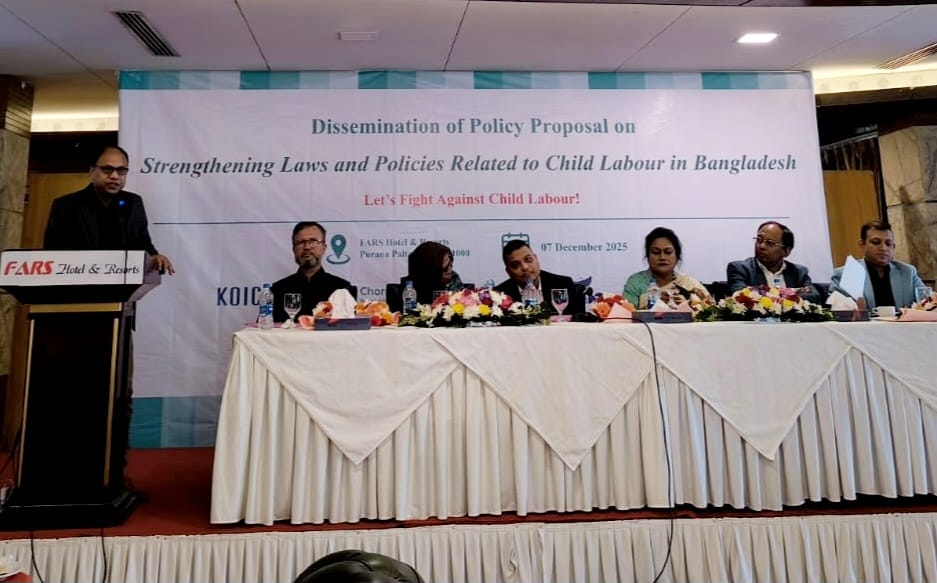
The observations came up at the “Dissemination of policy proposal on Strengthening Laws and Policies related to Child Labour in Bangladesh” organised by Educo Bangladesh and Child Labour Elimination Platform held in a city hotel on Sunday.
The event was moderated by Executive Director of Bangladesh Labour Foundation AKM Ashraf Uddin while Director of Program of Educo Bangladesh Abdur Rahim delivered the welcome speech.
Among others, Joint Secretary of Ministry of Labour and Employment Mohammad Mozammel Haque, Co-Chair of Central Child Labour Monitoring Committee Advocate Salma Ali, President of Bangladesh National Women Lawyers Association (BNWLA) Advocate Seema Zahur, spoke on the occasion. Manager
The event served as a heartfelt reminder of the urgency to protect millions of Bangladeshi children whose futures remain at risk due to child labour. Speakers said that a prehensive plan is necessary to eliminate child labour.
In the keynote presentation, Professor of Law at the University of Dhaka Dr Md Nazmuzaman Bhuiyan discussed the current state of child labour in Bangladesh and the government policies related to its elimination.
He outlined the policy measures that could lead the country out of this problem, noting that the amended labour law does not set any minimum wage for the informal sector, where 99 percent of working children are employed.
Therefore, he emphasised the need to determine child labour wages in the informal sector. He recommended introducing a national minimum wage for children and adolescents working in both formal and informal sectors.
Dr Bhuiyan also pointed out that the National Plan of Action (NPA), which expired in 2016, failed to meet its targets. The latest national education policy has extended compulsory schooling from grade five (age 10) to grade eight (age 14).
However, for this new compulsory age to become effective, legal amendments are necessary. Without these changes, the policy cannot be implemented.
He further said that the 11 to 14 age group faces the highest risk of engaging in the worst forms of child labour and may be involved in activities that endanger health and safety.
He called for increased social awareness and changes in attitudes and behaviour toward child labour.
Joint Secretary Mohammad Mozammel Haque said child labour is one of the major social problems in the country, driven primarily by poverty.
Despite activities by both government and non-government sectors, many children are still forced into labour to survive.
He said the government is strongly committed to combating child labour, but success cannot be achieved by the government alone.
He added that the Ministry of Labour and Employment has formulated a national plan of action and is making every effort to implement it.
Salma Ali said that political parties should include child labour issue on their election manifestos to show political willingness to address it.
Educo Bangladesh Manager Afzal Kabir Khan expressed hope that the government would take the necessary steps to amend existing laws and policies.
In his concluding remarks, he said child workers face various forms of exploitation, abuse, and violence.
Many children lose their productivity at an early age after working long hours in unhealthy environments. Along with amending laws and policies, he urged all to work toward raising public awareness.