Iran considers US military sites in UAE ‘legitimate’ targets

Iran’s Revolutionary Guards said Saturday that U.S. military facilities in the United Arab Emirates could be considered legitimate targets after American forces struck Iran’s key Kharg Island oil hub.
Iran considers it a “legitimate right” to defend its territory by striking U.S. missile launch sites in “ports, docks and hideouts” in the UAE, an IRGC spokesman was quoted as saying by the Fars news agency, which is closely linked to the elite force.
U.S. troops stationed in cities could also be targeted, he said, urging residents near potential targets to seek safety.
Earlier, U.S. President Donald Trump said U.S. forces had destroyed military installations on Kharg Island, a crucial oil export terminal in the Gulf, in an effort to pressure Iran to reopen the Strait of Hormuz.
The Revolutionary Guards have maintained a near blockade of the strait, a narrow passage between Iran and Oman that is crucial for global oil transport.
Kharg Island is a key hub for Iran’s oil industry, from which about 90% of Tehran’s crude exports are shipped.
The UAE has been among the Gulf states most heavily targeted in the conflict involving Iran.
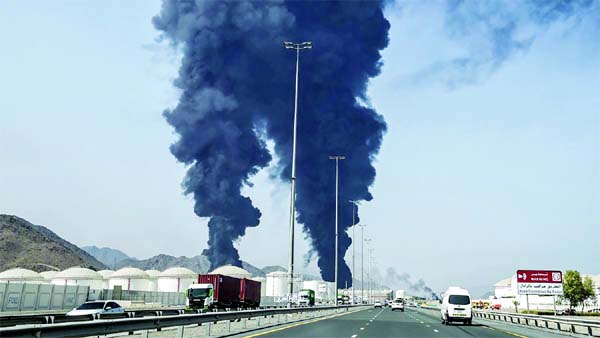
Authorities in the emirate of Fujairah said air defenses intercepted a drone on Saturday. Falling debris sparked a fire, but no casualties were reported.
Meanwhile, Iran may allow a restricted number of oil tankers to pass through the Strait of Hormuz if shipments are traded in Chinese yuan, a senior Iranian official told CNN, according to a report Friday.
The official said the potential move is part of Tehran’s plan to manage the flow of oil tankers through the strategic waterway.
Global oil is predominantly traded in U.S. dollars, except for sanctioned Russian oil, which is priced in rubles or the yuan, said CNN, adding that China has sought for years to expand the use of yuan in oil transactions, but the dollar remains the world’s primary reserve currency.
Concerns about disruptions in the strait, a critical route for the world’s energy supply, have pushed oil prices to their highest since July 2022, following the start of the Russian-Ukrainian conflict that began earlier that year, it said.
The Strait of Hormuz carries about 20 million barrels of oil a day and roughly 20% of the global liquefied natural gas trade.
The UN warned on Friday that restrictions on shipping through the strait could have a “massive impact” on humanitarian operations in the region.
Tehran has effectively closed the Strait of Hormuz since March 1, following Israel and the U.S. launching joint attacks against Iran on Feb.
28, which have so far killed around 1,300 people, including then-Supreme Leader Ayatollah Ali Khamenei. Hostilities have since escalated.