Family Card: Potential benefits and challenges

The government’s plan to introduce a “Family Card” programme marks one of the most ambitious social protection initiatives in Bangladesh’s history.
Designed to provide financial assistance and subsidised essential commodities to low-income families, the programme is intended not only to address immediate economic hardship but also to strengthen the country’s broader social safety net.
The initiative comes at a time when many citizens are still struggling with the lingering effects of the 2020-21 pandemic, rising inflation, and economic disruptions triggered by global crises such as the Russia-Ukraine war, US-Israel-Iran war etc.
In this context, the proposed Family Card programme has generated significant public interest and debate regarding its potential impact on poverty reduction, women’s empowerment, and fiscal sustainability.
Over the past few years, economic pressures and gaps in social protection have been rosed in Bangladesh.
During the Covid-19 pandemic, millions of people lost jobs or experienced reduced incomes.
Poverty levels increased as informal sector workers and small businesses were particularly affected.
Before the economy could fully recover, the Russia-Ukraine war disrupted global supply chains and pushed up the prices of fuel, food, and other essential commodities.
Existing US-Israel- Iran war fosters many households across the country facing higher living costs and financial uncertainty.
The Family Card programme is being proposed partly as a solution to address these structural shortcomings, which is a central commitment of the government and appears prominently in the ruling party’s election manifesto.
The initiative aims to provide monthly financial support or subsidised commodities to marginalised and low-income households.
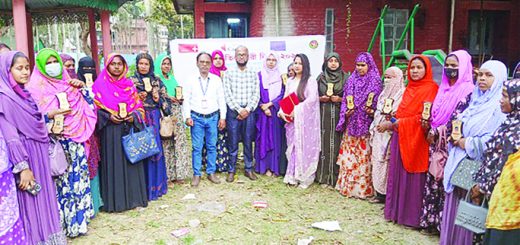
Under the pilot phase, which hasbegun on 10 March, the programme will initially cover 6,500 families across 14 upazilas.
Each eligible family will receive Tk 2,500 per month, transferred directly to mobile wallets or bank accounts through a government-to-person (G2P) payment system.
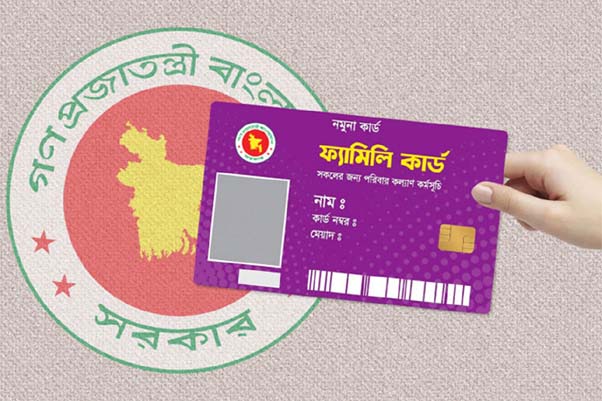
The card will be issued in the name of the mother or female head of household, reflecting the programme’s emphasis on women’s empowerment.
Beneficiaries will be selected using Proxy Means Test (PMT) scoring, which evaluates household income, assets, and land ownership to identify poor and ultra-poor families.
Rural families owning 0.50 acres or less of land and meeting income criteria may qualify.
Certain households will be excluded, such as those with government employees, large businesses, cars, or air conditioners.
The programme will prioritise particularly vulnerable populations, including landless and homeless families, and persons with disabilities, marginalised communities such as hijra, Bede, and small ethnic groups.
The card will function as a QR-coded digital smart card linked to a Dynamic Social Registry, integrating existing programmes such as Trading Corporation of Bangladesh (TCB) subsidised food distribution.
In the long term, the government plans to transform the Family Card into a “Universal Social ID Card” by 2030, potentially linking it with various welfare services such as education stipends and agricultural subsidies.
One of the most potential benefits is to strengthen social protection.
The Family Card programme is the possibility of consolidating fragmented welfare schemes into a more coordinated system.
By integrating multiple programmes under a unified registry, the government could reduce duplication and improve efficiency in resource distribution.
It will provide direct support to vulnerable families through the monthly support of Tk 2,500.
Though modest, this will significantly help low-income households meet basic needs such as food, healthcare, and education.
For many families living near the poverty line, even small cash transfers can improve financial stability.
Issuing the card in the name of women is expected to promote greater financial autonomy for mothers and female household heads.
Research from many countries suggests that when women control household finances, spending on children’s health, education, and nutrition often increases; thereby will promote women’s empowerment in the country.
Moreover, direct transfers to mobile wallets or bank accounts can reduce opportunities for corruption and middlemen involvement.
The use of digital verification systems such as QR codes and one-time passwords (OTP) may enhance transparency and accountability.
The development of a Dynamic Social Registry could become an important tool for future policymaking.
A comprehensive database of households would allow the government to respond more quickly during crises, such as natural disasters or economic downturns.
Despite many potential advantages, the Family Card programme also raises several challenges that policymakers will need to address.
If implemented nationwide, the programme could cost around Tk 60,000 crore annually, which would represent nearly 12 percent of the government’s revenue target.
Maintaining such a large commitment could be difficult without careful budget planning or increased revenue collection.
Although the programme uses Proxy Means Test scoring, accurately identifying poor households remains difficult.
Errors in data collection or misreporting could lead to inclusion errors (non-poor receiving benefits) or exclusion errors (poor families being left out).
Implementing a nationwide digital registry and managing millions of beneficiaries requires strong administrative capacity.
Ensuring proper coordination among different government agencies will be essential for the programme’s success.
Social welfare programmes in many countries sometimes face criticism over political favoritism.
Although the government has pledged that no intelligence agencies or party elements will be involved, maintaining neutral and transparent beneficiary selection will be crucial for public trust.
In the existing trend of rising living costs, the monthly assistance of Tk 2,500 may not be sufficient in the long run. If inflation continues to rise, the programme may require periodic adjustments to maintain its effectiveness.
In spite of multiple challenges, the proposed Family Card programme represents a bold attempt to reform Bangladesh’s social protection system and provide targeted support to vulnerable families.
By focusing on women’s empowerment, digital payments, and the integration of existing welfare schemes, the initiative has the potential to improve the efficiency and inclusiveness of social assistance
.However, its success will depend on careful implementation, transparent beneficiary selection, and sustainable financing.
If these challenges can be effectively addressed, the Family Card programme could become a transformative step toward building a more comprehensive welfare state and reducing poverty in Bangladesh.
In the coming months, the results of the pilot phase will be crucial in determining whether the programme can achieve its ambitious goals and eventually expand nationwide.
(Col Nazmul Huda Khan, MPhil, MPH, DMO, DAE (USA) is Director, Medical Services, BRB Hospital, Dhaka).