Waterfowl numbers rise in Hakaluki Haor

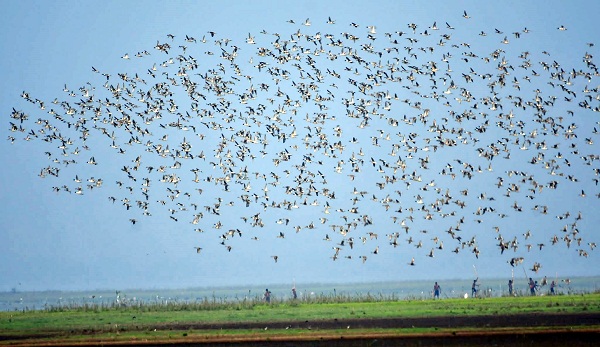
The number of waterfowl in Hakaluki Haor, known as Asia’s largest freshwater wetland, has increased this year compared to last year. At the same time, incidents of birds being killed using poison bait and illegal hunting nets have decreased.
The information was shared on Saturday afternoon by renowned bird expert Inam Al Haque, founder of the Bangladesh Bird Club.
A 12-member delegation led by Inam Al Haque visited Hakaluki Haor on February 4 and 5 to conduct a bird census across 43 beels of the wetland. The census was jointly organized by the Bangladesh Bird Club and the International Union for Conservation of Nature with cooperation from the Wildlife Management and Nature Conservation Department in Sylhet.
Among others who participated in the census were Divisional Officer Md. Abul Kalam, Bird Club General Secretary Sarwar Alam Dipu, Vice-President Jennifer Ajmeri, and member Anu Tarek.
According to Sarwar Alam Dipu, a total of 54,486 waterfowl of 53 species were recorded in the haor this year. Of these, 18 species are resident birds and 35 are migratory. In last year’s census, 35,268 birds of 60 species were counted in the haor.
He said the environmental condition of several beels, including Chinaura and Haorkhal, was comparatively better this year due to higher water levels. Experts believe birds may have gathered in these areas as water levels decreased in other parts of the haor.
Unlike previous years, the census team did not find any poisoned bait or illegal nets used for bird hunting this year. During last year’s census, however, a 100-metre-long banned current net was found in Nagua-Laribai Beel with two dead birds trapped in it. The team destroyed the net after the discovery. A packet of the pesticide Carbotaf, mixed with rice and used to poison birds, was also found near Pingla Beel at that time.
“In previous years, more than fifty dead birds were often found in Hakaluki Haor. But this year none were found,” said Sarwar Alam Dipu. He attributed the improvement to growing public awareness and increased vigilance by local beel management committees.
Bird Club sources said a rare white-fronted swan was spotted in the haor this year, a species that is usually seen in Bangladesh only once every 10–12 years. In addition, 194 swans were recorded in the haor for the first time. Swans are considered extremely rare in the country.
Several shorebird species were also observed, including red-billed grebe, gulinda and jaurali. The number of jaurali birds alone exceeded 3,500, while the total number of shorebirds recorded was more than 7,000.
Hakaluki Haor is spread across Kulaura, Juri and Barlekha upazilas of Moulvibazar district and Fenchuganj and Golapganj upazilas of Sylhet district, covering an area of about 28,000 hectares. In 1999, the government declared the wetland an Ecologically Critical Area (ECA). About 238 species of birds have been recorded in the haor.
However, observations by the Bangladesh Bird Club and IUCN show that the number of migratory birds across Bangladesh has declined by 35 percent over the past 20 years, while the decline in Hakaluki Haor is around 45 percent. Before 2000, about 75,000 to 80,000 birds used to visit the haor each winter.
Explaining the reasons behind the long-term decline, Inam Al Haque said habitat destruction and global warming are the main causes. “Bird habitats are being lost due to economic development, while climate change is affecting their survival,” he said, adding that protecting wetlands like Hakaluki Haor is essential for conserving bird populations.
He also warned that excessive pesticide use in agriculture around the haor is damaging fish habitats and reducing the availability of natural food sources for fish. According to him, at least 20 to 30 beels in the haor should be declared protected sanctuaries during winter to allow fish to breed.
Meanwhile, Md. Mohiuddin, the Upazila Nirbahi Officer of Kulaura, said a long-term plan is needed to protect the biodiversity of Hakaluki Haor. He said authorities are examining environmental conditions in the wetland and considering new fish sanctuary initiatives while also planning measures to control the excessive use of pesticides in agriculture.