Concrete action urged for climate-vulnerable coastal women

Staff Reporter:
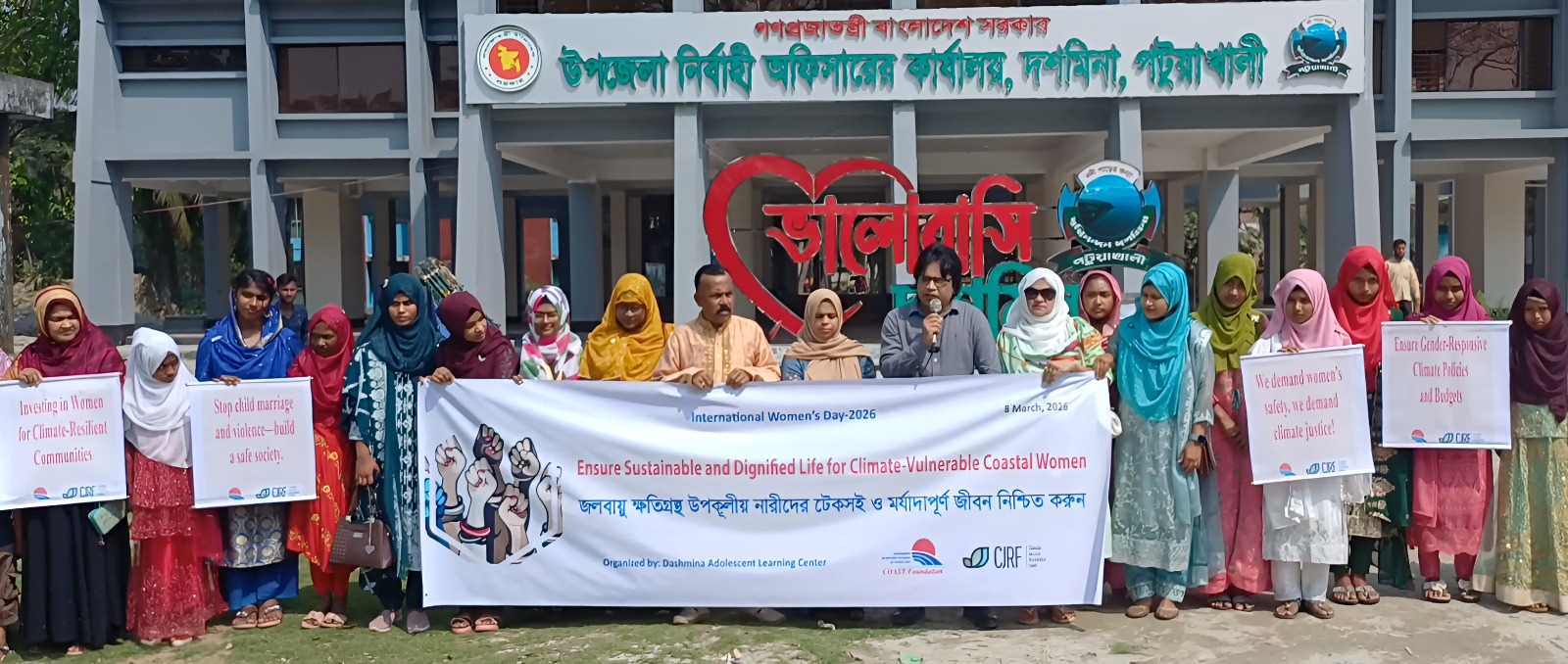
Speakers at a human chain marking International Women’s Day 2026 called for concrete action to ensure dignified and sustainable livelihoods for climate-vulnerable coastal women, stressing that symbolic observance alone is not enough to address the challenges they face.
They said urgent measures are needed to tackle rising salinity, drinking water shortages and limited access to health care, education and housing in climate-affected coastal and char areas, a press release said.
Alongside these, they urged the government to expand income-generating training and technical support for women and ensure the proper enforcement of laws to prevent child marriage, dowry and violence against women.
The human chain was held on Saturday at the Upazila Parishad premises in Dashmina Upazila of Patuakhali.
The event was moderated by M. A. Hasan of COAST Foundation. Among the speakers were Upazila Women Affairs Officer Jasmin Akter, President of the Climate Forum P.M. Raihan Badal, women leaders Nilufa Rauf and Tahmina Akter, teacher Tamanna Akter of the Adolescent Education Center, students Kamana Begum and Nadira Akter, and Atikur Rahman of COAST’s CCR Project.
Addressing the programme, M. A. Hasan said the day should be transformed into a strong call to action where the government, society and individuals work together to prevent violence and ensure protection and justice for every woman and child.
He stressed the need for effective policies, stronger law enforcement and improved support systems to improve the socio-economic conditions of climate-vulnerable coastal women.
Jasmin Akter said violence against women and children remains a serious concern in society, causing not only physical harm but also deep psychological and social impacts on victims.
She emphasised the need to build a society where women and children are protected and their rights fully recognised.
Climate Forum President P.M. Raihan Badal warned that disasters such as riverbank erosion, floods, cyclones and salinity intrusion have sharply reduced crop production in coastal regions, leaving many families malnourished, particularly women, girls and children.
He called on the government to prioritise climate-resilient infrastructure including embankments, cyclone shelters and safe housing.
Women’s leader Nilufa Rauf said ensuring women’s empowerment and child protection requires expanding education, providing legal support and changing social attitudes.
Tahmina Akter added that preventing gender-based violence also depends on awareness campaigns, proper enforcement of laws and the effective functioning of local violence prevention committees.
Tamanna Akter, a teacher at the Adolescent Education Center, said poverty and entrenched social norms continue to fuel child marriage, dowry and gender-based violence, while women’s household work remains largely unrecognised.
Student Nadira Akter said residents of isolated char areas still lack adequate access to health care, education, clean water and sanitation, calling for urgent improvement in public services.
Participants in the human chain included adolescent girls, women leaders, teachers, civil society representatives, journalists and local residents.
Similar human chains and discussion meetings were also held in Tajumuddin Upazila of Bhola and Galachipa Upazila of Patuakhali, organised by Adolescent Learning Centers with support from COAST Foundation.
Participants there also raised demands for stronger protection and improved opportunities for women in coastal communities.