Narsunda River in crisis despite Tk 110Cr project

Narshundha River, which flows through the heart of Kishoreganj district town, has now become almost like a dead canal. Although around Tk 110 crore was spent on a re-excavation and rehabilitation project to restore the navigability of the Narshundha River, garbage and waste from several markets including kitchen markets and slaughterhouse waste are still being dumped into the river, posing a serious threat to public health.
The river, which was once flowing, lively, and navigable, is now dying under the pressure of encroachment, pollution, and mismanagement.
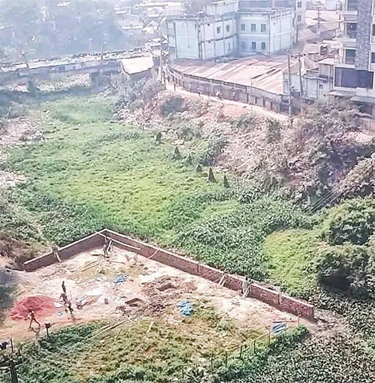
The Narsunda River, which flows through the heart of Kishoreganj town, is now in danger of extinction. The recent construction of a boundary wall almost in the middle of the river in the Puran Thana area, along with the construction of a six-story building there, has given this crisis a new dimension.
The issue is not just a matter of illegal construction; it reflects the overall failure of river management, urban governance, and the rule of law.
The work of building a wall inside the river had been going on for several days. The administration’s attention was drawn to the matter after pictures of the construction went viral on social media.
The newly elected Members of Parliament (MPs) of Kishoreganj inspected the site and ordered the demolition. The municipality also ordered the suspension of the approval and the removal of the illegal portion. The work of demolishing the wall has already begun with the help of construction workers.
This immediate step is commendable. However, the question remains: where were the concerned authorities before the ambitious work of building a wall in the middle of the river began?
A wall had been constructed in the middle of the river, going beyond the approved design and violating the conditions of the National Building Code (NBC). This is a clear violation of the Building Construction Rules 1996, the Local Government Act 2009, the Environmental Conservation Act 1995, the Natural Reservoir Act 2010, and the Environmental Conservation Rules.
If a structure can be built in a river despite the existence of so many laws, it is natural to raise questions about the weakness of law enforcement and lax supervision.
Saving the Narsunda River means saving the future of the town. Everyone must work together to ensure that the administration’s immediate actions turn into long-term commitments.