Dreams being dashed in human trafficking
Al Mamun Harun Ur Rashid :
The dreams of many Bangladeshis hoping to earn greenbacks in Europe are collapsing as they fall victim to human trafficking and are forced to return home or lose lives.
Such incidents not only devastate individual lives but also send shockwaves through the economy, as disruptions in overseas employment can ultimately affect the flow of remittances.
At the same time, the ongoing crisis in the Middle East has added to country’s growing concerns.
Following surprise ‘pre-emptive’ attacks carried out jointly by the United States and Israel in the name of security, uncertainty has spread across the region, raising fears about the stability of remittance inflows and the continuity of energy supplies.
The evolving situation is particularly worrying as the Bangladesh relies heavily on oil and gas imports from Middle Eastern countries.
Any prolonged instability in the region could disrupt energy supplies while also affecting employment prospects for millions of Bangladeshi migrant workers.
Against this backdrop, the perilous journey of many Bangladeshis seeking a better life in Europe is increasingly ending in tragedy in Libya.
Rising unemployment, soaring migration costs and the lack of accessible legal migration pathways have pushed many desperate jobseekers into dangerous routes controlled by trafficking networks.
Instead of reaching Europe, many migrants face exploitation, detention and abuse. Disillusioned and traumatised, they are often forced to return home with shattered hopes after enduring harsh conditions and imprisonment.
Amid this situation, a total of 165 Bangladeshi nationals were repatriated from Libya in a coordinated effort involving the government of Bangladesh and international partners, According to Foreign Ministry information released on Friday.
Earlier on February 26, a total of 175 Bangladeshis nationals also returned home from Libya from detention centre in Benghazi.
The returnees arrived in Dhaka at around 5:30am aboard a Buraq Air flight. Among them, 143 had been detained at the Ganfouda Detention Centre in Benghazi, while another 22 distressed and physically ill migrants had been living in vulnerable conditions in Benghazi and nearby areas.
The repatriation was arranged through joint efforts by the Bangladesh Embassy in Libya, the Ministry of Foreign Affairs and the Ministry of Expatriates’ Welfare and Overseas Employment, with assistance from the Libyan authorities and the International Organization for Migration (IOM).
Officials said most of the returnees had entered Libya irregularly after being lured by human traffickers with promises of reaching Europe by sea.
Libya has long been used as a major transit route for migrants attempting to cross the Mediterranean towards Europe.
However, ongoing instability in the country and the activities of trafficking networks have left many migrants stranded, detained or subjected to abuse, Foreign Ministry said.
Many of the repatriated Bangladeshis alleged that they had faced kidnapping, extortion and physical abuse during their stay in Libya.
Trafficking groups often exploit migrants by demanding ransom from their families back home or forcing them into detention centres run by armed groups.
The government said it continues to work with the Bangladesh Embassy in Libya, the expatriates’ welfare ministry and international partners to arrange the safe return of Bangladeshis detained in various detention centres across the country.
Migration experts say such incidents highlight the growing risks faced by Bangladeshi workers seeking overseas employment through irregular routes.
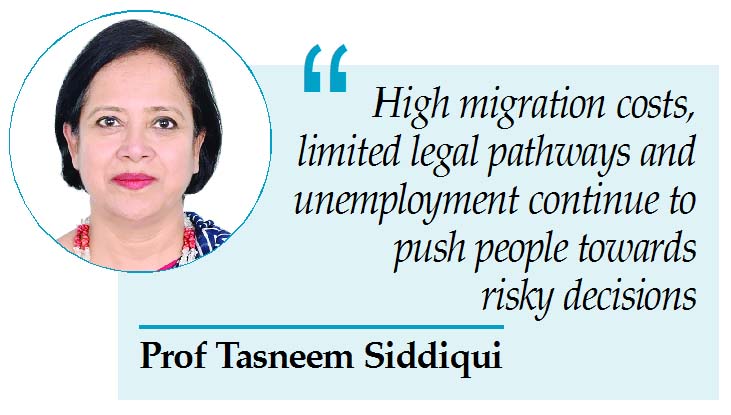
Prof Tasneem Siddiqui, founding Executive Director of the Refugee and Migratory Movements Research Unit (RMMRU), said told the New Nation that high migration costs, limited legal pathways and unemployment continue to push people towards risky decisions.
“As long as migration remains irregular and opaque, such tragedies will continue,” she said.
She further explained that for many Bangladeshis, reaching Europe has become an aspiration driven by the search for a better life.
“For many, migrating to Europe becomes an obsession in search of a better life. People aspire to reach Europe, but Europe lacks a policy for formal employment.
Although Europe needs workers in informal sectors, many people – whether semi-skilled or unskilled – are willing to undertake the perilous journey, despite the heavy cost and risk,” she said.
“Unfortunately, this dangerous journey often leads to tragic outcomes, with many losing their lives, while others return home empty-handed after falling victim to human trafficking,” she observed.
Apart from Libya, Bangladeshis are also being deported from the United States and the UK. Recently on January 20, at least 36 Bangladeshi nationals were deported from the US while 29 more on February 28.
Since 2025, some 322 Bangladeshi nations were repatriated as part of US government’s ongoing crackdown on illegal immigration.
Even during a meeting with the Foreign Minister Dr Khalilur Rahman on Wednesday, US Assistant Secretary of State for South and Central Asian Affairs, S. Paul Kapur discussed the repatriation procedure for undocumented Bangladeshis in the US.
Such incidents are taking place at a time when Bangladesh remains heavily dependent on remittance inflows from overseas workers, particularly in the Middle East.
Countries such as Saudi Arabia, the United Arab Emirates, Qatar and Oman host millions of Bangladeshi workers and account for a large share of the country’s annual remittance earnings.
Analysts warn that continued instability in parts of the Middle East and North Africa, along with tighter migration controls in Europe, could create uncertainty for migrant workers and recruitment flows.
“If labour mobility slows or workers face displacement due to regional tensions, it could eventually affect remittance inflows, which remain a crucial source of foreign currency for Bangladesh’s economy,” Prof Tasneem Siddiqui said.
Experts say strengthening safe migration channels, cracking down on trafficking networks and expanding legal labour markets abroad are essential to prevent migrants from taking dangerous routes through conflict-prone regions such as Libya.