Probe exposes state-level engineering of past elections


Staff Reporter :
Chief Adviser Professor Muhammad Yunus on Monday called for concrete safeguards to ensure that “election robbery” can never again take place in Bangladesh, after formally receiving the report of the National Election Investigation Commission into the 2014, 2018 and 2024 parliamentary polls.
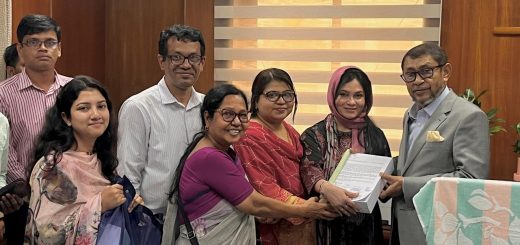
The report was handed over at the State Guest House Jamuna in the afternoon, after which commission members briefed the chief adviser on their findings.
Those present included commission chair Justice (retd) Shamim Hasnain and members Shamim Al Mamun, Kazi Mahfuzul Haque Supon, Barrister Tajrian Akram Hossain and Dr Md Abdul Alim.
Among the advisers attending were Law Adviser Asif Nazrul, Industries Adviser Adilur Rahman Khan, Information Adviser Rizwana Hasan and Cultural Affairs Adviser Mostofa Sarwar Farooki.
According to the commission, the 2014 election — in which 153 seats were decided uncontested and the remaining 147 were held in what it described as a fully “stage-managed” process — was designed and implemented to keep the Awami League in power, based on decisions taken at the highest level of the state.
The report says that after the 2014 polls were widely criticised globally as a one-sided election, the Sheikh Hasina–led Awami League adopted a mission to make the 2018 election appear “competitive.”
The BNP and other opposition parties, the commission noted, failed to grasp the depth of the planning and participated in the process.
Speaking after receiving the report, Professor Yunus said the scale and brazenness of manipulation laid bare by the investigation must be placed fully on the public record.
“We had heard about vote rigging. We knew some things,” he said.
“But how shamelessly the entire process was distorted, how the system was crushed and a verdict was written on paper according to their wishes — all this must be presented before the nation. There must be a complete record.”
He added that public funds had been used to organise elections that ultimately punished the nation.
“People’s money was spent to hold elections, and the entire nation was punished,” he said. “The people of this country were left watching helplessly.
To give them at least some sense of relief, those who were involved must be brought to light — who did it, and how they did it.
And arrangements must be made so that election robbery never happens again.”
The commission’s preliminary estimates state that in the 2018 election, ballots were marked at night in around 80 percent of polling centres to secure victory for the Awami League.
It also describes what it calls an “unethical competition” within the administration to ensure the ruling party’s win, resulting in turnout figures exceeding 100 percent in some centres.
For the 2024 election, in which the BNP and other major opposition parties did not participate, the report says an alternative strategy was adopted to create an illusion of competition by fielding so-called “dummy” candidates.
Across all three elections, the commission concludes, the plans were made at the highest level of the state and implemented through the systematic use of sections of the administration, police, Election Commission and intelligence agencies.
A special unit composed of selected officials — informally known as the “election cell” — coordinated much of the operation.
The report further states that between 2014 and 2024, control of the electoral system effectively shifted from the Election Commission to the administration, with bureaucratic machinery becoming the main force behind election management.
The commission has submitted a set of recommendations alongside its findings. Officials did not immediately disclose details, but sources indicated they include proposals aimed at structural reform, accountability mechanisms and legal safeguards to prevent political capture of the electoral process.
The government has yet to announce whether the full report will be made public, but Professor Yunus’s remarks suggested that transparency and accountability will be central to the next phase of action.