CAB demands cancellation of power deals signed under immunity law

Business Desk :
The Consumer Association of Bangladesh (CAB) has demanded the immediate cancellation of all electricity and energy sector investment and purchase agreements signed under the immunity law, alleging large-scale misuse of public funds and prolonged lack of accountability.
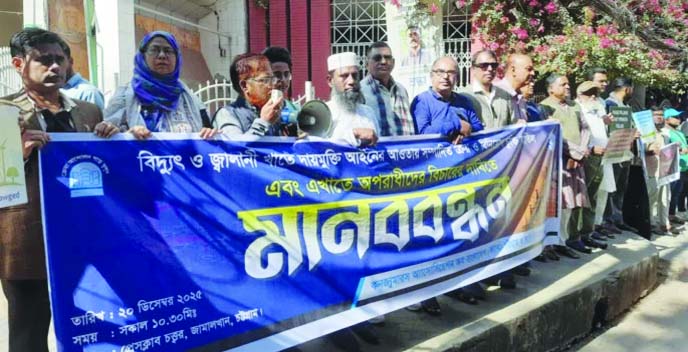
The demand was made at a human chain organised by CAB Chattogram and Jubo CAB Chattogram at the Jamalkhan Press Club premises on Saturday morning.
Speakers alleged that over the past 15 years, successive agreements signed under the Rapid Increase in Supply of Electricity and Energy (Special Provisions) Act enabled unreasonable benefits for a select group, resulting in the wastage of public funds and large sums of money being siphoned abroad in the name of capacity charges.
They said the immunity provisions have prevented scrutiny of these contracts and shielded those responsible, creating a major barrier to good governance in the power and energy sector.
The human chain was chaired by CAB central committee vice-president SM Nazer Hossain and led by Jubo CAB Chattogram coordinator Raisul Islam and CAB divisional organiser Russell Uddin. Several consumer rights activists, civil society members and journalists also spoke at the programme.
In his address, SM Nazer Hossain said that despite recent initiatives by the interim government to regulate the electricity and energy sectors and cancel some unnecessary projects, the immunity law remains in place, allowing corruption over the past one and a half decades to go unaddressed.
He alleged that state funds were looted through non-competitive contracts, contributing to repeated increases in electricity and fuel prices and raising production costs for industries, ultimately burdening consumers.
He claimed that while power generation capacity increased fourfold, overall costs rose elevenfold, citing rental payments to private power plants without generation, inflated LNG import prices and opaque power purchase agreements. According to him, these practices facilitated the rise of a powerful energy syndicate protected under state policy.
Speakers demanded the immediate cancellation of all contracts signed under the immunity law, public disclosure of those responsible for alleged irregularities, prosecution of the guilty, and recovery of misappropriated funds. They also called for a transparent, accountable and public interest-based energy policy.
The speakers further noted that in the 2024-25 fiscal year, the electricity sector subsidy stands at Tk40,000 crore, while the proposed gas subsidy is Tk7,000 crore, claiming that the benefits largely accrue to vested interests rather than consumers.
They also demanded the formation of an independent national commission, free from conflicts of interest, to review capacity charges, power purchase agreements (PPAs) and long-term service agreements (LTSAs) across all electricity and primary energy development projects.