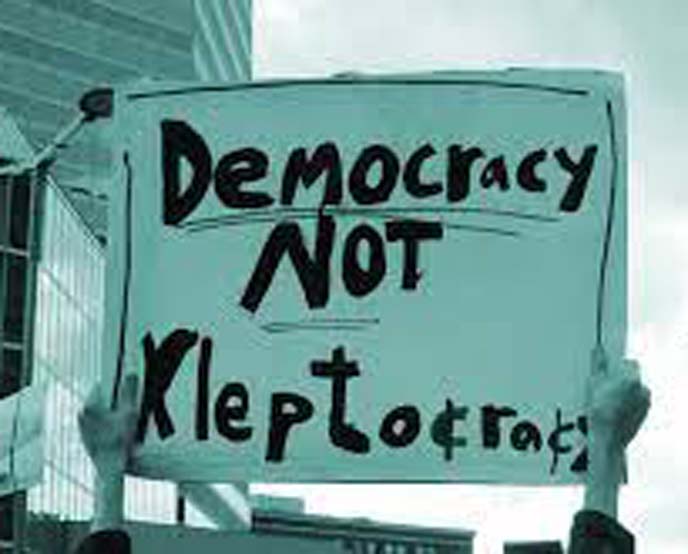
Morality lost: Kleptocracy gained

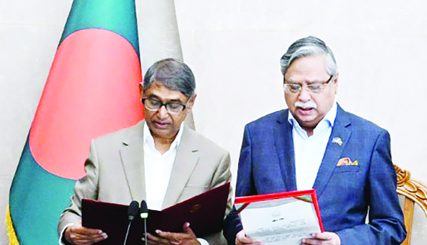
A.S.M. Abdul Halim :
On the 5th August, 2024 I came out of my Concord flat, at Shegunbagicha, Dhaka in the afternoon strolled and roamed about among thousands of Pedestrians, rickshaws, three wheel autos in a din and bustles, chanting slogan with joy and merriment. I was about to cross Kakrail crossing heading towards Shantinagar, just at that moment a friend of mine shouted from behind “Halim, stop, I’m here”, he caught hold of my hand and embraced me like a mad guy. He was overwhelmed with joy and emotions, said ‘Halim, look at that, what is going on?” I was amazed seeing such a jovial crowd and this joyous situation enthralled all over.
It was indeed a good moment, historical event, a huge crowd assembled, singing songs dancing, boys and girls, “no, no,, that is not, what I want you to see! ” he exclaimed with joy, “see, what is that!” I saw a very big fish over the heads of many a young guy who held it standing on a rickshaw, people all around gathered to see, to enjoy, taking photo of the historical fish. This was the fish brought from Gonobhaban, Sk Hasina’s aquarium, how interesting it was. In fact, though it was a victory day for the young people, it was a hay day for many, some were carrying toys, some carrying hens and cocks, some took flower tubs, many of them brought chair, table even bed sheet and what not.
They were so cheerful & excited that my friend laughed at me, saying “Hey, what are you looking at? Do you know what is this?” I replied in negative. He told me, “My friend, this is called philosophy of Kleptocracy, a lost case of morality. I knew about morality, but not very much about Kleptocracy.
Thereafter, we two friends, departed from each other, I came back home. Thought and thought, how morality is over shadowed by Kleptocracy. How do I compare? what is morality then, let me explain what I feel and understand. What is good is moral, which is bad is immoral. What people says good is moral when people say it is bad, it is immoral, which is well accepted by the society is moral, which isn’t accepted by the society is immoral, which is well accepted by the law of the land is morality and which is barred by the law is beyond morality, means it is immoral.
Morality is needed everywhere from individual to society, the politicians and the leaders involved in the state machinery. Kleptocracy on the other hand is almost opposite to morality. When morality stands for good deeds i.e. sanity, divinity, serenity, honesty. Kleptocracy stands for bad deeds, dishonesty, corruptions, immorality etc.
‘Kleptocracy’ is a term best known as a theory or philosophy used in politics in running the state craft; this may be a malafide idea of bad people aiming at achieving malevolent things. However, there are other positive thinking, ideas or philosophies like capitalism, socialism, communism broadly used in political economics or as each of them says, with positive thinking aiming at doing or providing welfare to the people.
Nevertheless, people’s thoughts differ about the ideas of these “ism”, and of course, Kleptocracy is completely different as if it sounds like “Corruptocracy”! Social thinkers and economists of today find Kleptocracy similar to the last autocrat governments’ dragonian malevolent actions, corruptions and colossal immoral actions. This immoral policy which may be known as ‘Kleptocracy’ may also be called ‘Corruptocracy’. By that way a new terminology may come in our political scenario.
During the last one and half decade in this Corruptocracy in Bangladesh there were innumerable stakeholders. SK Hasina was not alone, hundreds and thousands of associates (kleptocrats) made havoc in this country. They created this country itself a hell and they reigned here like a terror, oppressed, suppressed and tortured people of the country. Justice was driven out, injustice prevailed all over..
No reliable information, however, were gathered or any survey has yet been made as to the colossal damage to economy, amount of money laundering done and this is not possible to account for immoral activities doing during last one and half decade, but an idea may be derived from TIB’s report about corruption, Transparency International in its 2020 survey of South East Asian 8 countries, Bangladesh remains lowest both in score and rank- better than only Afghanistan.
Again TIB in 2024 in its corruption perception index which scored 180 countries on a scale from 0 (highly corrupt) to 100 (very clean). In this survey Bangladesh scored 23, a deplorable scenario indeed. Now if we come back to Kleptocracy to give a glimpse over the old theory in new form in Bangladesh. A small definition in Bengali for all to grasp it easily.
Kleptocracy -A_©vr ‡PŠh©Zš¿| Ò‡PŠh©Zš¿ Ggb GKwU miKvi e¨e¯’v hvi jÿ¨-ivóªxq ÿgZv e¨envi K‡i †`‡ki bvMwiK‡`i m¤ú` nvwZ‡q ‡bqv Ges e¨w³MZ m¤ú‡` cwiYZ Kiv| ivRbxwZwe`iv GB e¨e¯’v Kv‡qg K‡i Ges Gi ga¨ w`‡q †`k I †`‡ki bvMwiK‡`i m¤ú` jyUcvU K‡i|Ó
Bs‡iRx‡Z GUv‡KB Kleptocracy e‡j| GwU GKwU MÖxK kã kleptes A_©vr “thief” or klepto A_©vr “I steal” also referred to as Thievocracy, is a government whose corrupt leaders (Kleptocrats) use political power to expropriate wealth of the people and the land they grew, typically by embezzling or misappropriating public funds. One most important feature of political based socioeconomic theory is that there is often no public announcement explaining or apologizing for misappropriating nor any legal charge or punishment levied against the offenders. Exactly same things happened during the last regime of SK Hasina.
In a kleptocracy, corrupt politicians enrich themselves secretly outside the rule of law, through kickbacks, bribes and special favors from lobbyists or corruptions, or they simply direct state funds to themselves and their associates. Also, kleptocrats often export much of their profits to foreign nations in anticipation of losing power. Sk Hasina & her associates did all these mischiefs and fled away out of the country.
Kleptocracies generally possess some special characteristics. Kleptocratic ruler thinks their country’s treasury as a source of personal wealth, spending funds on luxury goods and extravagance as they deem fit. Many kleptocrats secretly transfer public funds into hidden personal accounts in foreign countries to provide for themselves, apprehending their removal at any time from power.
Thus, we see it is as it was the same fate happened to Sk Hasina and her thousands of corrupt associates. All of them looted, plundered wealth and fled away leaving the country devasted & almost bankrupt and in a chaotic condition.
And we see, the effects of a kleptocratic regime or government of a nation are typically adverse in regards to the welfare of the state’s economy and political affairs and civil rights. A further serious impact of the kleptocracy is the money that kleptocrats steal is diverted from funds earmarked for public amenities such as the building of hospitals, schools, roads, parks- having further adverse effects on the quality of life of citizens.
Bangladesh is the best & bright example of such case of kleptocracies (corruptions). There are many other examples in the world. In early 2004, the German anti-corruption NGO Transparency International released a list of ten self- enriching leaders in the two decades previous to their report. Name of such 5 top (kleptocrats) self- enriching are given bellow:
1. Former Indonesian President Suharto ($15 billion to $35 billion)
2. Former Philippine President Ferdinand Marcos ($5 billion to $10 billion)
3. Former Zairian President Mobutu Sese Seko ($5 billion)
4. Former Nigerian Head of state Sani Abacha ($2 billion to $5 billion)
5. Former Yugoslav President Slobodan Milosevic ($1 billion)
Those assessments were made about the leaders (kleptocrats) who ruled their country long ago. The present and immediate past scenario of the world leaders are in the quite dark. An in depth survey should be done immediately about the amount and the size of wealth and money transferred from Bangladesh to other country, how much wealth and money were expropriated by embezzling or misappropriating govt funds, how money extracted from the people through corruption, from innocent public i.e., farmers, professionals, and from people at large. And if efficient, neutral authority could do a survey of such corruption (kleptocracies), I am sure the autocratic government of last fifteen years shall attain the highest position.
Now, the government should come forward to do this work seriously to bring back money laundered so far. Bangladesh Nationalist Party-BNP however, made their recommendation much earlier. In their 31 points charter (the Structural Reforms of the state), it is distinctly underscored the idea for eliminating corruption (kleptocracies). It also suggested to publish a white paper about corruption occurred during last fifteen years. BNP’s acting chairman Mr. Tarique Rahman urged upon all for zero tolerance about corruption.
It was candidly mentioned in the 31 points charter that, “there shall be zero tolerance for corruption. A white paper will be published to investigate money laundering and corruption over the past decade & half, with those responsible must be held accountable”.
“An ombudsman will be appointed under the constitution to strengthen their oversight further”. And by that way, we must get morality upheld and kleptocracy must get lost”.
(The writer is former cabinet secretary and Chairman Bangladesh House Building Finance Corporation).