Yunus tells BBC Bangla: A fugitive party trying to destabilise Bangladesh

Staff Reporter :
Chief Adviser of the interim government Professor Muhammad Yunus has accused a fugitive party and its leadership, who fled the country, of attempting to destabilise Bangladesh.
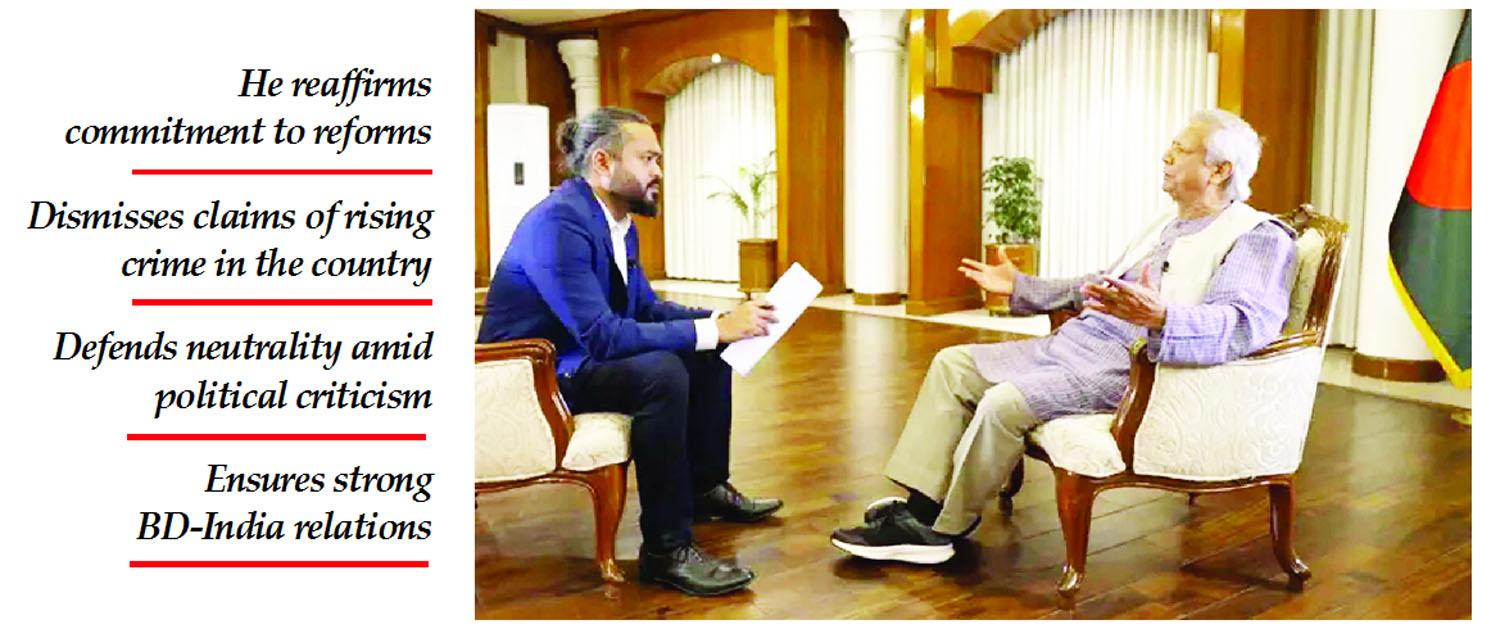
In an interview with BBC Bangla, Dr Yunus discussed various topics, including law and order, political reforms, the upcoming elections, and Bangladesh’s relationship with India.
“A fugitive group has left the country, or their leadership has left. They are trying their best to unsettle the country.
It is always a threat,” Yunus said, directly pointing to the Awami League as the source of this threat.
Dr Yunus also reiterated the interim government’s commitment to reforms, highlighting the formation of several commissions and the drafting of a “July Charter,” which, he said, would include agreed-upon reforms from political parties.
“We will present all the recommendations that the political parties have agreed upon in a separate document.
I will call on everyone, since you have all agreed, to sign it. The elections will be held in that context,” he stated.
Yunus confirmed that the elections would be held at the end of this year, saying, “We have already announced that. There is nothing new to say.”
Despite public concerns over rising crime, Yunus insisted that the crime rate had not increased significantly.
“The crime rate has not increased at all. It has remained the same as before,” he claimed.
However, he acknowledged that law enforcement officers had initially been hesitant to patrol the streets but reassured the public that the situation was being addressed.
When asked about the rise in robberies – police statistics show a 50% increase over six months – he admitted, “Initially, the problem was that the police force were not taking to the streets due to fear. Now, it has been rectified.”
Regarding mob violence and vandalism, he said, “It’s taking time. They have not been able to change their mentality yet.
We are trying. A lot of improvements have been made. But there is no complete solution.”
On the issue of diplomatic tensions with India, Yunus described Bangladesh-India relations as “very good,” though he acknowledged “some conflicts” stemming from what he referred to as “propaganda.”
“However, some conflicts have arisen in the middle, mostly due to propaganda.
The sources of this propaganda will be judged by others. As a result of this, a misunderstanding has occurred, but we are trying to overcome it,” he said.
He also confirmed ongoing communication with the Indian government, adding, “There is always contact.
They are coming here, and our people are going there. I spoke with Prime Minister Modi in my first week.”
Yunus dismissed allegations of government bias towards the newly formed student-led National Citizen Party, stating, “The government does not provide any assistance.
Those who want to participate in politics have resigned from their posts and left.”
In response to criticism from BNP’s Acting Chairman Tarique Rahman, who questioned the neutrality of the interim government, Yunus said, “Whether the public has doubts is a matter for debate.
When we [the interim government and BNP] sat down, no one expressed doubts. He said, ‘We are with you.'”
Reflecting on his nearly seven months in office, the chief adviser stated that his government inherited “a country where everything was in ruins,” and their efforts had focused on stabilisation and reform.
“The ruins we came from are now taking on a new form. We have simplified the economy.
We have gained the trust of both the country and abroad. Whichever country you ask, they have placed their trust in us,” he remarked.
Despite concerns over rising crime and political uncertainty, Yunus maintained that his administration had made significant progress, asserting, “We are not experts sitting here. We are trying our own ways to solve these issues.
“There may be mistakes. Some things have gone well, others have not. That happens. I’m not denying it.”